
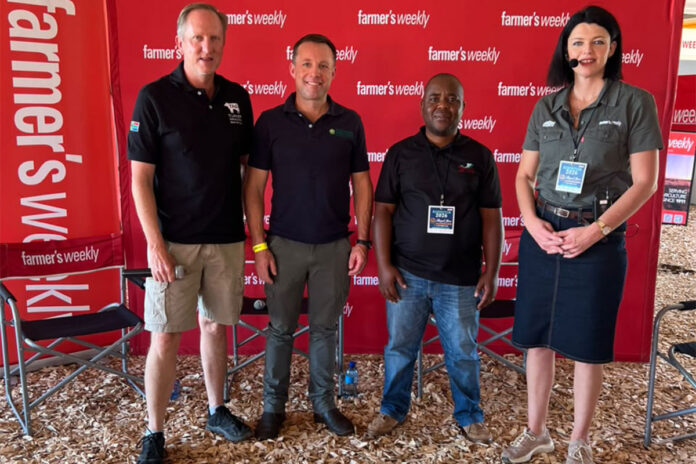
This was the warning from dairy farmers during a Farmer’s Weekly panel discussion, held under the theme ‘Dairy under pressure: balancing herd health and economics in the dairy industry’ at the Royal Show on Friday.
Andrew Morphew, dairy farmer and spokesperson for FMD Response SA, warned that the country was nowhere near bringing the disease under control.
“If we continue on our current path, we will never control FMD. We have not yet taken the steps necessary to eradicate it, and eradication might never be possible. Dairy farmers need to prepare for the possibility of living in an endemic environment, where regular vaccination and strict biosecurity will remain essential.”
Flying blind on infections
Morphew said one of the greatest concerns was that South Africa had no reliable picture of how widely FMD has spread.
“There is no broad surveillance taking place, so we do not know where the virus is or how prevalent it is. Vaccination is also suppressing clinical signs, meaning infected animals can spread the virus without displaying the symptoms we previously relied on to identify infections.”
Underreporting compounded the problem, as farmers had little incentive to report suspected infections.
Morphew said the Department of Agriculture was responsible for disease surveillance, but testing capacity remained severely limited, with only one laboratory at the Agricultural Research Council authorised to test for FMD.
He called for expanded testing capacity and a published national surveillance plan.
He also warned that government was measuring vaccination progress incorrectly.
“We are counting doses administered when we should be measuring how many animals are immune at any given time. The international benchmark is 80% immunity across the population to prevent disease transmission.”
With vaccine-induced immunity lasting approximately six months, Morphew said vaccination campaigns risked losing ground as previously vaccinated animals became susceptible again.
Vaccination costs versus devastating losses
Dairy farmer Tom Turner illustrated the financial consequences of inadequate community-wide vaccination through his experience. Despite vaccinating his herd, Turner suffered an FMD outbreak after the disease spread among neighbouring cattle.
The infection affected 100 cows and cost his operation approximately R960 000. However, the consequences could have been catastrophic without vaccination.
“Without vaccination, the outbreak could have cost me approximately R12 million, which might have ended my business. Vaccination is effectively an insurance policy, and dairy farmers cannot afford to go without it.”
Turner said vaccinating his herd cost approximately R400 000 annually, an additional expense that was difficult to recover from already strained margins.
He supported compulsory vaccination, but questioned whether livestock producers would voluntarily absorb the costs.
“I cannot see farmers willingly spending R47 per cow twice a year. Government will probably have to contribute towards vaccination if we want widespread protection.”
Turner stressed that individual biosecurity measures were insufficient when neighbouring farms remained unprotected.
Morphew agreed and added that farmers could not protect themselves indefinitely while surrounded by susceptible or infected cattle.
Shared responsibility
Both farmers called for greater accountability from government and livestock owners.
Morphew said uncertainty over whether vaccination would become compulsory, who would pay for it and how future outbreaks would be managed made planning extremely difficult. He also acknowledged that misinformation, vaccination costs, and traceability concerns discouraged some farmers from participating.
“The barriers differ between farmers, and we need to identify and remove them. The vaccination process must be as straightforward as possible if we want widespread participation.”
Turner said dairy farmers generally understood the financial consequences of FMD, but convincing other livestock producers to vaccinate remained a challenge.
Morphew warned that reduced clinical symptoms should not be mistaken for the disappearance of the disease.
Vaccination had lowered the immediate risk, but complacency could reverse those gains. “When we believe the danger has passed, we relax our precautions. That is when the virus returns,” Morphew said.