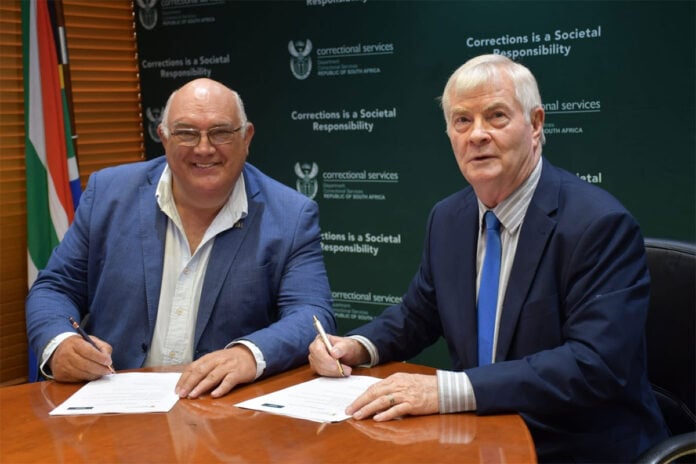
On 28 October, the Department of Correctional Services (DCS) and the Southern African Agri Initiative (Saai) have signed a memorandum of understanding (MOU) to boost agricultural production at correctional facilities and equip offenders with skills they can use after release.
The MOU establishes the National Correctional Rehabilitation Through Agriculture Pilot Programme, which will run for 12 months at three correctional facilities in Gauteng (Leeuwkop, Zonderwater, and Baviaanspoort), one in North West (Losperfontein), and two in the Free State (Groenpunt and Grootvlei).
Saai will provide technical advice and support free of charge, and no money will change hands between the parties.
“This project will not cost the taxpayer a single cent, because Saai is doing it on its own initiative,” Minister of Correctional Services Dr Pieter Groenewald said at the signing.
The agreement does not, however, set out budgets or funding arrangements for production inputs, equipment, infrastructure upgrades, or training. These costs will determine the full price of implementation, and the net savings the DCS can achieve by growing more of its own food.
Assessments come first
In written responses to questions from Farmer’s Weekly, the DCS said implementation would begin with an assessment of the agricultural resources and operational capacity at each centre.
Saai has requested information on available land, water, irrigation infrastructure, machinery and equipment, existing farming activities, production capacity, and personnel, which the DCS is compiling.
Saai will then assess each centre and draw up an implementation proposal for it.
“Each centre has different resources, opportunities, and constraints, and the programme must be built around what is practically achievable and sustainable,” the DCS said.
A detailed implementation timeline will only be set once these assessments have been completed.
No single production model
The DCS said there would be no uniform production model across the six centres. Potential vegetable crops are spinach, kale, Swiss chard, cabbages, carrots, and tomatoes, while poultry, dairy, beef, and pig production may also be considered, depending on each centre’s suitability. Value-adding and agro-processing will be looked at where commercially and operationally feasible.
The aim is to produce more of the food consumed in correctional centres, reduce reliance on outside suppliers, and support the DCS’s self-sufficiency and sustainability framework.
Food production, savings, and the number of offenders trained will be measured during the pilot.
Skills and rehabilitation
Low-risk offenders will be selected in accordance with the Correctional Services Act (No. 111 of 1998) and departmental policy. The number of participants has not yet been determined.
Asked whether participation would be voluntary and whether participants would be paid, the DCS said only that offender labour and gratuities were regulated by the Act.
Groenewald linked the skills component directly to the DCS’s rehabilitation mandate.
“Skilled offenders have better chances of finding employment upon reintegration into society. This will also decrease recidivism, as offenders will not be idling without any skills,” he said.
According to the DCS, Saai will facilitate the involvement of agricultural training institutions, technical specialists, and industry partners, with funding for training to be sought through the Agricultural Sector Education Training Authority. Training could cover vegetable production, livestock management, irrigation, equipment operation, and general farm management, along with mentorship.
“The training will not be limited to theory,” the DCS said.
Training providers and accreditation arrangements have not been finalised, and the DCS said no commitments could be made at this stage to particular qualifications.
A class of new, profitable farmers
Saai Executive Director Dr Theo de Jager said the organisation’s ambition extended well beyond preparing offenders to work on existing farms.
“We trust that we can transfer skills to them and give them exposure to technologies and the [agricultural] value chain, so that they understand how market-driven agriculture works. Our ambition goes far beyond preparing them for employment on farms. We also want to create a class of new, profitable farmers,” he said.
Saai describes itself as an agricultural interest network run by farmers, for farmers, representing family farmers in primary production. De Jager said the organisation’s understanding of family farming was deliberately broad.
“A family farmer in our Southern African context is not rich or poor, big, or small, black, or white, well-established or a newcomer. It is a family seeking a living from the soil. That’s why we joined this partnership,” he explained.
Life after release
The DCS said Saai would use its network to approach commercial farmers, agribusinesses, and co-operatives willing to offer mentorship, work exposure, and employment to offenders. Those placed on parole would continue to be supervised by the DCS’s Community Corrections.
“Successful reintegration requires more than training alone. Participants need access to networks, guidance, and opportunities to apply their skills,” it said.
No specific placement numbers or employment commitments have been agreed on yet, and a structured post-release support model will only be developed jointly by the DCS, Saai, and sector partners as the pilot progresses.
Oversight and expansion
Each party will appoint a programme manager, and progress will be reviewed every quarter against agreed indicators. The DCS will retain full responsibility for its facilities and operational decisions.
Asked whether it would track employment and reoffending among participants after release – the measures that would show whether the programme can deliver on its rehabilitation promise – the DCS said only that offenders’ progress was monitored in accordance with the Act.