

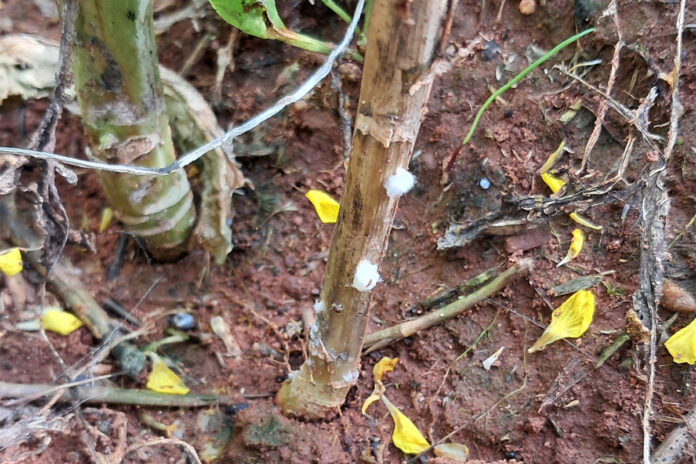
Researchers at the Western Cape Department of Agriculture (the department) write in the latest edition of Canolafokus that the fungus Sclerotinia sclerotiorum, which causes Sclerotinia stem rot, thrives in wet conditions with high relative humidity and that “it was to be expected that it would make an appearance during the flowering phase when the fungus infects plants via dead petals”.
“What has come as a big surprise is that in the Caledon and Moorreesburg/Riebeek-Kasteel areas, the disease was found on young plants even before they had started flowering,” Piet Lombard and Lizette Nowers, both scientific technicians at the department, said in the publication.
Speaking to Farmer’s Weekly, Lombard said he had seen some of the worst Sclerotinia infections of his career during the past week and a half.
“The high humidity and dense fog have caused the plants to stay wet for much longer, which significantly increases the risk of infection.
“But what we find odd is that while the infections were quite bad in some cases, other places where one would expect infections to develop remained disease-free. We don’t yet know why this is the case,” he added.
Lombard and Nowers noted that while the fungus could infect healthy plants without the presence of dead petals, it was considered unusual the world over.
“With the discovery of these cases in both the Overberg and the Swartland, this suggests that the presence of sclerotia from previous seasons, together with the continued dampness in the fields and the fact that growers don’t usually spray against Sclerotinia before flowering, could have led to these early infections.”
The optimal spraying window against Sclerotinia is typically when canola has reached between 20% and 30% flowering. However, Lombard said that under exceptionally damp conditions, spraying earlier could provide better protection.
‘Drought is a bigger threat’
Lombard said Sclerotinia infections generally result in yield losses of about 0,5% for every 1% of the crop infected, adding that he did not expect the unusually early infections to cause significant losses.
“At the moment, the drought conditions in the Swartland are a far bigger threat to the season’s yields,” he said, noting that yield losses in wheat were already inevitable and warning that canola could follow suit unless the region received good rainfall by mid-August.
André Kirsten, who farms in Malmesbury, said his canola was flowering and urgently needed rain, and that any signs of Sclerotinia in his region only really become apparent towards the end of the season.
“As a rule, I don’t spray for Sclerotinia, unless it is a very wet year. Currently, my wheat and canola crops urgently need water. I would like about 30mm to 40mm. The wheat is standing still and the canola is in full bloom.”
Jopie de Kock, a producer from Darling, said the heavy storms in May that caused widespread damage across the Western Cape had been the only significant rainfall the region had received, adding that it had driven most of the growth seen in his area this



