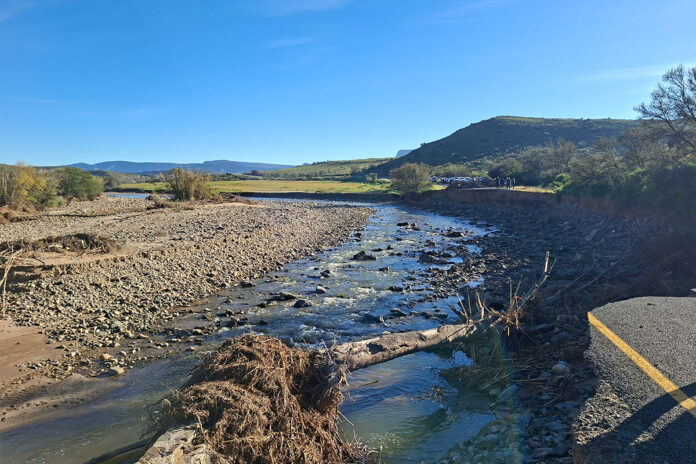
More than 200 roads were significantly damaged and completely closed following the severe weather events of 5 and 10 May, while many others still require repairs.
Western Cape Infrastructure Minister Tertuis Simmers told Farmer’s Weekly that the preliminary R2 billion repair estimate is likely to rise as investigations and designs progress.
He said the provincial Department of Infrastructure (the department) had applied to the national Department of Cooperative Governance and Traditional Affairs for emergency funding but had not received confirmation at the time of writing.
Consequently, emergency work has been financed by reprioritising the department’s existing budget, forcing some planned infrastructure projects to be postponed or stopped altogether.
“The pace of recovery will depend on the extent of funding support secured. However, full recovery of the network will take several years,” Simmers said.
Despite the funding uncertainty, about 80% of the roads that were fully closed have reopened, largely through temporary work undertaken by the department’s in-house teams.
Major emergency repair contracts have also been initiated on the TR22/1 through Mitchell’s Pass, the TR75/2 on the R324, and the MR201 through Bainskloof Pass. All three routes have reopened while permanent repairs continue. Work on other priority routes is either ongoing or at various stages of investigation and design.
Meiringspoort, which connects Klaarstroom and De Rust, remains closed. Efforts are under way to reopen one lane under controlled access by December 2026, while permanent repairs are expected to take about 26 months to complete.
Restoring agricultural access
Agriculture is particularly exposed to the disruption, as several of the worst-affected areas, including the Garden Route, Central Karoo, and Cape Winelands, are major farming regions.
According to Simmers, the damage has restricted access to farms, markets, and labour, while in some areas, transport has been disrupted during critical farming activities. Road closures and restrictions have also lengthened journeys and increased transport costs.
He said repairs were prioritised according to the strategic and economic importance of routes, traffic volumes, access to markets and employment, and the availability and length of alternative routes. Roads with no suitable alternatives, or where closures result in lengthy detours, are generally prioritised.
“The immediate focus is to restore full access and mobility across the network, followed by permanent repairs,” Simmers said.
Where possible, safe temporary access is established while permanent repairs are investigated and designed in parallel. However, temporary access is not always technically or financially feasible and depends on the extent of the damage and conditions at the particular site.
Coming back stronger
The scale of the May rainfall presents a further challenge when designing infrastructure to withstand future floods. Preliminary indications are that in several areas, rainfall exceeded that of a one-in-100-year event.
Simmers explained that roads and related infrastructure are designed to withstand a defined “design flood”, based on a route’s classification and importance within the network, rather than every conceivable flood event. Overtopping – when water flows over a barrier – and damage could therefore still occur during exceptionally severe rainfall.
He added that damaged infrastructure will be reinstated to current standards, with “build back better” principles applied where practical and cost-effective. This may include larger or stronger replacement structures, increased hydraulic capacity, and improved protection against erosion and scouring.
“Many structures repaired after the floods of 2022/23 and 2023/24 sustained little or no damage during the May [2026] floods, demonstrating the value of this approach,” Simmers said.
Permanent repairs also require detailed structural, geotechnical, hydrological, and hydraulic investigations. Environmental, heritage, and water-use approvals may need to be secured before construction can begin.
These requirements are particularly relevant at Meiringspoort, which forms part of a UNESCO World Heritage Site. Permanent repairs to the pass must comply with specialist environmental and heritage requirements, contributing to the lengthy anticipated repair period.
“These processes affect timelines, but they are necessary to ensure that infrastructure is reinstated safely and appropriately, with greater resilience to future flood events,” Simmers said.
He urged farmers and other road users to observe closures, restrictions, and warning signs, and to remain clear of construction areas.
Updates on road conditions and repair progress are available through official Western Cape Government communication channels, the Roads4U app, and local municipal notices.