
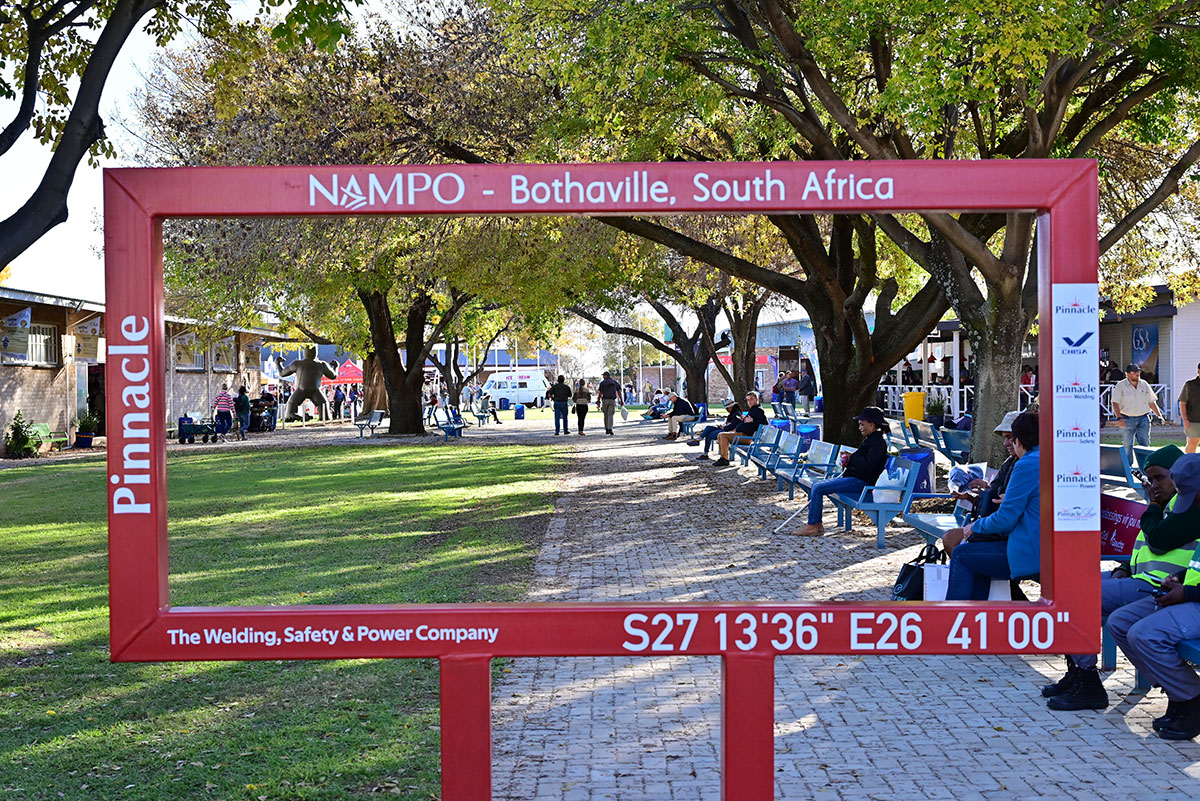
According to Grain SA figures released to the media at Nampo Park, 15 886 visitors attended the first day of the exhibition on Tuesday, 12 May, compared with 17 500 visitors on the opening day in 2025. Aircraft traffic was also lower, with 39 aeroplanes and 14 helicopters recorded, compared with 85 aeroplanes and 16 helicopters last year.
Dr Dirk Strydom, managing director of Nampo, attributed the lower attendance largely to favourable harvesting conditions following earlier wet weather that had delayed harvesting operations.
Strydom explains that many producers were capitalising on the sunny and dry weather to get harvesters into fields that had been too wet to access. Other factors include expo visitors planning their visit to coincide with the Guinness World Record Toyota Hilux event on Wednesday 13 May. Finally, the high price of fuel was also a contributing factor.
Despite the slightly quieter start, the atmosphere at Nampo remained energetic, with discussions throughout the day focusing heavily on the mounting economic pressures facing South African agriculture.
Under the 2026 theme, ‘Resilience through Innovation’, Grain SA used the opening day to place producer profitability and long-term competitiveness firmly in the spotlight.
One of the central discussions of the day was the panel session titled ‘To Farm or Not to Farm: The Economic Reality’, facilitated by Theo Vorster and featuring Grain SA chairperson Richard Krige, Hansie Viljoen, Jaco Minnaar and Japie Grobler.
The panel unpacked the growing pressure on grain producers, including rising input costs, tighter margins, market volatility and uncertainty around long-term farming viability. Speakers agreed that profitability could no longer be separated from sustainability.
“We cannot separate sustainability from profitability,” Krige said. “If producers are not profitable, investment slows, succession becomes uncertain, and food security is placed at risk.”
Discussions also highlighted the need for improved logistics systems, stronger market access, export opportunities and greater policy certainty to support long-term investment in agriculture.
Grain SA CEO Dr Tobias Doyer told delegates that South African agriculture would increasingly need to position itself as a globally competitive, export-driven grain economy.
“There is only one way we can remain globally competitive, and that is through better science, better technology and improved productivity,” Doyer said.
But beyond the serious economic discussions, day one also highlighted the lighter side of Nampo, with innovation, history and community spirit drawing crowds across the showgrounds.
Bayer and Khula used the opening day to announce a partnership aimed at helping South African farmers gain access to tools, skills, finance and markets needed to build sustainable and profitable farming businesses.
Khula, a South African agricultural technology company focused on emerging and smaller-scale farmers, operates digital platforms that connect producers with suppliers, financiers and markets. The agreement with Bayer focuses on three national priorities: food security, access to markets and access to finance.
Meanwhile, the Engen Tractor Museum once again proved to be one of the crowd favourites at Nampo, reminding visitors that the show is not only about the latest technology, but also about celebrating agriculture’s rich heritage.
Johan and Jaco Gouws of the North West Veteran Tractor and Engine Club hosted a media tour through the museum’s collection of vintage tractors and farming machinery.
Jaco demonstrated how a 1948 Ferguson tractor started on petrol before switching over to paraffin once the engine had warmed up. The tractor carried the same engine used in the Triumph Vanguard vehicles of the time.
He also showed visitors a 1955 Ferguson fitted with one of the early Perkins diesel engines after Ferguson acquired the Perkins factory. By 1958, Massey-Harris had taken over Ferguson, eventually leading to the well-known Massey Ferguson brand.
One of the highlights was a rare transitional tractor still carrying the Massey Ferguson emblem on the side while retaining the Ferguson name on the front, complete with its original 1958 paintwork.
Although economic realities dominated many conversations, the first day once again showed why Nampo remains more than just an agricultural exhibition. From serious policy discussions to vintage machinery, family outings and innovation showcases, the event continues to reflect both the business and the spirit of South African agriculture.