
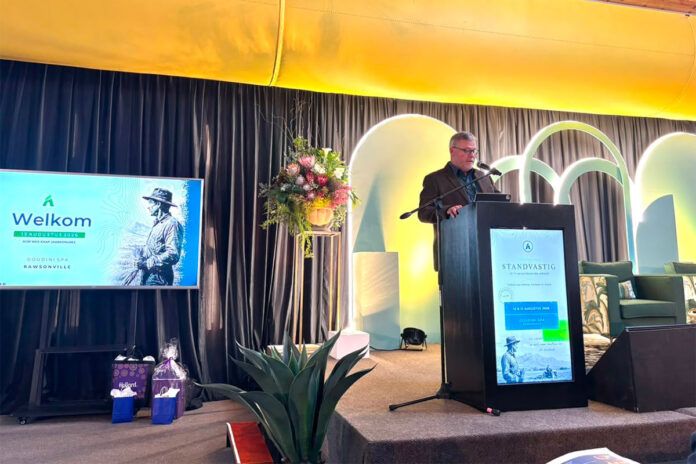
This was the central message at Agri Western Cape’s annual congress, held on 13 August near Rawsonville under the theme ‘Steadfastness in a Changing World’.
“Steadfastness is not the absence of change. It is the ability to change without breaking. It is a tree that bends in the wind, but whose roots hold firm. It is a community that holds on to one another when the ground shifts beneath their feet,” Agri Western Cape President Villiers Loubser said.
For Western Cape producers, the pressures behind this metaphor are all too real. Fires, droughts, and floods have damaged farms and infrastructure, while international conflict and rising input costs have squeezed margins that are already under pressure. In addition, foot-and-mouth disease (FMD) has created further uncertainty for livestock producers.
Loubser said organised agriculture could not prevent these crises, but it could help farmers prepare, co-ordinate a response, and recover more quickly. Its role ranged from representing producers in policy discussions to working with government departments, veterinary authorities, and disaster-management structures during emergencies.
Through collaboration between the AgriSA Disaster Relief Foundation, Agri Western Cape, and industry partners, more than R1,1 million was provided to members affected by drought and flood damage earlier this year, he said.
Similarly, responding to FMD required producer organisations and government agencies to pool their expertise and resources.
“Contrary to what some may suggest, we cannot do it on our own. We do it together,” Loubser added.
He pointed to agricultural associations that had remained active for more than a century as evidence of the value of collective action. They had survived droughts, recessions, and profound political and economic change because producers had continued to support one another.
Export success rests on fragile foundations
Dr Ivan Meyer, Western Cape Minister of Agriculture, Economic Development and Tourism, said the province’s agricultural performance illustrated producers’ ability to adapt.
He explained that although the Western Cape accounted for about 10% of South Africa’s land area and population, it generated about 58% of the country’s primary agricultural exports by value.
Meyer described this as an exceptional achievement, particularly because South African farmers did not receive the extensive state subsidies available to many of their international competitors.
“South African farmers punch far above their weight,” he added.
This performance, however, depends on infrastructure and logistics over which individual farmers have little control.
Meyer said that more than 220 roads and bridges had been washed away during severe storms in May, but around 80% had since been repaired through the combined efforts of the provincial government, farmers, and rural communities.
While the recovery shows what effective cooperation can achieve, persistent inefficiencies at the Port of Cape Town continue to constrain agricultural exporters.
Meyer said he wanted the port to function at full capacity so that producers would no longer have to contact him because their export fruit was being delayed or left to deteriorate.
He noted that the province had studied the operation of ports elsewhere, including privately operated facilities, to identify ways to improve Cape Town’s performance.
He added that it made little sense for Western Cape produce to be transported to Durban for export when a port was available closer to where it was grown.
Building resilience before disaster strikes
The same proactive approach is needed to prepare agriculture and public infrastructure for climate change.
Meyer said the provincial government could no longer follow a generic budgeting model that failed to account for climate-related damage. Climate risk would have to be built into departmental budgets, disaster planning, and infrastructure investment.
“We cannot afford to wait for the main event,” he added.
Meyer highlighted work led by Dr Ilse Trautmann, who retired last year as the Western Cape Department of Agriculture’s deputy director-general for agricultural research and regulatory services. Her work had strengthened the sector’s ability to anticipate and respond to climate risks.
This included the province’s participation in the Mediterranean Climate Action Partnership, an international coalition through which regions with Mediterranean climates develop practical responses to shared threats.
The partnership allows the Western Cape to draw on research and experience from regions facing similar risks, such as rising temperatures, droughts, floods, wildfires, and shifting rainfall patterns, and to apply appropriate adaptation measures locally.
Meyer said the rapid repair of damaged infrastructure, assistance coordinated through provincial disaster-management structures, and the adoption of smart water-management technology on farms show that adaptation was already taking place.
He added that the response to FMD offered a similar lesson. Protecting livestock and export markets requires early action and close cooperation between government departments, veterinary services, and producer organisations.
Changing relationship with the state
Johann Kotzé, CEO of AgriSA, said the ‘changing world’ referred to in the congress’s theme was not a future possibility, but the reality in which farmers were already operating.
He reflected on agriculture’s transition from a regulated system, in which the state directly influenced prices and markets, to one in which producers had to compete internationally.
South African farmers were producing more and participating more extensively in world markets than they had been 30 years ago, he noted. However, agriculture sometimes continued to expect the state to perform the same functions it had under the former system.
“The role of the state has changed, just as our role has changed,” Kotzé said.
Thus, industry could no longer wait for the state to solve every shared problem. Producer organisations had to determine where government intervention was indispensable and where agriculture could organise, fund, and implement its own solutions, he explained.
This did not make government irrelevant to production success. Agriculture and the state remain interdependent, as many of the systems on which producers relied fell outside an individual farmer’s control.
Kotzé illustrated this interdependence through the journey of an export product. What leaves a farm is not merely a product of soil, water, and a farmer’s labour. It is also the product of functioning roads and ports, inspections, certification, and access to international markets.
A breakdown at any point between the farm gate and the export destination could erode the competitiveness of the entire value chain.
Food security depended on the same network. Kotzé said it was not only about producing enough food but also about sustaining jobs and economic activity in rural communities and ensuring that agricultural products reached consumers.
Organised agriculture’s role was therefore broader than representing farmers’ interests. It had to bring the different parts of the system together and help keep them functioning as conditions changed, he said.
Data turns farmers’ experience into influence
Willem de Chavonnes Vrugt, president of AgriSA, said effective representation required more than a loud voice; it needed credible data that could influence decisions and deliver measurable results.
He said South Africa lacks current, reliable agricultural information on matters ranging from livestock numbers and land use to water and infrastructure, adding that this weakened policy development and the sector’s ability to challenge decisions that harmed producers.
Producer and commodity organisations therefore had to turn information from individual farms and regions into a credible national picture, he said.
De Chavonnes Vrugt cited AgriSA’s intervention in electricity-related decisions as an example. Data supplied by producers and analysed through the organisation’s economic structures allow it to challenge calculations that fail to reflect the true impact of electricity increases on farming operations.
The same evidence-based approach could strengthen engagements with authorities on rural safety, water, infrastructure, and biosecurity.
He concluded that farmers’ participation in industry surveys was critical, because by contributing accurate information, individual producers gave organised agriculture the evidence it needed to influence policy and secure practical results.