
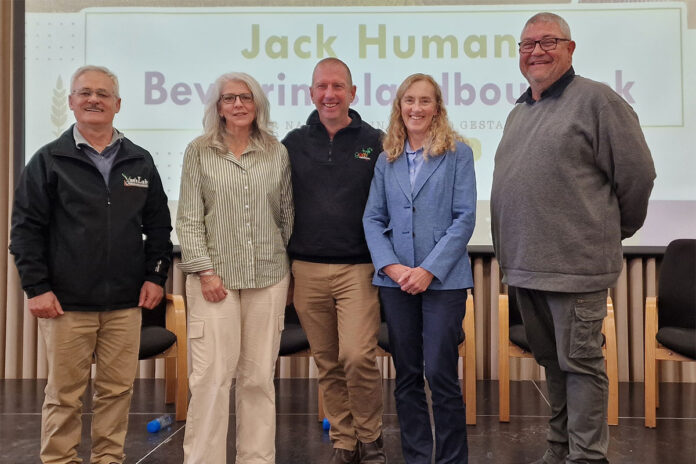
The first day of the event was hosted by Conservation Agriculture Western Cape, in partnership with the Western Cape Department of Agriculture (the department), at Elsenburg Agricultural Training Institute on 5 August.
Welcoming delegates, Prof Johann Strauss, senior scientist for sustainable cropping systems research at the department, highlighted the value of collaboration and knowledge sharing in strengthening conservation agriculture systems across the province.
Prof Sarita Bennett, discipline lead for agriculture and food at Curtin University in Perth, Australia, shared her findings from seven years of research into sclerotinia stem rot in canola.
She explained that the disease behaved differently under Western Australia’s (WA) Mediterranean winter rainfall conditions, where much of the research was conducted, than in summer rainfall regions. WA’s climate is similar to that of the Western Cape.
“We found that the pathogen has adapted to our winter growing season and to the environmental conditions across our growing regions,” Bennett explained.
She said disease outbreaks remained highly dependent on seasonal conditions, making crop protection decisions particularly challenging.
According to Bennett, failing to control severe outbreaks could have consequences long after a season ended.
“If you don’t spray and you get lots of disease, you’re leaving more inoculum for future seasons. That inoculum can remain in the soil for up to 10 years,” she said.
Expanding pulse production
Dr Jason Brand, pulse specialist and director of GEM Agronomy in Victoria, Australia, outlined opportunities for expanding pulse production within conservation agriculture systems.
He explained that the title of his presentation, ‘Pulses: Discovering the Gem of Your Farm’, was a reference to the GEM principle: genotype, environment, and management.
“To move forward with pulses, we really need to start developing varieties that are adapted to your climate, your environment, your soil types, and your farming systems,” he said.
Drawing on Australia’s experience over the past three decades, Brand described how improved genetics, no-till systems, disease management, and market development helped transform that country’s pulse industry into a major agricultural success story.
Australian pulse production exceeded 3,2 million tons in 2023, including almost 1,4 million tons of lentils.
“It’s not just about growing the crop; it’s about growing quality grain that’s delivered to the market,” Brand added.
He said pulses contributed nitrogen to the soil, helped break disease cycles, improved weed management, and created both domestic and export opportunities.
Climate change brings pest pressure
While diversification opportunities featured strongly throughout the day, delegates were reminded that changing climatic conditions were also creating new challenges.
Dr Vicki Tolmay, an entomologist from the Agricultural Research Council, focused on the complex world of grain aphids and the increasing need for integrated pest management.
She explained that different aphid species have different damage potential, host preferences, and virus-transmission capabilities, making accurate identification increasingly important.
“Know your enemy,” she said, stressing that understanding which aphid species was present on a farm was the first step towards effective management.
According to Tolmay, the grain industry can no longer rely on routine approaches and must increasingly embrace integrated systems combining scouting, resistant cultivars, biological control agents, technology, and responsible chemical use.
“Avoid preventative applications. Chemistry is too precious to squander,” she advised.
She also highlighted new monitoring initiatives, including suction trap networks and molecular identification technologies aimed at improving aphid forecasting and early warning systems.
Soil is the foundation of resilience
Prof Leon van Rensburg, founder of Van’s Lab and a former professor of soil physics at the University of the Free State, argued that producers were increasingly confronted by environmental stresses they could not control. This included drought, heat, wind, salinity, and nutrient-related stresses.
“It all starts in the soil. Soil is the foundation of crop resilience and sustainable yields,” he noted.
Van Rensburg explained that healthy soils improved water infiltration and storage, aeration, and root development, helping crops withstand increasingly variable conditions.
“We can’t eliminate stresses, but we can build soils that help crops withstand them,” he added.
One of his central messages was that soil structure often matters more than soil classification itself.
He described soil as the farm’s hidden infrastructure and a critical water-storage system, especially as climate variability intensified.
“The soil is the farm’s underground water reservoir. A good soil infrastructure acts like a dam, capturing, storing, and supplying water for crops,” Van Rensburg concluded.