
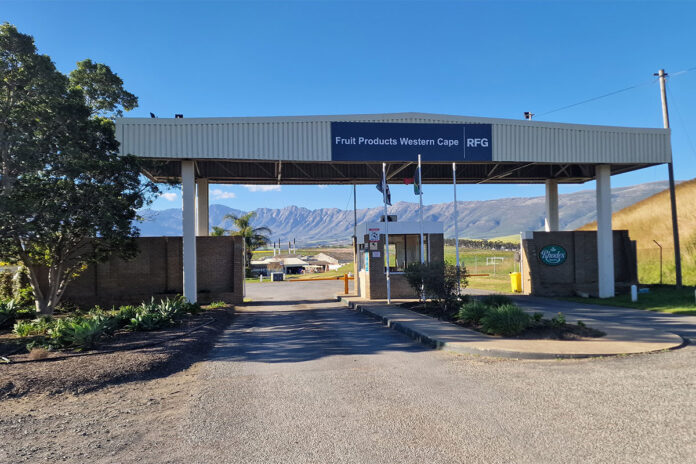
This commitment follows Premier’s announcement that it will close its Fruit Products Western Cape facility in Tulbagh, with the company having already written off about R1 billion in assets.
Addressing growers at the Canning Fruit Producers’ Association’s (CFPA) annual general meeting in Rawsonville on 11 August, Gertenbach also confirmed that Premier intended to exit the canned fruit category altogether. This meant the iconic Rhodes canned fruit brand would no longer be available once existing stock had been sold.
“The Rhodes brand is going to disappear from the shelves,” he said.
Gertenbach said Premier recognised a moral obligation towards affected producers, even though the company believed it had no further legal obligation once it exited the canned fruit industry.
“We will pay for fruit that’s not delivered to us,” he said.
He explained that Premier would first determine how much fruit could be absorbed through alternative channels such as Langeberg Foods, as well as the juice, purée, and dried fruit markets, before compensating growers for fruit that could not be placed elsewhere.
However, he maintained that the company’s legal advice was that its contractual obligations would fall away once it withdrew completely from the industry.
“Contractually, in terms of our legal advice from senior counsel, we don’t have any further legal obligation. But we have a moral obligation, and I understand it fully,” Gertenbach said.
CFPA Chairperson Anthony Dicey welcomed Premier’s willingness to engage with the industry, but argued that its obligations remained a matter for discussion.
“We take note of the commitment to engage constructively, but it’s not as simple as walking away from their contractual obligations.
“The compensation might help for one season, but the farmers have invested in long-term crops. I also cannot speak for labour. They might get a payout, but they’ll sit without jobs and income,” he told Farmer’s Weekly.
Limited global demand for canned fruit
Speaking candidly to growers, Gertenbach said the Tulbagh closure was driven by a lack of market demand rather than processing capacity.
Premier’s marketing teams had spent months engaging customers across major export markets, including the US, Europe, New Zealand, and Asia, and the feedback was sobering.
“The long and the short of what our salespeople came back with is that there just isn’t a market for more than 25 000t of fruit.
“Fifty percent of the clients we had by volume last season will not take product this year,” he explained.
Gertenbach attributed the deterioration in market conditions to growing international competition, changing consumer preferences, and trade disruptions.
“Thirty-five percent of our volumes used to go to the US market, but in the wake of [President Donald] Trump’s tariffs, that has dropped to zero,” he said.
He also argued that China had shifted from being a major customer to a significant competitor in global canned fruit markets.
“Where we once sent 300 full container loads of product to China, we’re now hardly able to send one.”
While acknowledging growing pressures in export markets, Dicey suggested that Premier’s assessment of the industry’s prospects may be overly pessimistic.
“We aren’t oblivious to the fact that the world in which we’re operating has changed.
“South Africa has a premium product. We’ve traditionally competed very well in global markets and have been a world leader,” he said.
Dicey added that Premier appeared to be “painting the picture slightly more negative to suit themselves rather than exactly as it is”.
Growers keen to explore solutions
Meanwhile, a grower committee chaired by Charl Herbst, director of Hortgro stone fruit, has been established to engage with stakeholders and explore possible solutions.
“We hope to able to meaningfully engage with Premier in a constructive way and negotiate going forward. We believe and hope we can find solutions,” Herbst said.
Summing up the mood among many growers, Barrydale producer Johann Kriel urged Premier to keep producers at the centre of the process.
“Our plea to Premier is simple: be fair, be just, and hear the farmer,” he said.