
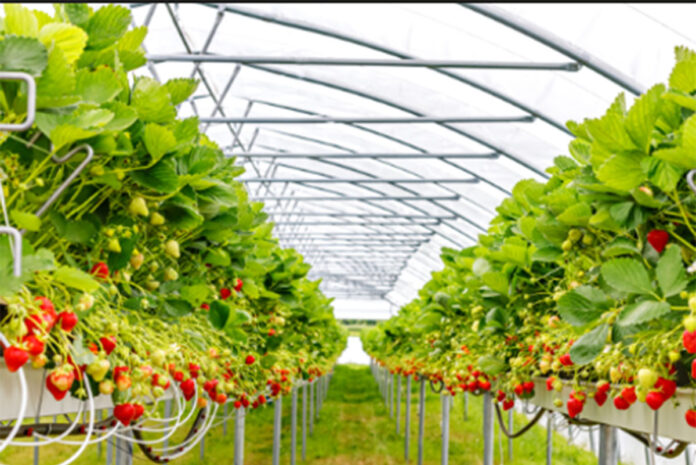
These figures were presented by independent horticultural consultant Michael Southwood during a recent online strawberry production workshop, where he outlined the scale, regional distribution, and economics of the local industry.
South Africa remains a relatively small player in African strawberry production. Egypt produces more than 382 000t annually, while Ethiopia and Morocco together produce between 167 000t and 210 000t.
Despite its modest size, however, the local industry has earned a reputation for producing premium-quality fruit for both domestic and export markets.
Western cape leads production
According to estimates from the South African Strawberry Growers’ Association, the country has around 740ha under strawberry production.
The Western Cape accounts for an estimated 49% of this total area. The Southern Cape accounts for 22% of the Western Cape’s land under strawberry production and is often treated as a separate production region because its mild climate supports later harvesting and export opportunities.
North West accounts for 32% of the total area under production, followed by Limpopo (13%), the Eastern Cape (3%), KwaZulu-Natal (2%), and Gauteng (1%).
Yields vary between regions
Average commercial yields are around 45t/ha, although well-managed farms in the summer rainfall regions can achieve between 48t/ha and 55t/ha. These areas benefit from cold, dry winters and favourable light conditions during late winter and early summer.
In the Western Cape, yields are generally lower at between 40t/ha and 45t/ha due to challenges such as hot weather during establishment; strong winds; shallow, stony soils; water constraints; and insect pressure.
High establishment costs
While strawberries offer attractive earning potential, they are also among the more expensive horticultural crops to establish.
Southwood estimated that setting up a modern strawberry enterprise could cost between R1,3 million and R2 million/ha, depending on the production system and infrastructure used. This excludes greenhouse-planted strawberries, which are substantially more expensive because of structural costs.
Premium first-grade fruit packed in 250g punnets typically sells for between R60/kg and R75/kg early in the Western Cape season. However, prices may fall to between R35/kg and R40/kg in October, when supply peaks, before recovering in November and December.
Export fruit can earn an additional R15/kg to R25/kg, although growers generally realise premiums closer to 15% to 20%.
Labour is the biggest expense
The cost of producing first-grade fruit is estimated at between R22/kg and R30/kg, but it varies between regions. Break-even prices range from R33/kg to R38/kg in the summer rainfall regions, R40/kg to R44/kg in the Southern Cape, and R37/kg to R45/kg in the Western Cape.
Labour is the single largest expense, accounting for between 35% and 45% of total production costs. Packaging, marketing, and transport are also major cost drivers, with post-harvest expenses accounting for an estimated 28% to 40% of the cost of exported fruit.
Pesticides typically contribute between 8% and 14% of production costs, while plant royalties account for a further 7% to 13%. Irrigation, fertiliser, and other operating expenses make up the balance.