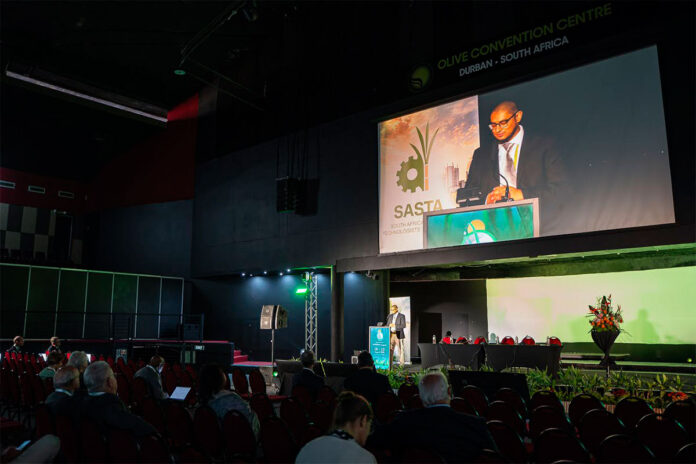
Held from 18 to 20 August during SASTA’s centenary year, the congress brought together sugarcane researchers, growers, millers, and industry representatives from South Africa and abroad to share research and discuss some of the challenges and opportunities facing the industry.
Speaking to Farmer’s Weekly, SASTA President Dr Muhammad Kadwa, said the centenary was an important milestone for an association that had spent a century providing a platform for the exchange of scientific and technical knowledge within the sugar industry.
He added, however, that much value of that research ultimately depended on whether it reached growers, millers, and other industry role-players who could put it into practice.
“That information is then shared and discussed at a platform like the SASTA Congress.”
Kadwa said extension specialists attending the congress could take research on issues such as pests and diseases back to farmers through their day-to-day work and farm visits.
For him, this was particularly important because industry-funded research institutions needed to ensure their work remained relevant to the problems that growers and millers faced.
Research takes centre stage
The agricultural programme at this year’s congress covered research into topics ranging from soil health, crop nutrition, and weed management to pests and diseases, mechanisation, and new breeding technologies.
Dr Sumita Ramgareeb, chairperson of the SASTA Congress Organising Committee, said the agenda reflected many of the challenges currently confronting sugar production.
The congress also provided a platform for agricultural and factory researchers to exchange information, something Ramgareeb said was particularly important in an industry where growing and processing were closely linked.
Research must reach farms
The need to connect research with commercial application was reinforced during SASTA’s first ever pre-congress technical tour on 17 August.
Delegates visited the South African Sugarcane Research Institute (SASRI), where they were introduced to the institute’s research into crop production, technology, and pest and disease management.
They next visited the Sugar Milling Research Institute (SMRI), where the focus shifted to research and technical support for sugar cane processing.
SMRI CEO Dr Janice Dewar said practical application had been central to the institute’s approach since its establishment in 1949.
She said research needed to ultimately be applied in mills, adding that this principle continued to underpin the institute’s work.
Technology at forefront, but fundamentals remain
New technologies featured prominently in the week’s discussions.
Kadwa pointed to precision agriculture, drones, artificial intelligence, and geographic information systems as technologies increasingly capable of supporting better decision-making on farms.
One example showcased during the SASRI tour was the expanded use by small-scale growers of drones to spray ripeners, with the area treated increasing from 15ha in 2021 to about 2 700ha in 2025.
However, Kadwa cautioned that adopting new technology did not compensate for poor production practices.
“Technology is not a silver bullet; it’s merely a tool that will assist farmers who still need to do the basics correctly,” he said.
He added that using quality seedcane, correctly applying fertiliser, maintaining field and factory infrastructure, and effectively managing soils would remain fundamental to successful sugar cane production.
Breaking down the silos
Another theme emerging from the congress was the need for greater collaboration between the different parts of the sugar value chain.
Ramgareeb said improving integration between agricultural production and processing remained important, while Kadwa said the commercial relationship between the two made collaboration unavoidable.
“A farmer has no market aside from a sugar factory, in the same way a sugar factory needs sugar cane and its feedstock,” he said.
This relationship extended to research. Dewar said one reason the SMRI had remained relevant to the industry for almost 80 years was its close working relationship with its members.
Industry representatives helped shape its strategy and research direction, while advisory structures helped ensure research findings were transferred into commercial operations.
“We have regular strategic review sessions informed by member feedback, and this has helped the institute remain relevant to the industry it was established to serve,” Dewar said.
Beyond conventional sugar
Diversification was another important issue raised during the congress, as the industry considers how to generate greater value from sugarcane.
Kadwa said opportunities such as ethanol production, electricity cogeneration, and the manufacturing of other sugar cane-derived products could provide additional avenues for the industry. However, pursuing these opportunities would require growers, millers, and government to work together.
He said government policy needed to provide sufficient certainty to encourage investment, while research was required to determine which opportunities were technically and economically viable.
“Sugarcane as a stalk has many uses, and with new science and technology, even more can be unlocked,” he added.
Dewar said this shift was already reflected in the SMRI’s research, which increasingly included diversification and sustainability alongside conventional sugar-processing technology.
She added that longer-term direction was towards integrated biorefineries capable of producing sugar and other products from sugar cane.