
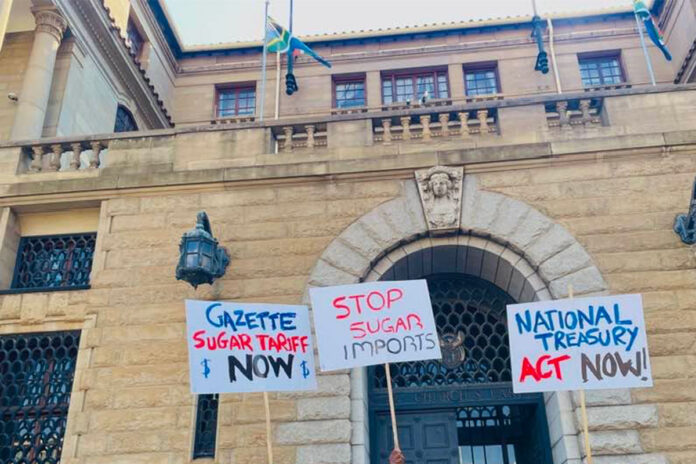
Growers from KwaZulu-Natal and Mpumalanga gathered outside Treasury’s offices on 27 July to call for the urgent gazetting of a revised sugar import tariff. They said delays in updating the tariff mechanism have left the local industry exposed to heavily subsidised imports from countries such as Brazil, India, and Thailand.
The protest followed the release of figures showing that sugar imports between January and May this year were almost double those during the same period in 2025.
According to data from the South African Revenue Service, 94 984t of sugar entered South Africa during the first five months of 2026, up from 55 213t during the same period in 2025. By comparison, only 1 491t were imported during the same period in 2022.
The increase has coincided with a sharp decline in local sales. Statistics from the South African Sugar Association (SASA) show that domestic sales fell to 255 015t between 1 April and 30 June 2026, more than 45 000t lower than during the same period last year.
According to SASA, before the current tariff mechanism weakened, domestic sales for the same period had reached 428 422t. In just a few seasons, however, the industry has lost almost 175 000t of local sales.
Tariff benchmark under scrutiny
South Africa currently uses a dollar-based reference price (DBRP) of US$680/t (around R11 084/t) as the benchmark for calculating the variable import tariff on sugar.
This benchmark has remained unchanged since July 2018, despite significant increases in production costs, including diesel, fertiliser, electricity, and labour.
SASA formally applied to the International Trade Administration Commission (ITAC) to increase the DBRP to US$905/t, saying the current benchmark no longer reflects the realities of sugar production in South Africa.
Under the country’s variable tariff system, an import duty is automatically triggered when global sugar prices fall below the DBRP, protecting local growers from low-priced or subsidised imports.
Increasing the benchmark to US$905/t would mean that higher protective tariffs would automatically apply whenever international sugar prices fall below that level, helping to shield South African growers and millers from unfair competition.
Industry bodies stress that they are not calling for a new tariff system, but rather for the existing mechanism to be updated to reflect current market conditions and production costs.
‘We cannot afford to lose this industry’
Dr Siyabonga Madlala, executive chairperson of the South African Farmers Development Association, said the industry could not afford to lose further market share, warning that the consequences would be felt far beyond the farm gate.
“If we collapse the sugar industry, it means we lose about a million livelihoods. Those are jobs, families, and industries linked to the sugar value chain.
“We cannot afford that as a country. We need to be creating more jobs and preserving jobs, not watching rural industries disappear,” he told Farmer’s Weekly.
Madlala said the industry was not asking government for special treatment, but for the existing tariff system to be implemented as intended.
“The industry cannot survive without proper trade protection. We submitted an application for a tariff review more than two years ago and we are still waiting. I am really disappointed because I would have hoped by now that the tariff would have been gazetted. Government’s response has simply been too slow.”
He said the flood of imported sugar was undermining a globally competitive industry.
“We are ranked as one of the most competitive sugar producers in the world. But what we are witnessing is cheap imports coming into the country at dumping prices, and that is killing our local prices. Countries like Brazil subsidise their farmers and exports, so this is not fair competition.
“We cannot sit back and allow ourselves to be ravaged by deep-sea imports while our rural economy is being destroyed.”
According to Madlala, the greatest frustration is that consumers are not benefitting from the imports.
“The sugar comes into South Africa cheaply, but it is not sold cheaply. Importers simply reduce the price slightly and pocket huge margins. It is not South Africans getting cheaper sugar on the shelves; it is traders exploiting the system while our farmers suffer and our industry loses market share.”
He added that South African growers already contend with significantly higher production costs than many of their overseas competitors.
“We face rising diesel prices, increasing fertiliser costs, higher electricity tariffs, and minimum wage requirements. Those are realities our farmers deal with every day. Yet we have no protection from government against heavily subsidised imports. We are crying foul because government has not been responsive enough.”
Madlala warned that allowing the industry to decline would have severe consequences for rural communities, particularly in KwaZulu-Natal and Mpumalanga.
“Sugar is deeply rooted in rural communities. In many sugar-growing areas, there are few viable alternatives because the land is not suited to other crops without irrigation.
“Sugar cane is a poverty alleviator. If we undermine this industry, KwaZulu-Natal and Mpumalanga risk becoming welfare provinces. People will leave rural communities for towns where there are already no jobs, and government will ultimately spend far more on social support.”
He stressed that the industry’s request was straightforward.
“We are not asking for protectionism or special favours. We are asking for the tariff mechanism that already exists to be updated to reflect today’s production costs and market realities. That is all. We need government to act before more growers, mills, and rural communities are pushed beyond the point of recovery.”
Delays are costing growers millions
South African Canegrowers Association Chairperson Higgins Mdluli echoed Madlala’s concerns, saying every week of delay was adding to the industry’s losses.
“Every ton of locally produced sugar displaced by an import is a direct hit to a grower’s income, a mill’s viability, and a rural community’s stability. The scale of what we are seeing now is nothing short of a crisis,” he said.
“Critically, local consumers see none of the benefit. This is not simply an industry problem. Every imported bag of sugar that replaces locally produced sugar puts South African jobs, family incomes, and the survival of rural communities at greater risk without making groceries cheaper for consumers.
“Import agents purchase this cheap sugar abroad and sell it locally at prices comparable to domestically produced sugar, pocketing the margin while South African growers, mill workers, and rural economies suffer the consequences.”
Mdluli said the impact extended throughout the sugar value chain.
“Under South Africa’s sugar industry agreement, sugar that remains unsold in South Africa must be exported. Selling that sugar into the already distorted global market leads to further losses. This erodes the industry’s ability to recoup value from crushed sugar cane and contributes to a projected sugar price of more than 10% lower than last year’s.”
He added that every week of delay in adjusting the DBRP costs the industry hundreds of millions of rands in displaced sales.
Industry under mounting pressure
The industry’s call comes as the ITAC continues to assess whether the current tariff adequately reflects market conditions.
Growers are urging Treasury to finalise the revised tariff without further delay.
Nkosinathi Msweli, a sugar cane farmer from Kearsney on the KwaZulu-Natal North Coast, was among the farmers who attended the protest at Treasury.
He has been farming since 1996 and operates a 123ha farm, with 75ha under sugar cane. He is heavily dependent on Tongaat Hulett, which is his only commercial market for processing his sugar cane.
Speaking during the protest, Msweli said the uncertainty surrounding Tongaat Hulett had already placed immense strain on growers.
“There are so many delays; why has [the revised import tariff] not been gazetted? A sugar master plan has been signed, and the imports are undermining that.
“As Tongaat Hulett farmers, we have been facing an uncertain future regarding the mills we supply, and now this problem of imports is adding even more pressure. We don’t know what we are going to do. We need government to intervene because the industry is bleeding,” he said.