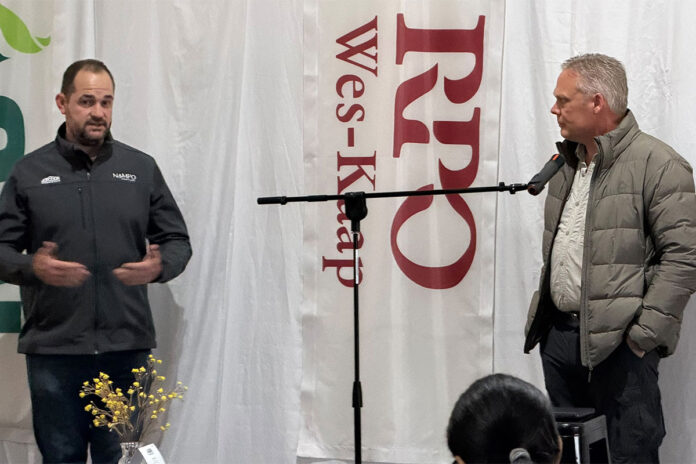
These concerns were raised directly with Minister of Agriculture Willie Aucamp during an information session hosted by Agri Western Cape at Nampo Cape in Bredasdorp last week.
Dr Dirk Strydom, managing director of Nampo, said wheat production margins in the Western Cape had been under pressure for some time, with successive difficult seasons compounding the financial strain on producers.
He added that it could take a farmer between five and seven normal years to recover financially from a drought, while consecutive poor seasons made that recovery increasingly difficult.
The implications extend beyond individual farming businesses. Strydom warned that a continued decline in wheat production would have serious social and employment consequences for the province, where farmers have relatively few alternative cropping options.
“If wheat is gone, it automatically impacts barley and oats,” he said, highlighting wheat’s importance within the region’s broader cropping systems.
Level playing field
Agri Western Cape President Villiers Loubser, who farms in the Swartland, challenged the notion that grain producers are operating in a properly functioning free market.
“We are far from an open free market, as we’re having to compete with farmers in other countries who receive subsidies and other government support.
“We aren’t asking government for subsidies, but [we want it] to act where it could influence the playing field, particularly on tariffs and imports,” he said.
Loubser also criticised delays in triggering tariff mechanisms intended to protect domestic producers.
He warned that continued deterioration in the wheat industry would affect far more than farmers, with machinery dealers, input suppliers, and rural towns all dependent on the economic activity generated by grain production.
Even events such as Nampo Cape could look very different within five years if fewer farmers were able to invest in machinery, technology, and other inputs, he added.
Farmers also questioned South Africa’s growing dependence on imported wheat.
One producer pointed out that the country had previously been self-sufficient and asked whether government had considered the billions of rands now leaving South Africa to pay for roughly two million tons of wheat imports.
Pressure on the value chain
José de Kock, who farms grain in the region, spoke about the pressures within the value chain, saying producers had become price-takers, while other participants, including millers, bakers, and traders, continued to make money.
“Farmers are battling high input costs, the transport differential, and tariff-related challenges. We’ve been footing the bill for years but cannot afford to do so anymore,” he said.
Concerns such as these prompted wheat industry role players to request an investigation under Section 7 of the Marketing and Agricultural Products Act (No. 47 of 1996) into trade and tariff policy, value chain efficiency, storage, infrastructure, logistics, food security, and innovation, which the National Agricultural Marketing Council launched in May this year.
When asked for an update on the investigation, Aucamp told Farmer’s Weekly that he had discussed the matter with Grain SA but had not yet seen a report, adding that it would be taken further once a report was available.
Aucamp backs farmers’ concerns
The minister made it clear that he agreed with much of the farmers’ assessment.
“I know for a fact that our grain farmers are not being treated fairly,” Aucamp said, arguing that South African farmers produce high-quality grain while lower-quality imports influence the prices received locally.
This concern is also reflected in a Bureau for Food and Agricultural Policy analysis of the 2024/25 season, which found that locally produced wheat had a baking value about 39% higher and a milling value about of 14% more than comparable imported wheat. Yet, the local grade-weighted SAFEX price was 9%, or roughly R700/t, below the weighted import price.
Food profitability cannot be ignored
For Aucamp, however, the issue ultimately is whether farmers can make enough money to continue producing.
“Food security discussions generally centre on food availability and affordability while overlooking a third element: food profitability.
“It is not a sin for a farmer to make a profit. Farmers who can no longer make money from a commodity will eventually stop producing it or move into alternatives where possible,” he said.
The long-term contraction in wheat production illustrates the risk. Aucamp said the area planted to wheat had fallen substantially and was now at its lowest level in almost a century.
He added that continued pressure on profitability would ultimately drive more producers away from the wheat.
“We should not lose our capacity for being self-sufficient when it comes to food. But then farmers should be enabled to provide that food.”
Aucamp said he could not prescribe exactly how imbalances in the value chain should be resolved, but warned that squeezing primary producers to the point where production was no longer viable would threaten both farming businesses and food security.
Key decisions lie outside agriculture
The discussion also highlighted the limits of what Aucamp can achieve through the agriculture portfolio alone.
Many of the policy mechanisms farmers want changed are controlled by other departments. Tariffs, for example, fall under the Department of Trade, Industry and Competition.
Responding to Loubser’s concerns, Aucamp said: “You’re right, I agree, and we’re doing what we can.”
He described the number of government departments whose decisions affected agriculture as “highly frustrating”.
While the Department of Agriculture would continue pushing for action, Aucamp acknowledged that resolving the wheat industry’s problems would require wider government support.
He said that changing its trajectory would require a shift in thinking and “real political buy-in”.
Regulate, but don’t overregulate
Despite acknowledging shortcomings in the current system, Aucamp cautioned against excessive state intervention.
He remains a supporter of an open free-market system, saying government should stay out of private business as far as possible.
“Regulate, but don’t overregulate,” he said.
Aucamp instead encouraged farmers to become more involved further down the value chain, as this would enable them to capture more of the value generated by their products rather than remaining solely price-takers at primary production level.
He also stressed the importance of organised agriculture, saying producers need to act collectively and engage with other participants in the value chain.
The challenge is therefore to correct trade and market distortions without replacing them with excessive government control, Aucamp added.
Political will needed
Western Cape Minister of Agriculture, Economic Development and Tourism Ivan Meyer reinforced the urgency of the issue at the close of the session, describing the problems facing grain farmers as “existential”.
He said this was not simply another complaint from the industry but rather a threat to an industry whose decline would reverberate throughout the value chain and rural economy.
According to Meyer, addressing the threat required Gestaltungswille: the political will to actively shape and change the situation.
He said the grain industry’s concerns need to feed into the broader government planning process and engagements with National Treasury and other departments.