
The development of physical data-centre capacity is important because it can provide the local computing power and bandwidth required for the large-scale adoption of AI. Yet physical infrastructure is only one part of the challenge. The software and models that enable AI systems to function are equally important.
Developing and maintaining advanced AI models is currently among the most capital-intensive technological endeavours being undertaken. As a result, much of this work remains concentrated in developed countries with access to substantial capital, advanced research institutions, and large computing resources.
This concentration creates a longer-term strategic risk. As integrated smart systems are introduced at the national level and increasingly used in critical infrastructure, the underlying models and frameworks may not be owned or controlled by the countries in which they operate.
As of mid-2026, approximately 90% of the world’s AI-specialised data-centre capacity was located in only two countries, namely China and the US. This leaves much of the world with limited or no access to sovereign computing capacity.
The strategic importance of access to AI models is also reflected in United States legislation that restricts the sharing of certain models, particularly the most recent and capable systems, on national-security grounds.
Competing international approaches
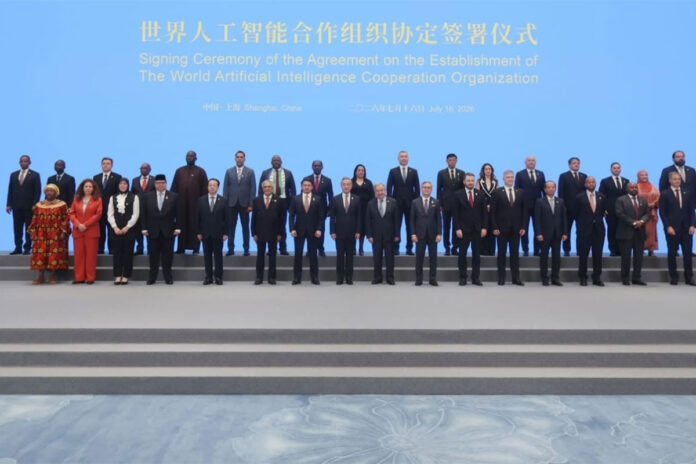
China has moved to position itself as a leading provider of AI modelling and infrastructure to the Global South through the establishment of the World Artificial Intelligence Cooperative Organization (WAICO). Twenty-nine countries, including South Africa, have joined the organisation.
Headquartered in Shanghai, WAICO is designed as an intergovernmental platform for extensive consultation, joint contribution, and shared benefit. Unlike frameworks that use technological tiers and assessments of “trustworthiness” to restrict access to advanced computing resources, WAICO presents itself as following a people-centred approach.
The principles contained in the organisation’s founding documents broadly correspond with approaches promoted by BRICS. They emphasise adherence to the United Nations Charter, extensive consultation, shared contributions and benefits, and the human-centred development of AI.
Chinese open models, including those developed by DeepSeek and Z.ai, have also gained substantial traction among American companies. Their share reportedly increased from below 10% of tokens used in mid-2025 to approximately 40% by mid-2026.
The US has launched its own international AI-sharing initiative through the Pax Silica organisation, with 35 mostly Northern Hemisphere countries joining. However, Pax Silica is not based on an open-weight model. The core model code is not shared, and access is instead provided through licensing arrangements.
The distinction is strategically important. Access to an AI service does not necessarily provide control over the underlying model, its development, its future availability or the rules governing its use.
Practical needs may not require frontier AI
As AI technology advances, it is becoming increasingly clear that many practical applications do not require the most advanced or computationally intensive models.
For most businesses, the immediate implementation requirements are found in administration, data analysis, coding, and the improvement of existing workflows. These tasks can often be performed using smaller and less resource-intensive systems.
Chinese developers have increasingly focused on these more accessible models, enabling them to offer curated products at considerably lower prices than many American competitors. This could make AI adoption more affordable for developing countries and smaller businesses, although questions regarding long-term dependence remain.
These developments demonstrate why access to local data-centre infrastructure and computing capacity has become a strategic concern. Nevertheless, the argument for sovereign computing should not be interpreted as meaning that all AI use and digital integration must be processed through data centres located within South Africa.
Local infrastructure versus international access
AI implementation expert Dr Francois du Plessis points out that international infrastructure remains critical for many everyday applications.
“For everyday use of AI in farming and business, the time it takes a request to reach a data centre abroad and return is a matter of seconds, which is well within what the work requires. The reliability of South Africa’s international fibre connections means the country can rely on data centres elsewhere without a meaningful loss of speed or availability.”
For routine applications in agriculture and business, the speed difference between a local and an international data centre may therefore be negligible. Document processing, administrative support, data analysis, and many decision-support functions do not necessarily require the model or computing infrastructure to be located within the country.
This does not eliminate the need for local infrastructure. Rather, it suggests that South Africa must distinguish between applications that require sovereign control and those that can be outsourced without creating unacceptable risks.
Critical public infrastructure, sensitive government information, strategic datasets, and systems affecting national security may justify local ownership or control.
The cost to agriculture must be considered
The development of large data centres also creates costs and trade-offs that extend beyond the technology sector. Du Plessis cautions that the benefits of a local data centre may be concentrated among a relatively small group, while the costs are carried more widely.
“If a data centre were built in South Africa, some people would certainly profit from it, although the farming industry could carry the cost through the pressure placed on a fragile electricity grid, an already stretched water supply and the potential increase in temperature in areas surrounding such a data centre. That imbalance, where a few gain and the wider agricultural community bears the loss, is at the heart of the concern,” says Du Plessis.
This is particularly important in agricultural regions where electricity and water are already constrained. A large data centre may compete with farms, households, and existing businesses for limited resources. Its cooling systems, energy consumption, and possible localised heat effects must therefore be considered alongside employment, construction activity, and digital investment.
The central question is not simply whether South Africa should build more data centres. It is where they should be built, how they should be powered and cooled, what functions they should perform, and whether the public benefits justify the demands placed on local resources.
A coordinated national approach
South Africa therefore needs a single, coordinated development programme for AI and digital infrastructure. Such a programme should identify which computing capabilities are strategically essential and should be owned, controlled or hosted within the country.
It should also determine the purposes for which sovereign infrastructure will be reserved, which applications can safely be outsourced and what safeguards are required when foreign models or cloud services are used.
The objective should not be complete technological self-sufficiency, which may be financially or practically unrealistic. Nor should South Africa become entirely dependent on foreign infrastructure and models over which it has little control.
A balanced strategy would protect critical national capabilities while allowing businesses, farmers, and service providers to benefit from affordable international systems. South Africa’s challenge is therefore, not merely to attract data-centre investment but to ensure that this infrastructure supports national development without placing an undue burden on agriculture and surrounding communities through increased electricity, water, and environmental costs.