
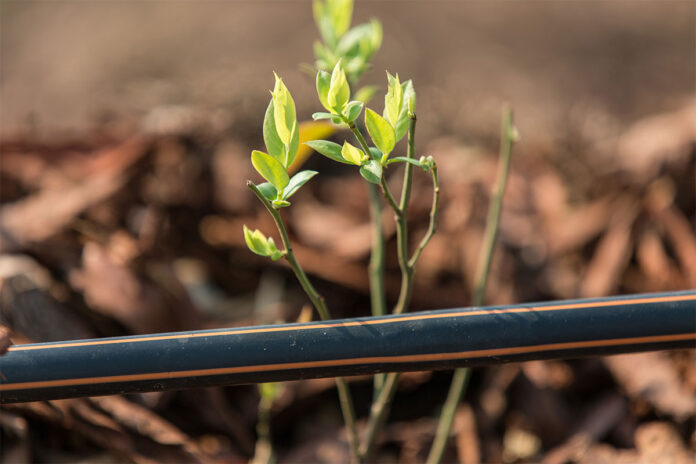
Coenie Scheepers, managing director of Ambrosia Citrus Estate and Majeje Blueberries, says the switch from 2,3ℓ/h drippers to 0,7ℓ/h drippers has been key to achieving efficient resource use and maintaining long-term profitability at Ambrosia.
“We now use low-flow drip irrigation in all our orchards, but it all started with the lemon development. It’s been a journey of adjusting our approach as our experience in managing low-flow drip irrigation expanded. By diligently measuring multiple factors and making decisions based on data, we’ve been able to make a success of low-flow drip irrigation.
“We’ve learnt a lot and, based on our experience over the past 15 years, there are several system design aspects we’ll approach differently in new developments,” he says.
The low-flow concept
The move towards low-flow drip irrigation was driven by the need to optimally manage water and nutrient delivery.
“We want to manage the moisture levels in the trees’ root zone based on the exact requirements of the tree at the time. In our marginal soils, this remains the best approach,” explains Scheepers.
The team follows a pulse-irrigation approach, with regular pulses based on soil moisture data, weather circumstances, and phenological stages.
However, Scheepers says they had a different plan in mind when first switching to low-flow drip irrigation.
“With the low rate at which water is delivered and the continuous approach that aligns with that, our idea was to continuously irrigate for long periods. But we found that, even at flow rates as low as 0,7ℓ/h, you can still over-irrigate and lose water and fertiliser beyond the root zone.
“Shorter pulse irrigation events that are managed based on tree needs ensure much better lateral water movement while limiting deep percolation.”
He says it’s about balancing the horizontal and vertical distribution of water.
“In our marginal soils, we can best achieve this and optimally manage soil–water balance with needs-based pulse irrigation.”
Listing the benefits of low-flow drip irrigation, Scheepers highlights the ability to timeously adapt to conditions and quickly react to insights from data.
“Furthermore, we can irrigate the entire farm simultaneously because of the lower system capacity demands, achieve more with the water at our disposal, and use fertiliser optimally.”
Measure and maintain
Scheepers describes disciplined maintenance as key to drip irrigation success.
“Even more so with low-flow drip irrigation. We flush all our driplines every second week, and we practise continuous peroxide injection as well as shock peroxide treatments. At first, we only did shock treatments. This worked well to an extent, but with continuous peroxide injection, you achieve constant maintenance, and we find that fewer shock treatments are necessary.”
He shares two important factors in the success of chemical maintenance. “We must treat the system with the correct chemical; one that will react with the material that builds up in the drippers. Cut out drippers and test it against potentially suitable chemicals to determine which one produces the desired reaction.
“It is also crucial to regularly measure peroxide levels at the end of the dripline to ensure the dosages are sufficient.”
Scheepers continues by saying that measuring is as important as maintenance. “We have around 1 000 permanent test points across the farm where dripper flow rates are regularly monitored. This gives us insight into the ageing of the driplines, identifies problem areas where drippers must be replaced, informs us about required maintenance, and ensures that scheduling calculations are done with actual flow rates.”
He emphasises that regular measuring of actual dripper flow rates is a practice that is too often neglected in drip irrigation management.
Beneath the soil, measuring is as important. “Moisture levels in root zones are measured with probes. Probe data is combined with weather data to directly inform scheduling decisions.
“We also dig profile pits once a month and place massive value on augering soil samples from different spots and doing the squeeze test to determine moisture levels. This unlocks important insights into soil moisture levels and how water moves in the soil.
“By physically inspecting soil moisture and seeing the shape and size of the wetted bulb, you truly learn to understand how these factors can be managed.”
Sufficient system design
According to Scheepers, their biggest lesson in system design has been around ensuring sufficient flushing capacity.
“It’s about getting enough velocity through the driplines to ensure that flushing is easy and effective. We included 20% overdesign in our 2011 low-flow system. Based on the experience with this system, I would easily add up to 50% overdesign to our next system to ensure sufficient capacity for efficient flushing.
“Yes, it will result in a more expensive system, but in the long run, I’d know that I can maintain my driplines more efficiently. The added capacity also ensures that your system can keep up with higher flow rates as the driplines age.”
Another important design adjustment has been to add more flushing valves to ensure that smaller sections of driplines are flushed at a time and higher flushing speeds can be maintained.
Scheepers reiterates that, although it is important not to overinvest, you must have a long-term view when it comes to the cost of your irrigation system.
“I know that if we had spent 30% more on our 2011 system, we would have easily recovered that investment through the savings made possible by even more efficient irrigation and a lower occurrence of dripper clogging.
“When planning your irrigation system, it’s important to set yourself up for success. Create the opportunity to do things the right way from the get-go, and leave space for adjustments made necessary by the realities faced in the field.”
He says that another change he would make to system design is to add more dedicated mainlines to manage blocks independently.
“We have to be able to manage blocks differently based on soil types. As is the case on most farms, we have massive variation in soil type within orchards, and irrigation must be adapted accordingly.
“A lot of data must be collected during the planning phase of an orchard, and soil mapping is a crucial planning activity. This data is important to identify which zones can be managed together, which zones must be approached differently, selecting flow rates and dripper spacing, and more.”
Scheepers adds that the importance of soil mapping is a perfect example of why it is crucial to involve the necessary experts in the orchard and system planning process.
“Experts must collect the necessary information and collaborate on practical and optimal solutions. Then, infrastructure must be designed and installed accordingly. It is also important to visit other farms to see their systems in action, and do a lot of research.”
He says he also had a significant mind shift around continuous fertigation. “We initially didn’t make this part of the system design and didn’t practise continuous fertigation. However, it’s one of the major benefits of drip irrigation and should be a non-negotiable part of low-flow drip irrigation.”
He adds that they have learnt a lot about continuous fertigation from their blueberry project. “We’ve seen clear benefits from this practise, and we’re systematically making changes to systems in all our orchards to ensure continuous fertigation across the entire farm.”
The initial installation: dripper comparisons
To determine if system costs can be reduced, the team decided to install two different driplines in each tree row in the lemon development in 2011. The goal was to compare driplines at different price points.
The design called for double-row driplines, which created the opportunity to compare driplines under equal conditions. UniRam™ driplines were installed on one side of the trees, and a lower-cost dripline with a smaller flow path and filtration area was installed on the other.
“Both driplines performed well, but at around eight years after installation, the alternative dripline started showing a lot of flow variation in our flow-rate tests. We were no longer able to reduce clogging that leads to flow variations with maintenance treatments, and in 2025, we started replacing all these lines with UniRam™ driplines,” says Scheepers.
“I will never again implement any dripline other than Netafim’s UniRam™. We closely monitor flow rates and variation and have learnt that UniRam™ truly is a stable dripper.
“Yes, after 15 years the drippers’ flow rate has been affected, and I would place the average at 0,9ℓ/h rather than the original 0,7ℓ/h. Flow rates were, however, maintained for much longer than that of the other dripline under the same conditions and are much more homogeneous across the system. We can still manage our irrigation efficiently by adjusting to the known flow rate.”
According to Scheepers, UniRam™ driplines have been key to their success with low-flow drip irrigation.
“With a less stable dripper, we would have had more flow rate variation and might have come to the conclusion that low-flow drip irrigation isn’t feasible. We would have made different decisions based on this conclusion and would have missed a massive opportunity.”
Optimal water management
Scheepers says that although water is a scarce resource that should be used with care, their core focus isn’t necessarily on saving water.
“It is about using water optimally. The true measure is water-use productivity. How many kilograms of fruit can you harvest per litre of water? When water and nutrition are applied optimally, the result is sustainable profitability unlocked through resource-use efficiency.”
Managing a tree, he continues, is about managing energy efficiently. “This is why it is so important to irrigate at exactly the right time. Our irrigation system gives us the tools to capitalise when we have very hot days. The hotter it gets, the happier we are that we use drip irrigation. With drip irrigation, we can irrigate at the right time to enable the tree to use the heat and promote fruit size and quality.”
Scheepers does warn that correct scheduling is key in low-flow drip irrigation success. “If you don’t have the tools to collect and interpret the necessary data to inform scheduling decisions, there is a big risk that you’ll schedule incorrectly and do more damage than good. It is essential to use the correct equipment, choose quality equipment, and have important checks and guidelines in place to enable optimal management.
“Remember, informed decision-making is often the difference between optimal and suboptimal management.”
He concludes that they have, without doubt, made mistakes along their low-flow drip irrigation journey.
“We’ve been privileged to expand our understanding of low-flow drip irrigation management over the years, and we’ve learnt many important lessons around dripline selection, dripper spacing, system design, maintenance, scheduling decisions, and more.
“It is rewarding to know that we’ve made a success of implementing low-flow drip irrigation technology, and that we can push the boundaries of how water and nutrient application can be managed.”
For more information, visit netafim.co.za.