Many farmers will have seen Lekkewaan’s range of electric utility vehicles at Nampo Harvest Day and other agricultural exhibitions, but it is only when these machines are put to work on the farm that their true value becomes evident.
Designed for practicality rather than novelty, the Lekkewaan (Lekke) range has earned a reputation for versatility, durability and low operating costs.
The Lekke Noddy often draws the most attention at agricultural shows, largely because of its distinctive appearance and the link to its namesake, one of the most iconic characters in British children’s literature. While its playful styling attracts plenty of curiosity, the Lekke Noddy – like the rest of the Lekkewaan range – is built as a serious working vehicle.
Thanks to the Lekkewaan team at its Centurion warehouse and national sales manager, Sampie van Schalkwyk, Farmer’s Weekly recently had the opportunity to test two of the company’s roadworthy electric vehicles: the Lekke TailG F55 scooter, and the Lekke TailG 1.6 EEC (European Economic Community) utility vehicle.
Although the experience differed considerably from the motorcycle test rides usually undertaken, it quickly became clear why these compact electric vehicles are finding an increasing number of applications on South African farms.
Lekke TailG 1.6 EEC Specifications
Battery: Lead-acid, 72V, 52Ah
Motor: 1 000W
Speed: 15km/h to 30km/h (three-speed selection)
Load capacity: 350kg to 400kg
Rear differential: 2 X 4
Range: 40km to 50km
Charging time: 6 to 8 hours
Warranty: Six months
Built for sturdier loads
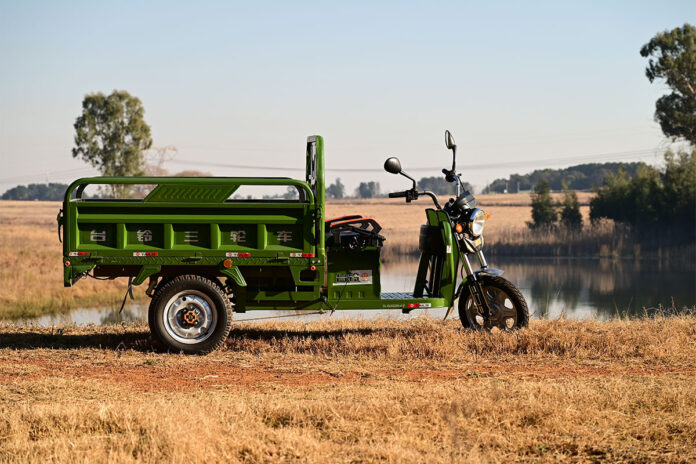
The Lekke TailG 1.6 EEC is designed for a very different role. Built as a compact utility vehicle, it is intended for everyday transport and ease of light-duty hauling.
Because it is approved for use on public roads, it allows cargo to be transported between the farm and town. Its 1,6m-long tipping load bed features drop-down sides, making loading and unloading quick and efficient.
The vehicle is available in red, blue or green.
“Our clients tell us they hardly use their bakkies on the farm once they introduce the TailG into their operations,” says Van Schalkwyk.

The 1 000W electric motor may not deliver high speeds, but its torque is impressive. During testing, it comfortably carried two adults up a steep, rocky incline while maintaining steady performance. With a load capacity of up to 400kg, it is well suited to a wide range of agricultural applications.
In addition to its practical farm applications, the TailG 1.6 EEC is an excellent vehicle for large estates, warehouses, factories, campuses, municipalities, and maintenance teams. The 1,6m cargo bed makes it easy to carry tools, equipment, produce, or supplies anywhere with minimal operating costs.
Battery options across the range include a lead-acid battery with an expected lifespan of around two years and approximately 750 charging cycles, or a lithium battery offering a five-year warranty, an estimated nine-year lifespan, and approximately 4 500 charging cycles.
Compact, practical performer
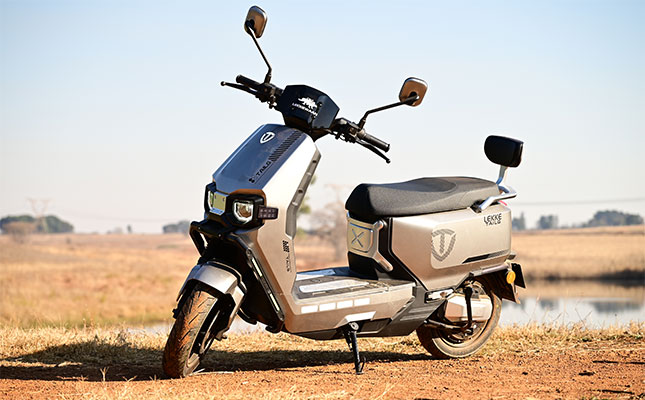
Although the TailG F55 was not specifically developed as a farm vehicle, it has the potential to fulfil a variety of transport needs on agricultural enterprises. Lekkewaan positions it as a reliable electric scooter for both work and leisure, making it equally suitable for commuting, travelling around a smallholding, moving between buildings on a business or industrial site, or running errands on the farm.
Powered by a 2 000W electric motor and a dependable 72V battery system, the F55 reaches a top speed of 45km/h and offers a range of up to 100km on a single charge.
While it is intended primarily for tarred or paved surfaces, it also handled a steep dirt road with loose gravel and uneven terrain surprisingly well during our test.
Comfortable to ride and requiring very little maintenance, the F55 offers an economical transport solution without compromising convenience. It is equally at home on the farm or as practical daily transport for a student travelling around campus.
Lekke TailG F55 Specifications
Battery: Lead-acid, 72V, 35Ah
Motor: 2 000W
Top speed: 45km/h
Range: 90km to 100km
Charging time: 5 to 7 hours
Warranty: Six months
Roadworthy: Yes
Compact utility
Although it is not a roadworthy vehicle, a summary of the TailG 1.3 completes the review of Lekkewaan’s range of three-wheeled vehicles.
The Lekke TailG 1.3 is built as a compact utility vehicle intended for demanding day-to-day farm work.
Its 1,3m-long tipping load bed features drop-down sides, making loading and unloading quick and efficient. The vehicle is also available in red, blue or green.
Citrus producer Hennie de Beer of Vaalbos Trust Boerdery near Marble Hall, Limpopo, has first-hand experience of these vehicles in daily farming operations (see accompanying article).
Its quiet operation makes the TailG 1.3 suitable for work around the homestead or any area where noise is a concern.
The fully electric drivetrain eliminates fuel costs, oil changes, and many of the maintenance requirements associated with conventional utility vehicles.
Strong support network
Behind the Lekkewaan brand is a well-structured business with a growing distribution and support network. Although the vehicles have only been available in South Africa for a relatively short time, they are increasingly being adopted across the agricultural sector. Over the past eight years, 4 000 units have been sold.
The company operates from warehouses in Centurion, Wellington (headquarters) and Gqeberha, with more than 90 dealers and agents across South Africa and Namibia.
“It is our partnership with predominantly tractor and agricultural equipment dealerships across the country and in Namibia that makes our distribution chain fast, reliable and effective,” says Van Schalkwyk.
He says after-sales support is one of the company’s greatest strengths.
“We stock virtually every component for every vehicle in our warehouses. Dealers can order parts through our online business portal, which is linked directly to our inventory system. That means through a local dealership, farmers are only a phone call away from getting the parts they need.”
While agriculture remains Lekkewaan’s primary market, the vehicles are also being used in mining, logistics, warehousing, and delivery operations.
Farmers have found innovative applications for them, with one client converting a TailG into a mobile firefighting unit by fitting a water tank and pump. Their quiet operation has also made them popular on game farms.
Van Schalkwyk said that a range of new products would soon be introduced. All he would reveal at this stage is that the new additions to the current range will be launched before the end of the year.
Despite the geographical distance, the then general manager Pierneef Smit leveraged more than a decade-long, trusted relationship with the Chinese supplier to ensure operational continuity.
China to South African farms
The Lekkewaan story began during a visit by South African fruit farmers to China, where they encountered the compact electric utility vehicles being used extensively in orchards.
Recognising their potential, Smit imported the first shipment for local evaluation.
Following positive feedback from farmers, additional vehicles were imported, and the business grew from there.
When establishing the South African brand, the company drew inspiration from the monitor lizard, or likkewaan.
By combining the Afrikaans words lekker and wa, the name Lekkewaan was created.
Today, the company holds the exclusive rights to import the TailG range into South Africa.
Lekke TailG 1.3 Specifications
Battery: Lead-acid, 60V, 38Ah
Motor: 1 000W
Speed: 15km/h to 30 km/h(two-speed selection)
Load capacity: 250kg to 300 kg
Range: 30km to 40 km
Charging time: 6 to 8 hours
Climbing angle: 15°
Warranty: Six months