With strawberry farming, every management decision ultimately comes back to one question: what does the plant need to produce high-quality fruit?
It sounds like a simple question, but according to agricultural and horticultural consultant Dr Michael Southwood of Southern Cross Trust, the answer lies at the heart of successful strawberry production.
Speaking during a recent online workshop titled ‘Understanding & Managing Strawberry Production in Southern Africa’, he explained that growers who consistently produce high yields of quality fruit do so because they understand how the plant responds to its environment and subsequently create conditions that minimise stress.
At the centre of it all, Southwood said, is the strawberry plant’s crown, which controls whether the plant will remain vegetative or produce flower trusses.
“Excessively high crown temperatures suppress flower initiation, while cool, stable conditions encourage continued production. Every management practice, from ventilation and irrigation to plastic mulch and canopy management, is therefore aimed at maintaining favourable crown temperatures and avoiding plant stress,” he explained.
Protected cultivation
The degree of microclimate control depends on the production system. Protected cultivation allows growers to regulate temperature, humidity, and irrigation far more precisely than under open-field conditions.
By keeping rain off the plants, systems ranging from simple hoop tunnels to sophisticated greenhouses can improve packouts and extend production well into summer, when strawberries are scarce and prices are at their highest.
However, greater control comes at a cost.
“Capital investment is considerably higher, and the margin for error is much smaller,” Southwood explained.
Unlike open fields, where strawberries are grown in soil, greenhouse plants are grown in substrate. Rockwool was once the medium of choice, but rising costs have seen most South African growers switch to coco peat–perlite mixtures.
Southwood said a substrate containing roughly 70% coco peat and 30% perlite offers a good balance between moisture retention, aeration, and cost, although some growers also use equal proportions of coco peat, perlite, and peat.
Each plant should have at least 2ℓ of substrate with a water-holding capacity of about 60% and an air-filled porosity exceeding 18%, representing a high level of aeration.
Healthy roots, Southwood said, are the foundation of productive plants.
“Most production problems start below ground. Poor root development limits water and nutrient uptake, delays flowering, and ultimately reduces fruit size and yield.”

Thus, plant quality is critical. Nursery plants should have crowns of at least 10mm thick, and the upper 3mm to 5mm of the crown should remain above the substrate after transplanting to minimise crown and root diseases.
Flowers produced during the first few weeks should be removed so the plant can direct its energy towards establishing a strong root system before carrying a crop.
The choice of planting material is equally important. While short-day cultivars are commonly used for winter and spring production, growers targeting the late-summer market increasingly rely on day-neutral and frigo plants for greenhouse systems.
Day-neutral plants produce fruit regardless of the number of daylight hours, which means they can produce fruit outside of the traditional production season.
Frigo plants are bare-root strawberry plants that are lifted during winter dormancy and stored under refrigeration for several months before planting. Because they’ve accumulated carbohydrate reserves before storage, they establish rapidly and come into production much sooner. This allows growers to target out-of-season markets when prices are highest, provided the microclimate is managed optimally.
Southwood said larger frigo plants with thicker crowns can be stored for longer, giving growers greater flexibility in scheduling production. Ideally, these plants should be examined under a microscope before being placed in cold storage to confirm that the primary and secondary flower buds have already been initiated.
Precision irrigation of substrates
In contrast with open fields, irrigation under protection uses small amounts of water applied frequently. Instead of supplying large volumes of water once or twice a day, growers typically fertigate up to 12 times daily with small amounts of water and nutrients. Depending on the season, plants receive between 240ml and 400ml of water a day, increasing to around 500ml during hot weather.
“The objective is to maintain the optimum balance of moisture, oxygen, and nutrients in the root zone,” Southwood explained.
“Around midday, growers should aim for 25% to 30% run-off to flush excess salts from the substrate before it starts to affect the plants’ performance.”
Uniformity is essential. Every plant should receive the same amount of water and nutrients, requiring regular monitoring of water quality, electrical conductivity, pH, and run-off so fertigation can be adjusted as crop demand changes.
Southwood cautioned that adding fertiliser doesn’t necessarily produce more fruit. Excessive fertiliser applications increase salt concentrations around the roots, reducing nutrient uptake and fruit sweetness rather than improving production.
Regular leaf analyses and monitoring of irrigation water and run-off allow growers to identify nutrient imbalances before deficiencies or toxicities develop.
Because these adjustments are highly technical, many growers work with crop nutrition specialists to refine fertigation programmes according to the plants’ stage of development, fruit load, and analysis results. This helps ensure plants receive the nutrients they need without wasting fertiliser or creating nutritional imbalances.
Creating the right environment
Getting irrigation and nutrition right is only part of the challenge. The environment above the crop is just as important, with temperature, humidity, light, and airflow all working together to influence photosynthesis, pollination, flowering, and, ultimately, fruit quality.
Southwood recommended maintaining daytime temperatures between 20°C and 24°C and nighttime temperatures between 10°C and 14°C wherever possible. More importantly, growers should focus on the plants’ average temperature over a 24-hour period rather than short-term fluctuations.
Temperatures outside these ranges affect both plant growth and fruit quality.
“Strawberries don’t like extremes. Cool conditions slow growth and nutrient uptake, while crown temperatures above about 28°C to 30°C can slow or even stop flower initiation. Excessively warm nights later in the season also result in smaller fruit with a higher acid-to-sugar ratio,” Southwood explained.
Humidity also requires careful management. Air that’s too humid restricts transpiration and creates favourable conditions for diseases, while overly dry conditions limit calcium movement within the plant, increasing the risk of physiological disorders such as tip burn and dry calyx disorder.
Maintaining the right environment requires constant adjustment as conditions change throughout the day. Growers producing under simple hoop tunnels often rely on natural ventilation by opening the sides of the structures as conditions change.
Those aiming to extend production further into summer increasingly invest in roof-mounted circulation fans, misting systems, shade screens, and, in some cases, evaporative cooling systems to keep temperatures under control.
However, Southwood noted that only a handful of farmers in South Africa use evaporative cooling because of the high cost.
Light quality is equally essential. While growers want to protect plants from excessive heat, they also need to ensure enough light reaches the crop. Therefore, many growers selectively remove older leaves around the crown to improve light penetration into the canopy, while also maintaining good airflow and reducing disease pressure.
Pollination is another consideration. Bees remain the most effective pollinators, making it important to use greenhouse plastics that allow sufficient ultraviolet (UV) light to pass through, as bees rely on wider UV wavelengths to navigate.
In more enclosed greenhouse systems, growers may also introduce smaller managed hives to ensure reliable pollination throughout the season.
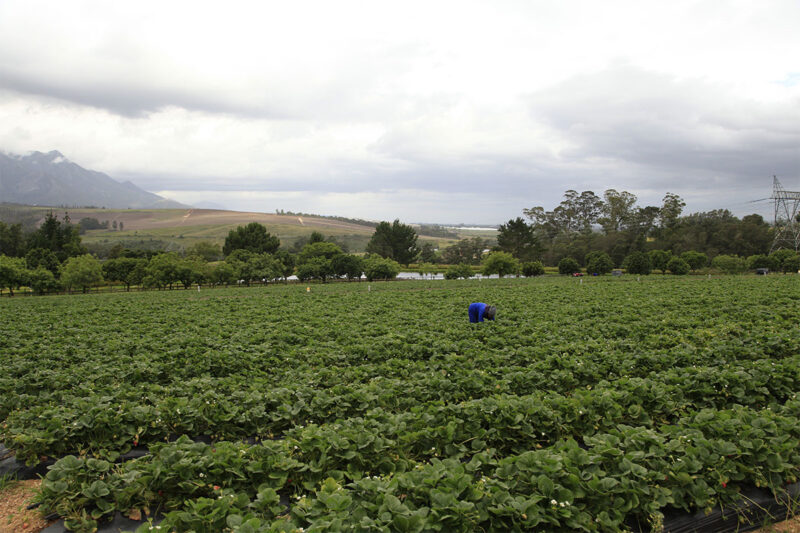
Open-field production: working with nature
While protected cultivation allows growers to manipulate much of the crop’s environment, open-field producers must work with nature rather than against it. This makes careful planning long before planting just as important as in-season management.
The process starts with selecting the right site. Fields should be well drained and receive plenty of sunlight. Farmers should avoid areas prone to excessive heat, frost pockets, or poor air movement.
Soil preparation should ideally begin nine to 12 months before planting, allowing enough time to correct pH, improve soil structure, and address nutrient imbalances.
Building healthy soil is also becoming a greater priority. Rather than relying solely on fumigation to suppress soil-borne diseases, many growers now incorporate compost, cover crops, and biological products to improve soil health and encourage beneficial soil organisms.
“The time between crops is usually the biggest challenge. If you can fit in a cover crop, do it. Some produce plenty of biomass within six to seven weeks during summer, but they still need about three weeks to decompose before planting [strawberries], leaving a very narrow window for the soil preparation that strawberries require,” Southwood said.
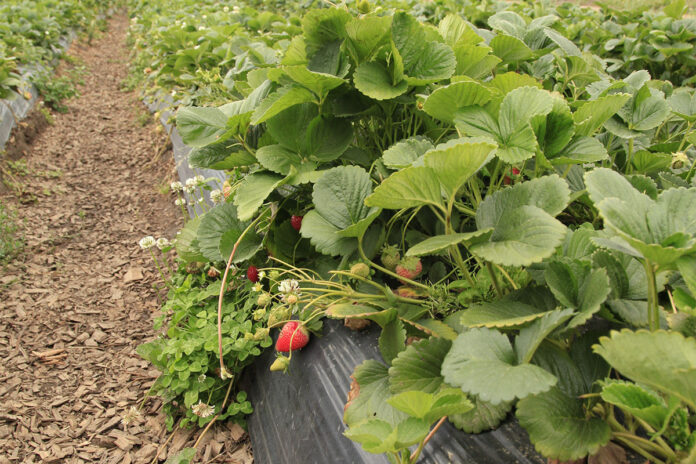
Raised beds remain the cornerstone of successful open-field production. Aside from improving drainage, they create a well-aerated root zone, encourage healthy root development, and help protect the crown from waterlogging after heavy rain.
Plastic mulch is just as vital. It suppresses weeds, conserves soil moisture, and warms the soil during winter, helping plants establish more quickly. During summer, however, exposed black plastic can raise soil temperatures until the developing canopy is big enough to provide the beds with shade.
Irrigation follows the season
Unlike production under protection, irrigation in open fields is constantly shaped by the weather and the crop’s stage of development.
During establishment, frequent overhead irrigation helps settle the soil around the roots and encourage rapid root growth. Once the plants are established, irrigation is reduced during winter before increasing again ahead of the main spring flowering flush.
Timing is critical. Southwood said growers should increase irrigation before flowering begins, as water stress at this stage reduces flower size and ultimately limits berry size.
“Strawberries are more than 90% water, so any moisture stress during fruit development directly affects yield,” he explained.
A different approach is required during summer. Rather than applying large volumes of water during the hottest part of the day, Southwood recommends applying about 60% to 65% of the daily irrigation requirement before 11am and the remainder in the mid-afternoon before temperatures start to decrease.
Heavy midday irrigation increases the risk of root diseases and produces softer fruit with a shorter shelf life.
Attention to detail pays off
Whether strawberries are grown under protection or in open fields, successful production is rarely the result of one big management decision. More often, it comes from dozens of small decisions made consistently throughout the season.
Runners should be removed continuously so that carbohydrates are channelled into flowers and developing fruit rather than vegetative growth.
Weeds and older leaves should also be removed regularly to improve airflow and light penetration through the canopy.
Good sanitation is particularly significant. Southwood warned that poor hygiene often goes unnoticed early in the season, only to catch up with growers during the cool, humid months when Botrytis becomes established. Maintaining a clean canopy throughout the season is therefore far more effective than trying to control outbreaks later.
At the same time, increasing numbers of growers are incorporating predatory mites and other beneficial insects into integrated pest management programmes to suppress spider mites and thrips while reducing reliance on insecticides.
Quality doesn’t end at harvest
Harvest may mark the end of production, but it’s not the end of quality management.
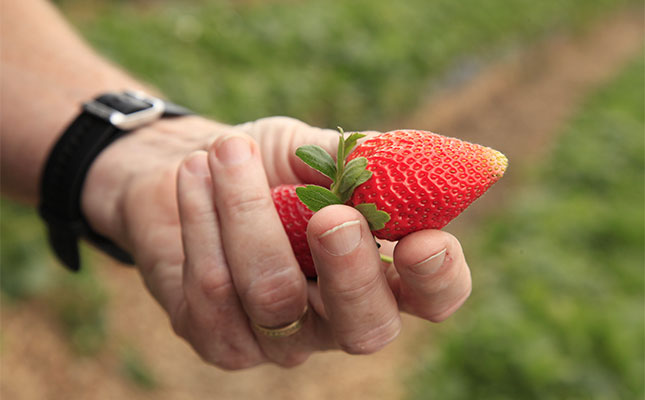
Because strawberries are highly perishable and don’t continue ripening after harvest, the fruit should only be picked once it has reached the desired colour and flavour. Harvesting should also take place during the coolest part of the day, with fruit immediately moved to the shade to eliminate field heat.
Southwood said harvested fruit should ideally be cooled to below 4°C within one to two hours of harvest using forced-air cooling: “The sooner the fruit is cooled, the longer it will retain its quality and shelf life.”
Leaving harvested pallets standing in the field can shorten the fruit’s shelf life by several days. Damaged or diseased fruit should also be removed from the field rather than discarded between the rows, where it becomes a source of disease inoculum.
Creating the conditions for success
Regardless of where strawberries are grown – under plastic or in open fields – Southwood believes the principles of successful production are universal. Healthy roots, balanced nutrition, careful irrigation planning, and paying close attention to the crop’s needs all help create the conditions that allow the plants to perform at their full genetic potential.
While greenhouse growers have more opportunities to manipulate the microclimate, open-field producers can achieve the same objective by understanding how the plant responds to changing conditions and adapting their management accordingly.
“In the end, everything comes back to creating optimal conditions for the plant to perform,” Southwood said.
For more information, email Michael Southwood at [email protected].