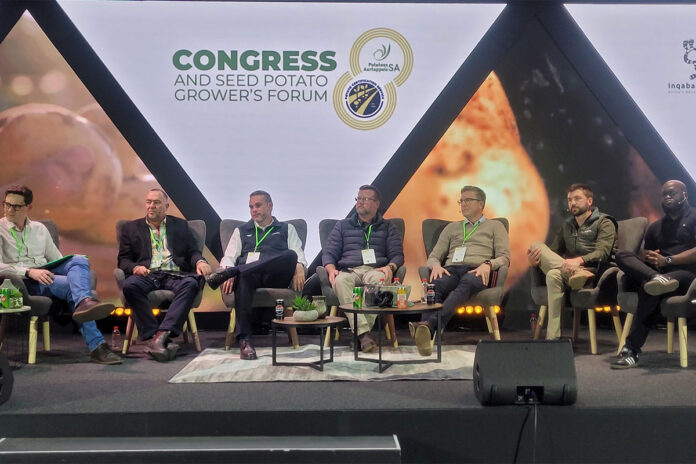
Speaking during a discussion on technology adoption, Coenraad Fraenkel, extension manager at Citrus Research International, said farms first and foremost need capable people who can identify operational gaps and select the right tools to address them.
“You will never replace people. Get good people in place and give them the best tools to enhance their capabilities.”
He said that studies of irrigation farmers in the citrus industry who consistently outperformed their peers showed that technology itself was not the deciding factor.
“Instead, they have organised small teams of people that constantly go through orchards to check that the irrigation system is working perfectly, doing soil moisture tests and, while they’re at it, scouting for pests.”
Discussing the common issue of farmers being hesitant to trust insights gleaned from farming software, Fraenkel advised producers to choose an application that provides reliable insights and use it to its full capacity, rather than attempting to combine information from multiple tools in search of an answer.
Loffie Brandt, head of sales enablement at Absa AgriBusiness, said farmers should approach new technology in the same way they approached other changes on their farms: through testing and verification.
“Farmers do trials all the time. With technology, it’s the same. You need to trial it, test it, and verify the results. I understand why farmers are nervous, especially with a high-input crop such as potatoes, where they cannot afford mistakes. But trials are common practice on farms, so why should technology be any different?”
Karidas Tshintsholo, founder and CEO of Khula!, said the value of any technology depends on the quality of the information supplied to it and the farmer’s ability to interpret the results.
“Technology is a tool. It cannot replace people. If you put garbage in, you get garbage out, so you need to collect and input the right data to obtain useful insights.
“The process starts with the farmer confirming what the technology is telling them, and it ends with the farmer making the right decision based on those insights.”
Hyperlocal weather data are paramount
Looking at the value of weather stations, Sandveld potato farmer Johan Stephan said many farmers install weather stations but fail to use the information effectively.
He explained that calculating crop water requirements from evapotranspiration data can make a significant difference to irrigation management.
“It takes more effort to guess irrigation requirements than to calculate them using weather data.”
According to Fraenkel, hyperlocal weather data have become increasingly important in the citrus industry, particularly as climate variability affects crop performance. Building long-term trends allows farmers to identify anomalies such as unusual pest pressure or poor flowering before the full impact becomes apparent.
He cited a case in which poor fruit set was eventually linked to wind conditions that had doubled the evapotranspiration rate at a critical stage.
“You don’t always feel a major difference in the wind, but it can have a significant impact on evapotranspiration. A change at a critical time can greatly affect fruit set, which is why hyperlocal weather monitoring is essential.”
The discussion highlighted that the greatest value from technology came not from collecting more data but from using reliable information, skilled people, and farmer experience to make better decisions.