

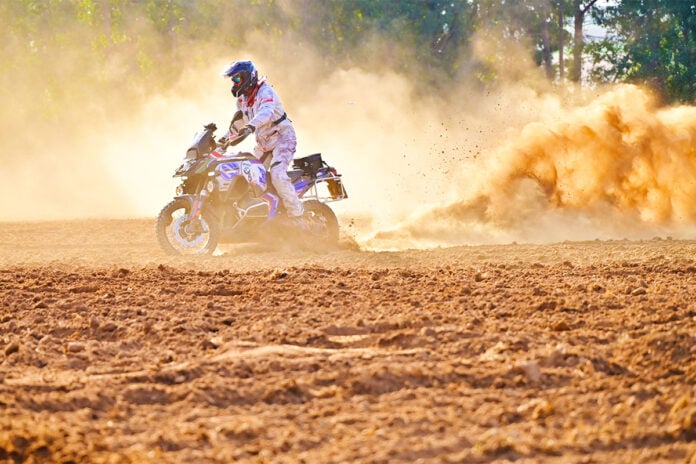
Judging by how quickly bookings for the Great African GS Challenge sold out, the adventure motorcycling community clearly welcomed the return of an event that once was a priority on its calendar. Adventure riders from across the country were eager for a weekend of dust, noise, camaraderie, and a much-needed adrenaline rush.
I also took part in the Challenge, courtesy of Ducati Johannesburg, and rode a Ducati DesertX during the event. I also wanted to discover whether the organisers had succeeded in their aim of recapturing ‘the spirit that originally defined the GS Challenge’.
Although the event’s name retained its BMW GS association, the organisers opened this year’s Challenge to all brands of off-road-capable motorcycles. Country Trax Off-Road Riding Academy, near Amersfoort in Mpumalanga, hosted the event at the venue where the original Challenge was born in the early 2000s.
Prepared for adventure
With the Ducati DesertX V2 run in, serviced and fitted with crash bars at Ducati Johannesburg, I was ready for the adventure ahead. The comfortable chalets at Country Trax were fully booked, so my travelling companion and I opted to camp. No problem: my mate Jan Grobbelaar, although not a motorcyclist (yet), is an accomplished camper and 4×4 enthusiast. He had everything needed to settle us comfortably into his three-room tent.
All I needed were a few essentials for day rides on rough roads: a tyre repair kit, water, snacks, a small first-aid kit, more water, a rain suit, something strong for pain (you never know with bikes), and yet more water.
Before dropping the clutch and getting into the riding, I must compliment the Country Trax team – Dale and Gerhard du Toit, along with contributors including Jan du Toit and Stefan Boshoff – on an exceptionally well-organised event. Jan’s farm, set in the beautiful rural Highveld around Amersfoort, provides a superb setting for adventure riding, and the routes they chose for the weekend were excellent. The venue comfortably accommodated more than 100 riders. The food was excellent, and there was plenty of it for hungry riders.
Country Trax had mapped the routes for both days in advance on an app. Riders could choose red routes for longer, more demanding rides or green routes for shorter, less challenging outings.
Some reservations
Was it challenging? Certainly – just enough to keep me humble, expose a few gaps in my skills and persuade me to book again next year and complete the Country Trax Advanced Off-Road course. I had arrived with some reservations. My own bike had been damaged, forcing me to take a few months’ break from riding. I was a little concerned I might not be physically fit enough for demanding off-road riding.
Fortunately, reviews suggested that the DesertX was an exceptionally capable machine, able to tackle almost anything the route might throw at it. That brought me to my second reservation.
When Mark Walter handed over the bike, his parting words, after I had signed the loan agreement (probably signing away my entire pension should I damage it), were: “Treat it as if it’s your own.” That gave me plenty to think about – and was the main reason I chose the less demanding green route.
When I asked about the green route, Jan reassured me: “Don’t worry, you’ll be fine. I’ll put you with a group that takes things slow and steady.” I soon discovered that our definitions of ‘slow and steady’ differed. My group disappeared in a cloud of dust, leaving me with a racing pulse as I chased them towards a turn-off. I finally caught up when they slowed on a rutted uphill track leading to a farmhouse.
Without the confidence the DesertX inspired, I might have claimed a sudden intestinal haemorrhage and turned back. Bike trouble was hardly a believable excuse in front of my new riding companions, who were casting envious glances at my brand-new mount.
When our ‘road captain’ stopped to ask directions from the farmer at his gate, I suspected we were lost. The farmer’s animated pointing and arm-waving confirmed it: we had to turn around. ‘
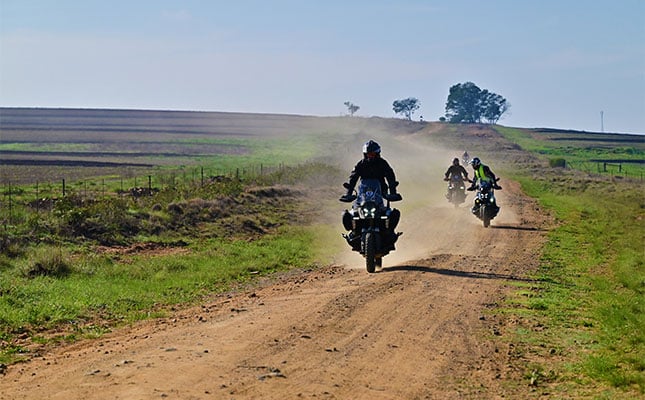
A few kilometres later I began to relax and enjoy myself. The DesertX’s handling is superb, and I could see why reviews describe it as one of the most capable and well-balanced middleweight adventure motorcycles on the market. Its long wheelbase, combined with 21” front and 18” rear spoked wheels, gives it remarkable stability, particularly on faster sections of farm road.
Climbing steadily higher
We followed reasonably good dirt tracks, climbing steadily away from the flatter basin fields towards rocky ridges and the foothills of the escarpment.
For now, we left behind the public gravel roads running through extensive livestock and crop farms. Those roads offered fast, flowing dual-sport riding that the DesertX devoured, but they could also be unpredictable. Sharing them with large agricultural vehicles meant staying alert at all times.
I was particularly impressed by the DesertX on corrugated surfaces. Other riders have praised its steering damper and stable chassis for limiting headshake, even at speed, and I agree. Over fast, repetitive corrugations, the rear tyre seemed to follow the surface without bouncing or deflecting. Technical reviews attribute this to the completely redesigned ‘full floater’ progressive rear linkage system.
As the morning progressed, the riding became more technical. Natural twin-tracks wound through ironstone koppies and across sandstone ledges, demanding precise throttle control and body positioning. The momentum drills I had learnt years earlier, now firmly embedded in muscle memory, served me well.
Once again, the DesertX impressed. Despite a kerb weight of roughly 223kg, it felt surprisingly light and playful once moving. The narrow tank, seat and gusset design gave me excellent control when standing, whatever the surface.
Letting go
Inevitably, we reached one of my least favourite challenges: steep, loose, rocky descents. Climbing at least offers the reward of reaching the summit, admiring the view and enjoying a sense of achievement. Descending seems to demand all the effort without any of the satisfaction. There wasn’t even time to wave goodbye to the magnificent view.
I braced myself. Tensing up is a natural response when negotiating a descent like this on a 200kg-plus adventure bike, but the DesertX soon encouraged me to relax and let the motorcycle work beneath me. Its ultra-short first and second gears allowed the Testastretta/V2 engine’s compression and engine braking to regulate the descent, reducing the need for constant use of the brakes. The bike slid only once, when I instinctively touched the brake while negotiating a particularly large rock.
We also encountered muddy sections left by early spring rain across this rugged part of Mpumalanga’s interior plateau the previous week.
I was already sweating from the concentration and physical effort, and was about to raise my visor for more airflow when the rider ahead of me fell in a muddy puddle. Fortunately, she was on her feet in a flash, giving two thumbs up before her bike had even stalled in the sludge. Selfishly, I welcomed the brief water break while we righted her motorcycle and checked rider and machine for damage. Both were fine.
My relief was short-lived. We were following a track beside a concrete canal forming part of a water project that feeds the Little Vaal River with rainwater and runs towards the power station at Standerton. By then, the DesertX had made me comfortable with both our pace and the terrain. I was admiring the valley stretching far below when another muddy section appeared.
I had to choose my line quickly. Bakkie tracks near the canal’s edge appeared to skirt the worst of the mud, but there was little margin for error: a fall into the canal would send both bike and rider about 3m to the bottom. Just as I was nearly clear of the mud and the danger, the front wheel suddenly disappeared beneath me. I hit the ground – thankfully, not the bottom of the canal.
Once I had caught my breath, I gave the group a rather shaky thumbs up to show I was still alive. I checked that my limbs were working, slowly stood up, hit the kill switch and tried to hold a steady pose for a photograph. My knee and shoulder ached, and something was going on around my left shin, but nothing seemed serious. The bike looked fine, too. Only later did I notice the cracked windscreen. That really hurt.
During a quick smoke break, our fearless leader checked his GPS, which had apparently lost its signal many kilometres earlier.
‘Guys, you are not going to believe this,’ he announced.
I wasn’t ready for another shock. “We have been – and still are – on the RED route. TOMORROW’S red route!”
Wow. Time travel certainly hurts.
That evening during dinner, there was a lot of conversation flowing around the long tables in the convivial atmosphere of the dining hall. Many stories were shared about getting lost, the difficulty level of the routes, the performance of all the different motorcycles, the beautiful scenery, and many new friendships forged and old friendships renewed – exactly what the organisers planned.
We’ll see each year again next year – same place!