

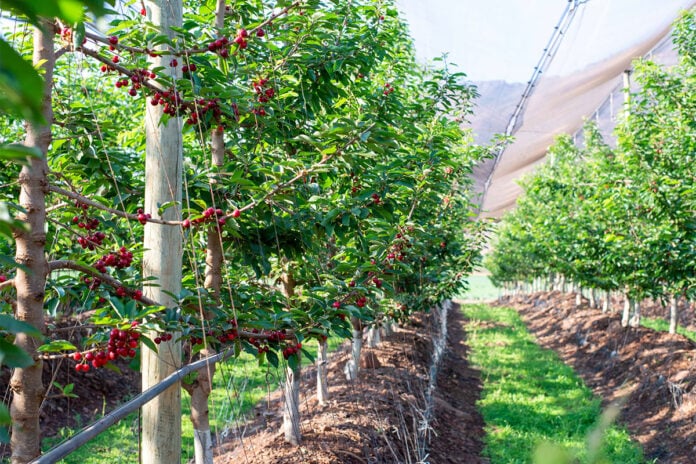
Because profitability remains one of the key aims of any farming strategy, farmers wish to earn as much income as possible for their efforts. This leaves them with two options, they can either cut expenses or increase production and improve quality.
Production can be increased by employing a number of practices and principles.
“Of these, pruning and training are essential practices when it comes to fruit farming. Investing time in proper tree training from the start is an investment in healthier trees, better-quality fruit, and a more productive orchard for years to come,” says Dr Nigel Cook from Prophyta.
While pruning often receives most of the attention, the way a young fruit tree is trained during its early years lays the foundation for its future performance. Good tree training helps create a strong framework that can carry heavy crops, allows sunlight to reach the fruit, improves air movement through the canopy, and makes every day orchard tasks such as pruning, spraying and harvesting easier.
Although fruit trees naturally develop different shapes, pruning and training can guide their form to improve yield and fruit quality.
“The aim of pruning and training is to shape tree structure to improve light penetration and promote air circulation. Proper training techniques, such as espalier or central leader training, can facilitate overall tree health and productivity,” says Zander Ernst, director of marketing and production at Allesbeste Boerdery.
It benefits farmers to bring orchards into production as soon as possible after planting, and training systems help achieve this. They encourage faster growth and earlier fruit set while developing a strong tree structure that can carry heavy crops without limbs breaking. The system and wires also support the harvest load, and because the branches are anchored, the fruit is less likely to be damaged by abrasions.
The type of training system used will be determined to a great extent by the fruit variety and the growth pattern of the tree, says Dr Cook.
“Training systems are determined not only by the type of fruit but also by the specific cultivar, the soil type, the ground slope in the orchard, the rootstock that you choose, the irrigation system, netting and the microclimate, not only on the farm but on that specific piece of land. You first have to know what you are dealing with, before you decide on the training system in the orchard.”
Dr Cook points out that orchard management is a precise science.
“You have to manage each cultivar according to the cultivar’s characteristics. That is part of precision agriculture, knowing what you are dealing with and planning your actions accordingly. You have to do all the small things correctly. The days are long gone where you treat one block of apples or pears the same as all the others.”
Dr Cook further explains that the goal of a training system is to establish a solid structure at the right angle to allow for enough sunlight but also to prevent sunburn without sacrificing fertility due to overshadowing.
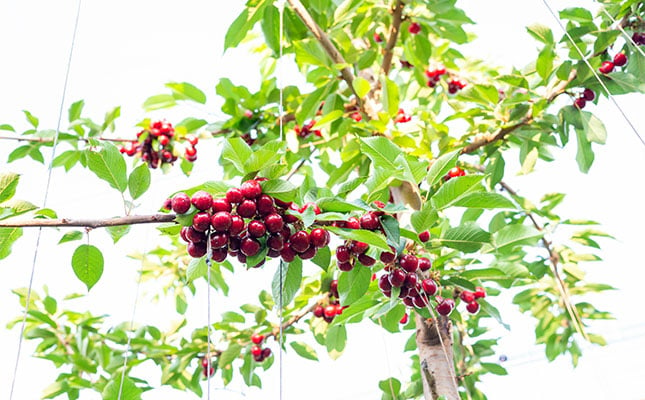
Three main systems
In an espalier system the trees are trained to grow in two dimensions, typically flat against a structure such as a trellis. It also creates a tree form that is easier to pick, prune and spray thoroughly for pests.
In an open-centre training system three or four shoots are chosen to form main scaffold branches the first winter. Other competing shoots should be removed or headed by removing one-fourth to one-third of their length.
A central-leader training system focuses on a single main leader for the tree. If a nursery tree has few or no branches at planting, head it at approximately 60 cm above ground. To train trees to a central leader a single vigorous shoot near the centre of the tree should be chosen. During spring or early summer, shoots near the leader that could compete with the central leader should be removed.
The different training systems will produce distinct canopy architectures. The thin spindle system promotes greater tree height, whereas the Kym Green Bush system produces more compact trees with larger canopy volumes.
General rules
- Do proper planning before planting.
- Begin training as soon as trees are planted.
- Remove unwanted shoots during summer while they are still small.
- Use limb positioning rather than heavy pruning where possible. Spacers and ties can help guide existing limbs into the desired position.
- Apply the training programme consistently throughout the tree’s development.
- Carry out pruning during the dormant season.
- Adapt training methods to the tree’s age: use formative pruning for young trees, shaping for intermediate trees, and maintenance pruning for mature trees.
- Micro-climate can influence the trees’ growth patterns, adapt your training method and schedule accordingly.
Training and pruning go hand in hand. Pruning keeps trees manageable by controlling their size. In young trees, it strengthens structure and encourages branching; in mature trees, it can boost production and improve fruit quality.
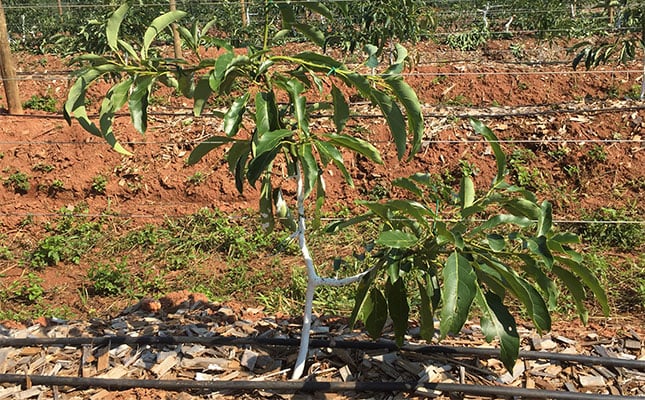
Case studies
- Mahela Group
According to Neels Jansen van Rensburg, general manager at Mahela’s Ohrigstad farming operations, they follow the central-leader training system.
“Since we started our cherry production we have used the central-leader system as this works well in our area under netting. We can train the trees for the optimum tree size and yield. We are, however, discussing the option to look at other systems in trials to determine if we are still on the best system and whether we should adapt.”
He says that it is important to understand the particular fruit tree’s growth patterns.
“This is the foundation of effective branch training because trees allocate resources according to innate tendencies. You have to let these guide you to train the branches without fighting the plant’s natural behaviour. By matching your actions to how a tree grows naturally, you reduce stress, improve branch strength, and achieve a lasting shape.”
According to Janse van Rensburg the negative side of this system is that the trees can grow very high making pruning and picking very tricky.
“If not trained and pruned correctly, the shade of the upper branches can overshadow the lower branches, and this can have an effect on the yield and quality of fruit.”
He warns that the central-leader system asks for constant attention.
“Young trees have to be monitored around the clock. Accuracy when it comes to pruning and training is essential and competing shoots have to be removed regularly to keep the leading central shoot strong.”
On the positive side, Janse van Rensburg says, the system gives a strong central leading stem that does not easily break in strong wind or under good yield.
“The pyramid form of the tree mostly allows for enough light to come through the leaves and branches resulting in an even ripening of the cherries. This form follows the natural growth method of the tree as most trees tend to grow upward at first.”
In addition, he points out that this system uses less horizontal space meaning that one can plant more trees on smaller hectarage.
He further explains that rope is tied to new branches on the cherry trees to force horizontal rather than vertical growth.
“The branches spiral around the main stem, and we aim for about 22 branches per tree. We tie the side branches with string to encourage horizontal growth and prevent them from shading one another.”
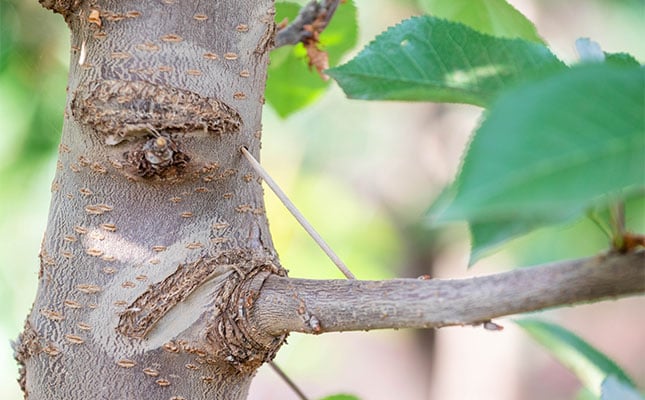
Jansen van Rensburg says they also use toothpicks to guide the angle of emerging side shoots.
“We begin shaping and training trees while they are still young. As new branches emerge, we insert a toothpick on the upper side of the branch where it meets the trunk. This pushes the stem downward, encouraging a more horizontal branch angle. Our aim is for side branches to grow at an angle of more than 30 degrees.”
Because the trees are grown under nets to protect them from frequent hail, the branches tend to grow towards the light.
“We want lateral growth, so we also tie branches down to the trellis with rope. As the tree grows, the rope is adjusted to keep the branches horizontal. Once the branches are set in position, we may remove the rope,” he explains.
Part of the manipulation of the trees involves guiding the growth of the branches to obtain a tree that is not higher than 3,2m with between 20 and 24 branches.
- Allesbeste Boerdery
According to Ernst, Allesbeste began exploring trellising and high-density orchard systems a decade ago.
“At Allesbeste Boerdery, some avocado trees are trained on trellises from planting through intensive pruning and branch manipulation.”
Because better pruning is essential for higher production and trellising relies heavily on pruning, Ernst began experimenting with the system.
“Trellising also makes it easier to see which branches need to be pruned.”
Ernst explains that as trellising boosts production in many other fruit crops, so they decided to explore its potential in avocado production.
The flexible, willowy branches of the Maluma cultivar make trellising a promising new practice for avocados.
“As hoped, planting these avocados to a trellis system is proving to improve productivity, post-harvest handling and fruit quality, as seen on some of the world’s high-density apple and citrus farms.”
The Maluma’s branches grow at 90° angles to its trunk, unlike varieties such as Hass, whose branches grow at angles of less than 45°. The Maluma also starts bearing fruit from as early as six months and is harvest-ready within 12 months of planting. As a result, young branches are pulled down and often break under the weight of the fruit.
In 2015, Ernst tested the trellis system on 30 two-year-old avocado trees. After the first season, he expanded the trial into a commercial-scale block so he could begin measuring commercial results sooner.
“Our trellis training system maximises sunlight interception, improves yield and fruit quality, and gives workers easier access to the trees.”
Trellis training starts at planting, using the correct tree density, suitable pruning and branch manipulation. According to Ernst, trees should ideally be about a metre tall when training begins.
Tree growth is regulated by plant hormones. Cytokinin moves from the roots to promote bud break and cell division, while auxin moves downward from new shoot tips. Their balance affects vegetative growth: high auxin levels suppress bud break and support apical dominance.
By changing branch angles, growers can adjust this balance and train trees to develop strong structures that support crop loads, encourage early bearing and improve operational efficiency. However, training can be labour-intensive at first.
“We’ve opted to develop Tatura (Y-shaped) and vertical trellising systems on a 50:50 basis to determine in time which is more beneficial. Both show advantages. We are continuously learning and improving our system. In addition we also do research on wire spacing and angles, and based on the results, we’ll adapt our methods accordingly,” Ernst adds.
For more information, email Zander Ernst, Allesbeste at [email protected] or Neels Janse van Rensburg, Mahela at [email protected] or Dr Nigel Cook, Prophyta at [email protected].