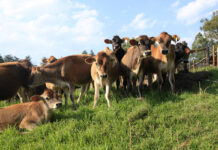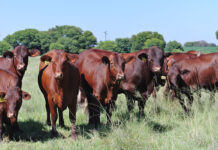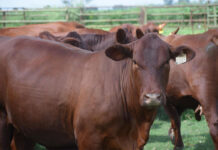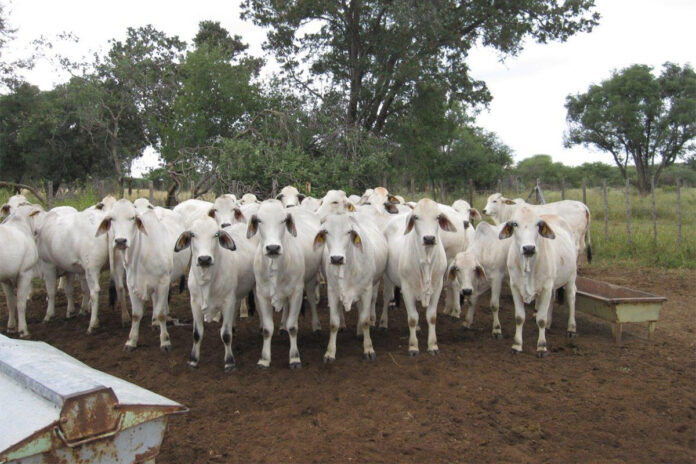
The Harrobi stud is run by Hagen and Birgit Eggert near Otavi in northern Namibia. The Brahman stud was started by Birgit’s father Hans-Harro Erpf, who was one of the first farmers to import white Brahmans from Texas in 1954.
“After the passing of my father-in-law, we inherited a part of his stud. The name, Harrobi, arises from Harro and Bi, Birgit’s name. Our stud consists on average of 550 animals, including approximately 220 head of cows. We focused strictly on fertility from the beginning. Our herd ranked first since 1998 for the best intercalving period in the Namibian Brahman Breeders’ Society’s category for herds of 100 cows and more. The Harrobi stud was regularly awarded Breedplan’s Completeness Performance 5-star rating. We are very strict about temperament. Ill-tempered animals are not tolerated at all,” says Eggert.

Extensive farming conditions
The Eggerts farm on the farm Askevold under extensive farming conditions. The average annual rainfall is 550mm, while temperatures of up to 40°C in summer are common. The area is also prone to regular periods of drought.
Over and above the Brahman stud, the Eggerts’ farming enterprise includes a trophy hunting concern aimed at international markets and 300ha of dryland crop production, mainly white maize, sorghum, and Sugar graze.
White maize serves as a cash crop, whereas the sorghum and sugargraze are used for silage. Because of the recurring droughts, feed reserves like the silage and grass bales are built up in good years to sustain the cattle during bad years.
“Bush encroachment remains one of the biggest challenges as far as grazing is concerned, with sicklebush (Dichrostachys cinerea) being the main culprit. We have since 1990, when we first started farming, tried numerous methods to combat this problem. We eventually achieved success through the application of a chemical called Mezavue. This has enabled us to clear some 4 000ha of our 7 000ha farm, increasing the grazing potential significantly,” says Eggert.
Agricultural heritage in Namibia
Eggert’s great-grandfather Heinrich Friedrich Eggert arrived in the country in about 1900 while Namibia was still a colony of Germany. In 1930, he bought the farm Askevold from a Swedish national named Johan Askevold, who had named the farm after himself.
“The farmstead we still live in today was built by my great-grandparents themselves. They produced and burnt the bricks themselves and finished the house in 1934. It still has its original roof, wooden window frames, and doors,” Eggert continues.
Medium framed and structurally correct
The Eggerts acquired some heifers and bulls in South Africa upon the inheritance of the Harrobi stud. Their objective was, from the onset, to breed medium-framed Brahmans that are structurally correct, with a particular focus on outstanding milk and carcass, which are key estimated breeding values. For the Eggerts, measuring eye muscle, rump, and rib fat by means of scanning on a yearly basis is of utmost importance.
“Our stud forms part of the Brahman Beef Genomics Project (BGP) as introduced by the Brahman Breeders’ Society of Namibia in 2015. The objective is to promote the genotyping of as many animals as possible in order to increase the accuracy of breeding selection and to construct a reference population.
Since the introduction of the advanced BGP-2 project, it has become compulsory for all stud bulls to be genetically typed. I must give credit to the Namibian Brahman Breeders for the tremendous strides that have been made in our country as far as genotyping is concerned,” Eggert explains.
According to him, the Brahman breed is excellently adapted to the challenging climatic and environmental conditions of semi-arid Namibia. The breed’s outstanding hybrid vigour makes it the obvious choice for crossbreeding purposes.
The Harrobi stud forms part of the Northern Select Auction initiative, formed 32 years ago, which caters to a variety of beef cattle breeders and has different breeds on offer.
First of firsts
“We were first to join the group, to put animals up for sale, selling on both a winter and summer auction, first to offer free transport after auction on the main route, and first to offer online bidding, which got us new clients from neighbouring countries like Zimbabwe, Zambia, and Botswana.
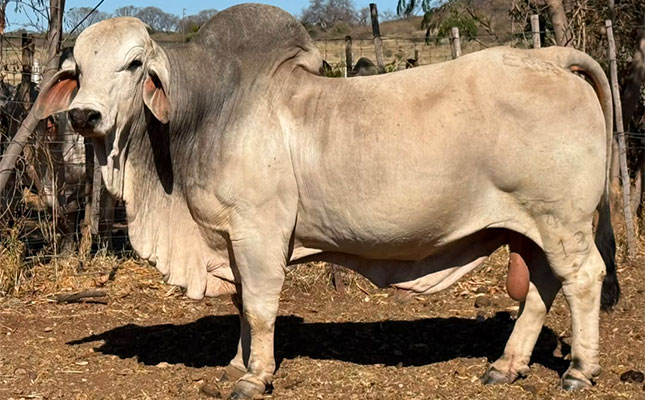
“We are thankful for the ongoing support of our clients, who have, through their ongoing support, allowed us to leave a widespread Harrobi footprint in Namibia. This is underpinned by the fact that one of our bulls, 13-0045, with a high estimated relative producing ability, has over 300 descendants in the country. This phenomenal bull is 13 years old and is still going strong. Bulls that are not sold at the auctions are sold out of hand. Bulls that do not meet our standards are sent for slaughter, without exception,” says Eggert.
The Harrobi studs main goal remains unaltered. This is to breed an early-maturing and well-adapted Brahman with structural correctness based on scientific values in order to support the Namibian beef producers as well as producers outside the country’s borders.
For more information, email Hagen Eggert at [email protected].