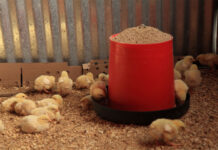

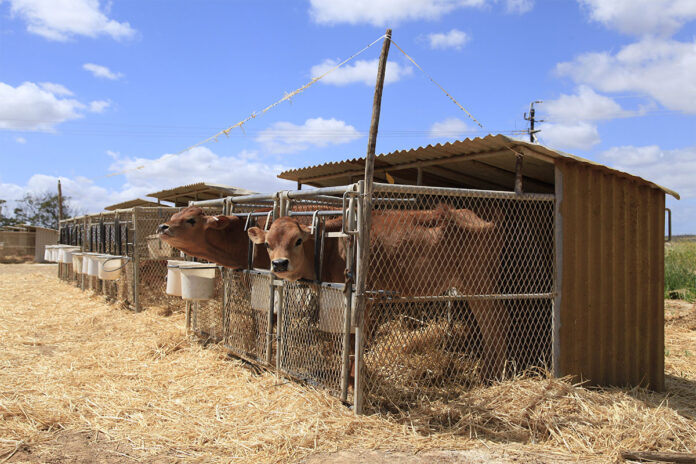
Heat stress in calves is easy to miss. Unlike lactating cows, they don’t immediately show production loss and can tolerate higher temperatures because they aren’t producing milk yet and their rumens haven’t fully developed.
However, this greater heat tolerance doesn’t make calves immune to heat stress.
Speaking at the 12th annual DMC Hollard Conference, held in August near Durbanville in the Western Cape, Dr Jimena Laporta, associate professor of lactation physiology at the University of Wisconsin-Madison in the US, explained how heat builds up in a calf’s body over the course of a hot day.
A calf may look comfortable at 7am, but by early afternoon, her breathing may have quickened as she tries to release excess heat. By 7pm, she may still be carrying much of the heat accumulated during the day. In severe cases, a calf may take close to 100 breaths per minute, which is a clear sign that she’s struggling to regulate her body temperature.
Laporta pointed out that heat stress during the first two months of a calf’s life can be especially harmful, as it may reduce feed intake and interfere with normal development.
“This is a period of rapid growth. Farmers generally aim for calves to double their birthweight by the time they reach weaning. However, much of the development taking place internally in critical organs and tissues can’t be seen, but helps shape the calves’ future fertility and production,” she explained.
The parenchyma of the mammary glands (the tissue that will eventually produce milk) grows about 25-fold during these first two months. The ovaries, gut, and immune system also develop rapidly during this time, growing about sixfold.
Protecting calves from heat during this critical window can therefore support both their immediate health and their performance later on in life.
Cooling starts with shade
With so much development taking place during the first two months, the question is how farmers can protect calves without making cooling them an unnecessarily complicated task.
Laporta’s starting point is simple: “Shade is the number-one thing we need to provide.”
However, while shade protects calves from direct sunlight, it doesn’t necessarily keep them cool. Heat can still build up inside a poorly ventilated hutch or pen, making additional airflow essential.
The next priority, therefore, is to move warm air away from the calves by implementing active ventilation, and when airflow alone is insufficient, carefully managed misting can provide additional evaporative cooling.
There’s no single way to provide that extra cooling. A system suited to an open group pen may not work in an enclosed hutch, and climate and cost will also influence what’s practical.
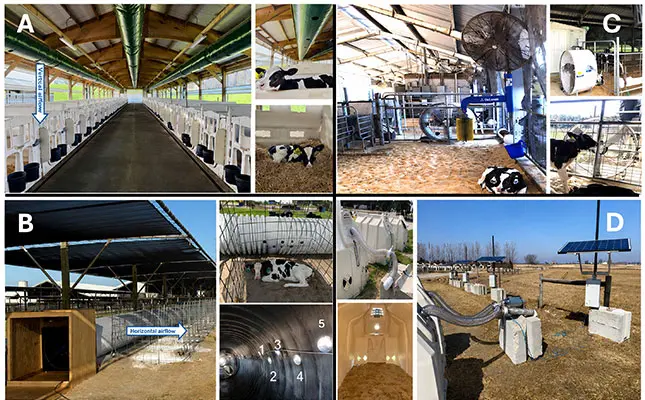
Therefore, Laporta’s research group tested a range of approaches under different conditions, from an ordinary fan in a group pen to solar-powered hutch fans and ducted systems serving several calves.
A simple fan in Florida
One of the simplest trials took place in Florida, US, where long, hot, and humid summers can make it difficult for calves to shed excess heat, even at night.
The calves were housed in groups and fed via automatic milk feeders. Rather than changing the housing, the researchers installed a conventional 48-inch fan to move air across them. The fan produced horizontal airflow of about 1,8m/s. Cooled calves had lower respiration rates and rectal temperatures. They also drank more milk, ate more starter grain, and required fewer medical treatments, including antibiotics.
The researchers continued following the animals after weaning. Those that had been cooled as calves produced more milk when they entered the milking herd, with the advantage continuing into later lactations, according to the data Laporta presented.
Cooling individual hutches
In the US Midwest, individual hutches protect calves during cold winters. In summer, however, the same enclosed shelters can trap heat and become what Laporta described as “little ovens”.
A calf may enter a hutch to escape direct sunlight, only to find herself in a hot space with little air movement.
Laporta’s team fitted the hutches with small solar-powered fans. These lowered the calves’ respiration rates, skin and rectal temperatures, while also removing hot, stale air from inside the hutches.
Ammonia and carbon dioxide concentrations decreased, as did bacterial growth. The calves showed less inflammation and better immune function, and more of the fan-cooled animals remained in the herd to complete a first lactation.
The fans were only used for the first four weeks of life, rather than the full two-month pre-weaning period.
“If I were a heifer and had to choose, I would definitely choose a hutch with a fan, especially after seeing the difference in survival [rates],” Laporta said.
Extra help in humid conditions
In the hot, humid summers of Georgia in the US, Laporta’s team worked with calves housed outdoors in open-sided hutches beneath shade structures.
In collaboration with the Dairyland Initiative, the researchers developed a system in which a fan pushed air through a capped drain pipe running past the hutches. Five openings at each hutch directed air towards the calf, and a mister was fitted to the central outlet for additional cooling.
The calves quickly showed their preference for the system.
“They chose to be close to it during the day and at night. They wanted that air blowing in their faces,” Laporta said.
The airflow was especially valuable after sunset, when high temperatures and humidity made it difficult for the calves to shed the heat they’d accumulated during the day.
Cooled calves had lower incidences of pneumonia and diarrhoea, ate more starter feed after weaning, and grew faster. Their performance at first lactation was still being monitored.
One fan for a whole row
In Wisconsin, US, the researchers tested a system for calves kept in individual pens arranged in long rows inside a barn.
Instead of placing a fan above each pen, they used one fan to inflate a long fabric tube suspended above the calves. Openings along the tube directed air into each pen.
The system increased airspeed around the calves from about 0,3m/s to 1,5m/s. As a result, their respiration rates, rectal and skin temperatures fell, and they sweated less.
The design allowed one fan to serve several calves and could be added to an existing facility without major structural changes.
Check conditions at calf level
Although the trials used different equipment, they followed the same principle: cooling must reach the calf and not merely circulate air through the building.
Walls, pen divisions, bedding, and equipment can interrupt airflow, leaving hotspots even when a fan is running. Conditions should therefore be assessed where the calf lies and at different times of the day, as a pen that feels comfortable in the morning may be considerably hotter by late afternoon.
Fans and ducting should be kept clean and free of obstructions, while misting should provide relief without soaking bedding or increasing humidity in enclosed housing.
These measures should complement the essentials: shade, clean water, dry bedding, and good hygiene.
Heat stress can affect several generations
Cooling calves after birth is only one part of managing heat stress. The conditions their dams experience during the dry period can also affect calves’ future health and production.
The dry cow
During the six- to eight-week dry period, the cow’s mammary glands are preparing for the next lactation.
Laporta said cows exposed to heat stress during this period produced, on average, about 5kg less milk per day in their next lactation than cows cooled with fans and water soakers.
The difference continued for roughly 40 weeks and was accompanied by lower milk fat and protein production.
“What we do in the dry period can have a carryover effect for the entire lactation,” she says.
The unborn calf
The dry period overlaps with a portion of the final trimester of pregnancy, when roughly 60% of a calf’s birthweight is gained.
The foetus cannot regulate its temperature effectively, so it must rely on the cow.
“If the cow is heat stressed, the foetus will be heat stressed,” Laporta said.
According to the data she presented, at least 20% fewer heifers exposed to heat stress before birth reached their first lactation. In addition, those that entered the milking herd had shorter productive lives and produced less milk, with losses ranging from about 2kg to 6,5kg per day across later lactations.
The granddaughter
A heifer is born with all the oocytes that may eventually produce her own calves. These are already developing while she is in utero.
Laporta’s research suggests that this may allow the effects of heat stress to reach another generation.
If the granddams were heat stressed during the dry period, 25% fewer granddaughters reached weaning, 26% fewer reached first lactation, and 27% fewer reached second lactation.
Laporta’s team is also beginning to see effects in great-granddaughters. Therefore, cooling dry cows protects more than the next lactation; it may influence the performance of the herd for years to come.
The solution should fit the farm
Laporta stressed that no single cooling system will suit every farm, and sometimes the simplest solution may be the most effective.
“[The cooling system] has to adapt to your housing strategy, your goals, and your budget,” she explained.
For some farms, a well-positioned fan may be enough. Others may need solar- powered hutch fans or a ducted system that cools several calves at once.
The solution doesn’t need to be expensive or complicated; it needs to suit the climate and housing and deliver air where it’s needed.
“Early life matters. What we do with those calves can have a long-term effect on their future health and production,” Laporta said.
For more information, email Dr Jimena Laporta at [email protected].