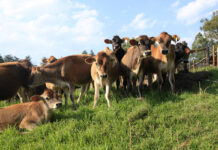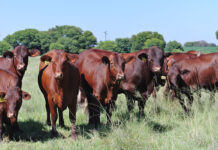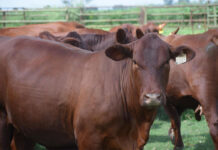

When FMD moved through a herd undergoing a Phase D growth test, as well as various stud and commercial herds at ZZ2, one of South Africa’s largest diversified agricultural businesses, notable differences were observed between cattle breeds on its extensive farms near Mooketsi in Limpopo.
Fanie Potgieter, general manager of ZZ2 Cattle Division, says when the herd undergoing the Phase D growth test contracted foot-and-mouth disease (FMD), the division was presented with an unexpected opportunity.
The outbreak occurred while a group of bulls were participating in a formal Phase D performance test, allowing the ZZ2 Cattle Division to observe how different cattle breeds responded under the same environmental and management conditions.
The observations raised important questions about adaptation, disease resilience, and the future role of indigenous genetics in South African beef production, according to Potgieter.
“We had 68 bulls in the Phase D test and halfway through the test they got FMD,” recalls Potgieter. What followed left a lasting impression. “The European breeds suffered the most. The least suffering was the Ngunis.”

Measuring performance under pressure
The outbreak affected bulls from different breed groups participating in the growth test.
Unlike many disease outbreaks where observations are largely anecdotal, ZZ2 was able to assess the impact against recorded performance information gathered during the trial by weighing the animals every 14 days.
According to Potgieter, the differences became visible in the growth data.
“If you looked at the growth graphs, the Nguni cattle took the least knock. The differences became visible in the growth data. The impact on the Ngunis appeared low and relatively short-lived,” he said.
“They lost maybe four or five kilograms in about 14 days and then they picked up again. They didn’t even realise that they were actually sick,” Potgieter points out.
The observations reinforced ZZ2 Cattle Division management’s confidence in the breed and its ability to function under local conditions.
“We became even more convinced about the Nguni,” he says.
Why did the Nguni respond differently to FMD?
The observations at ZZ2 have since developed into something more significant than a farm-level discussion.
Potgieter says the company is participating in a research initiative with the University of Pretoria aimed at investigating possible genetic factors underlying the differences observed during the outbreak.
The objective is to move beyond observation and determine whether there are measurable biological factors that could help explain the breed’s apparent resilience.
“They are going to do genomic-level research to try and determine what the cause of that is,” explains Potgieter.
While he stresses that the conclusions must ultimately come from the scientific process rather than producer opinion, he believes the findings warrant further investigation.
“We believe they will find something saying that inherently the Nguni is less susceptible, but we must allow the science to tell us that,” cautions Potgieter.
Why adaptation matters
For ZZ2, the discussion around disease resilience begins with a broader principle, namely adaptation.
The company’s cattle enterprise operates in the often-harsh conditions of the Mooketsi area of Limpopo. There, livestock contend with heat, tick pressure, rugged terrain, and seasonal climatic variation.
Across approximately 65 000ha, the ZZ2 Cattle Division manages between 4 000 and 6 000 cattle, making adaptation a practical business consideration rather than a theoretical concept.
According to Asser Mantsho, operations manager of the ZZ2 Cattle Division, cattle that perform under those conditions ultimately prove their value through production.
“You must have what is adapted and working for you. Don’t try to change the environment for the cattle. Let the cattle live and adapt in the environment. Then your costs come down and your management becomes easier,” advises Mantsho.
That philosophy increasingly shapes the division’s breeding and selection decisions.
Fertility remains king
Despite advances in performance recording, digital management systems, and genetic evaluation, Mantsho says fertility remains the single most important selection criterion within the herd.
For him, fertility is one of the clearest indicators that cattle are functioning effectively in their environment.
“If an animal can get pregnant annually, wean a calf, and conceive again, it basically means it is adapted to the environment,” Mantsho points out.
The operation follows a tightly controlled 65-day breeding season and maintains strict standards for breeding females.
“Every cow on the farm must have a calf every year. If she can’t get pregnant in that time, she doesn’t have a place on the farm.”
According to Mantsho, the cattle division currently records an average inter-calving period of approximately 398 days across all herds, with the average age at first calving being 34 months.
Mantsho notes those results are achieved under extensive conditions.
“We don’t feed. We just utilise grass and protein lick. If you can give us a calf every year from just eating grass and wean a healthy calf, then you’re adapted to the farm,” explains Mantsho.
Looking ahead
The lessons from the FMD outbreak extend beyond a single disease event.
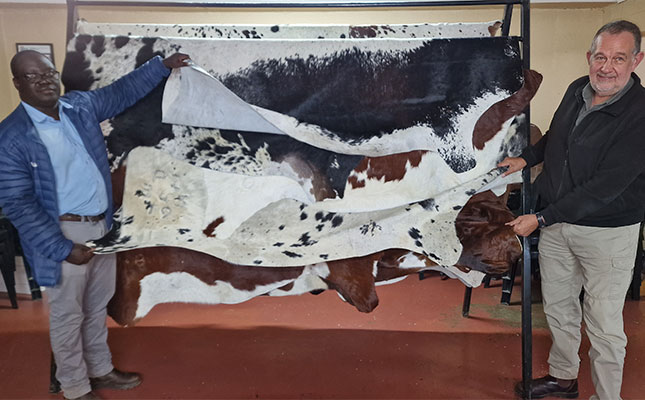
After years of evaluating cattle under the demanding conditions of the Mooketsi area, Potgieter says one conclusion continues to stand out. “The biggest lesson that I learned is that the Nguni is even better than I expected.”
Looking ahead, Potgieter believes those qualities will become even more important.
“If we have dramatic changes in climate and temperatures, then the Nguni is going to show itself as the winner in this game.”