Just 2km outside Stanford, where fynbos meets farmland against the Klein River Mountains, Rachel and Jannie Beukes are quietly pursuing their regenerative farming dream.
They launched Overberg Pastures in Tesselaarsdal in 2019 with little more than enthusiasm and a Facebook page, collecting online orders for their pasture-raised broilers and selling drum-plucked birds off a bakkie.
“It didn’t work,” recalls 27-year-old Jannie. “We had to sell our surplus live in the township. We wouldn’t get our price, and took so much care raising the chickens, only to see them carried off in plastic bags with their legs sticking out.”

In 2020, they relocated to a rented 2ha smallholding in Stanford, leasing a further 18ha from a neighbouring beef farmer.
Expansion has been organic and steady. From their first batch of 100 Arbor Acres broilers in 2019, they have increased to 700 birds per month, supplemented by growing sidelines in pork and duck production.
Social media as a growth engine
One of the biggest drivers of this expansion has been social media marketing.
“Instagram revolutionised our sales,” says Rachel. “Our biggest strength is our ethics. We don’t compromise on animal welfare or regenerative farming principles, and that’s our marketing niche. Every time we run an Instagram ad, we get 50 to 100 leads.”
Leads are added to a WhatsApp broadcast list where customers place orders for deliveries across the Overberg, Somerset West, and Cape Town’s southern suburbs.
Whole chickens sell at about R110/kg, breasts at R159/kg and thighs at R130/kg. “We do charge a premium, and most customers are happy to pay if they share our belief system. Even at this price we struggle. It’s an expensive way to farm,” adds 26-year-old Rachel.
Learning on the fly
With no formal agricultural training, the couple turned to books, online tutorials and the hard lessons of the land itself. American animal behaviour expert Temple Grandin shaped their beliefs around the humane treatment of livestock for slaughter, while ‘Pastured Poultry Profits’ by Joel Salatin is their regenerative bible.
Salatin’s rapid rotational grazing system mimics natural ecological cycles, first grazing cattle or sheep, followed by chickens. The herbivores are moved daily to a fresh section of pasture using portable electric fencing, grazing the grass down to a height favoured by chickens, stimulating root growth, and leaving behind manure.
“A few days later, mobile chicken coops are moved in. As chickens forage in the cowpats for maggots, they spread manure and add their own, fertilising the soil, stimulating root growth, and improving carbon sequestration,” explains Jannie.
Seven-week cycle
The Beukes couple follow a seven-week production cycle. This starts with sourcing 350 day-old chicks from a free-range hatchery in Caledon every two weeks.
Chicks spend two weeks in summer – or three weeks in winter – in 3m x 6m Wendy house brooders, complete with infrared lamps, waterers, and fresh wood-shaving bedding.
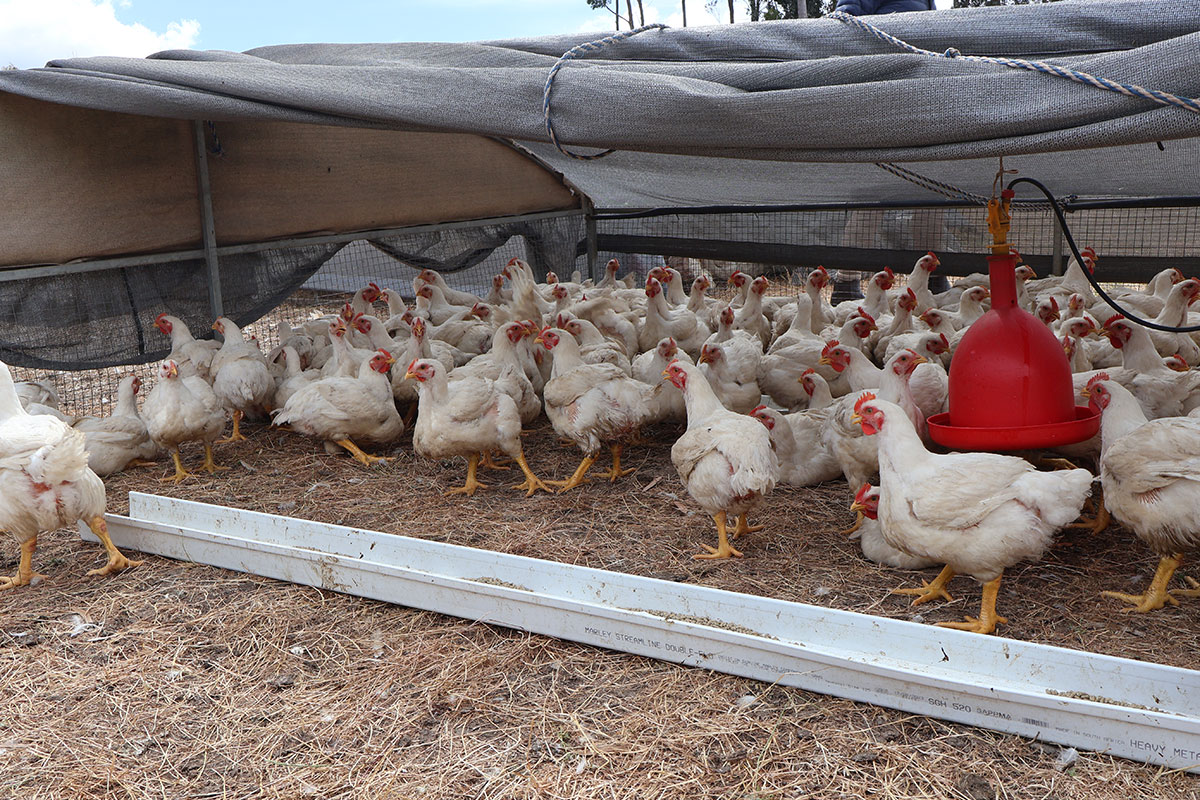
At three weeks they move into mobile, floorless coops. Manufactured by Jannie, the 4m x 4m coops are constructed of galvanised steel frames, with a light shadecloth or PVC roof, automatic bell drinkers and four feeders.
Each coop holds 150 to 175 birds and is light enough for one person to move with a dolly, yet sturdy enough to withstand storms.
“When you’re farming on a small scale, there is so little to compromise on. The one thing you can do for free is to be efficient with your time. That’s why dollies must be on wheels. It takes just 45 minutes to move and restock six mobile coops with food and water,” says Jannie.
The role of pastures
After experimenting unsuccessfully with mixing his own rations, Jannie now buys unmedicated, certified non-GMO feed ration from Eddie’s Eggs. This is complemented by foraged grasses, seeds and insects.
“Pasture-raised chickens do not rely on grass for bulk nutrition. Their diet is about 30% grasses. Grass to a chicken is like popcorn to a human. It’s tasty, but not super nutritious. It’s more like a vitamin booster,” says Jannie.
With a diet high in vitamins A, E and D and healthy omega fats, and a lifestyle of sunshine, fresh air and clean ground, these chickens taste different and have a distinctive yellow skin.
“Our birds are healthy and not full of antibiotics, hormones or animal byproducts,” says Jannie.
Finding the sweet spot
At seven weeks birds are slaughtered at Farm House Abattoir near Jongensklip. “Seven weeks is optimal for us,” says Jannie. “The birds have fuller genetic expression with full white plumage. They slaughter out at around 1,7kg. After that profitability drops because their feed intake spikes, and customers don’t want bigger birds.”
Feed, abattoir costs, and labour are the farm’s biggest expenses. “Sometimes it feels like a labour of love. There are easier ways to grow chickens, but we wouldn’t do it any other way,” says Rachel.
Looking ahead
Poultry contributes about 60% of farm income, with 20% generated by pork and duck products, and 20% from reselling locally sourced organic or regenerative produce such as beef, lamb, trout, honey, and eggs.
“We are growing. It’s just a balancing act between cash flow and time. We are developing a new website to streamline orders and customer payments,” explains Rachel.
The Beukes’ estimate they can expand to 2 000 broilers before outgrowing their current location. Their long-term dream is to own their land and close the regenerative cycle.
“The end goal of the regenerative cycle is to grow food for cows,” says Rachel. “Right now, we’re growing food for our landlord’s cattle. If we had our own herd, we could manage the pastures differently, with mob grazing, improved pasture species, and irrigation. Our audacious goal is to buy a farm, but it’s a long way off.”
For now, they continue refining their systems, improving soil health and supplying customers with chicken they’re proud of.
“We enjoy the lifestyle and get satisfaction from knowing we are doing the right thing,” says Jannie. “It’s not always financially rewarding – your biggest strength can also become your biggest weakness. But sometimes you just have to close your eyes and go for it.”
Feed schedule
- Day 2 to Week 3: Three bags of starter ad lib, with electrolytes in the water for first three days, followed by six bags of grower ad lib;
- Week 4: 115g broiler finisher (18% protein) per bird per day;
- Week 5: 140g finisher per bird per day;
- Weeks 6–7: 180g finisher per bird per day.
Hard-earned lessons
Some of their trial-and-error lessons include:
- Their early light-weight wood and sheet-metal coops blew away in a storm;
- A total of 122 birds died when new steel coops overheated in summer. Now they spray coops with water hourly when temperatures exceed 28°C;
- Raising layers for an egg producer proved too labour-intensive for too little return;
- Load shedding once forced them to heat brooders with bottles of warm water throughout the night. Now, they have solar power as a backup to Eskom;
- Cleaning brooders weekly was a gamechanger for reducing ammonia build-up and preventing respiratory issues. Mortality has dropped from 10% to 5%.
Predator control without killing
US farmer and author Joel Salatin coined the phrase: “May the whiteness of your birds blind the foxes”. However, here in the Overberg, the healthy white plumage of the birds seems to have the opposite effect of attracting predators.
“We’re the KFC of the veld,” jokes Jannie. “Raising birds outdoors attracts all sorts of predators: rooikat (caracal), honey badgers, genets, and neighbourhood dogs.”
Their solution is a chest-high electric sheep net around the coops at night. “If the rooikat comes to sniff, the shock knocks him off his feet. But we don’t shoot or trap anything. We’re part of the ecosystem.”
Ducks and pigs: two growing enterprises
While broilers remain the heart of Overberg Pastures, Rachel and Jannie are developing two promising sidelines.
Twenty-five white Pekin ducks reliably lay one egg per day, while 50 ducks are raised separately for meat production. They eat 100 to 150g of feed daily and lay economically for 280 days before being sent to cull. The meat ducks follow a similar feeding regime to the broilers and slaughter out at eight weeks.
“Our ducks are complete werf animals,” says Rachel. “They sleep in a Wendy house but in the day are free to roam to the furthest points of the farm.”
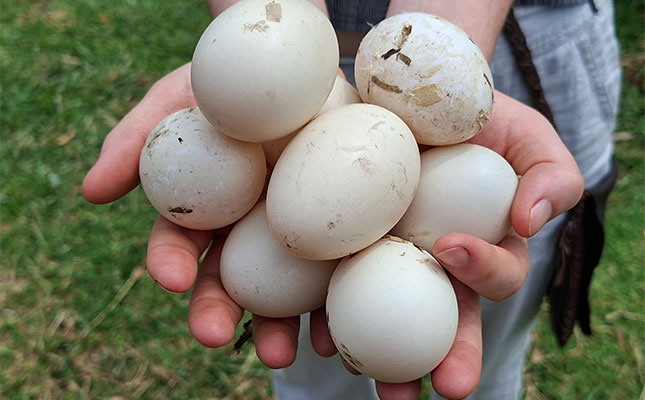
The couple hatch their own ducklings and plan to increase to 150 ducks in the next cycle.
“They’re profitable because they’re a premium product, but we’re growing slowly because we need to first establish our market.”
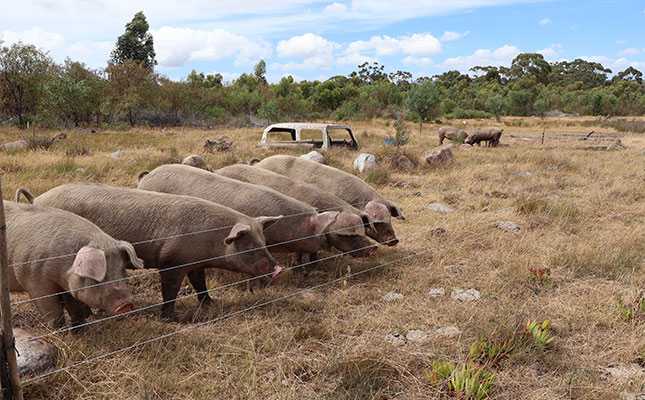
In a big step towards multispecies grazing, the Beukes’ recently added a breeding herd of six Duroc sows and a Landrace boar to their system. Electric fencing keeps pigs in two mobile yards, enriching the soil with their manure.
“With their dark skin and hardy constitutions, Durocs seem to thrive in free-range conditions. They don’t get sunburnt, they’re good on pasture, and the taste is amazing,” says Rachel.
Sows are covered every nine months, with one year between farrowing. Each sow produces about 12 piglets, with 10 typically surviving. At five months, they slaughter out at about 30kg. The Beukes couple are now growing out nine pigs to 90kg, to test dry-curing for bacon and charcuterie.
Email [email protected], Instagram: @overbergpastures, or call 082 087 6416 (Rachel) and 073 735 8845 (Jannie).