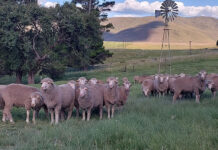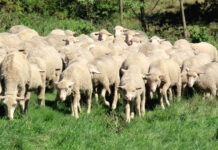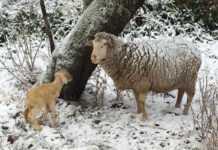


The life-size statue of a Merino ram at the entrance to Overberg Agri’s head office in Bredasdorp bears testimony to the rich wool-growing tradition of the region. However nowadays, if you see a flock of sheep grazing in the Southern Cape, they’re more likely to be Dohne Merinos.
Dirk du Toit, who runs Potberg Dohnes with his father Vlooi, says the breed is characterised by low input costs, excellent lambing percentages and high-quality wool, and consistently performs well, under good and sub-optimal conditions.
Speaking to Farmer’s Weekly at Nampo Cape in Bredasdorp, Du Toit says the breed is particularly adaptable.
“Last year was one of the driest and longest summers we’ve ever experienced. But as a stud breeder, you have to sell your genetics, and getting through the summer was tough. But we’ve just had an excellent lambing season, which just proves the point that this breed is extremely versatile,” he says.

He believes many farmers made the switch from Merinos to Dohne Merinos in order to achieve higher-quality meat production. However, the Dohne Merino is also known for its good-quality wool.
“Over the years, Dohnes have been bred to produce excellent wool. In the current market where long wool fetches excellent prices, farmers do very well with Dohne Merino wool, and we’ve seen rams producing 15- and even 14-micron fleece at the 12-month testing age,” he says.
According to Du Toit, of all its traits, the Dohne Merino’s mothering ability starkly stands out.
“Our ewes attain a lambing percentage of more than 150%, and we breed specifically to retain these characteristics.”
Bred for excellence
The Dohne Merino Breed Society of South Africa makes use of SA Stud Book’s Logix database, which gives breeders access to all genetic characteristics of all breeders in the country. Du Toit says genetic selection is non-negotiable to keep improving the breed, and access to the country’s breeders’ Best Linear Unbiased Prediction (BLUP) data makes it possible to easily see how his breeding stock compares with other breeders, as well as which breeders to approach when looking to improve particular traits.
“We focus strongly on the total weaning weight, which is the total weight of lambs weaned by a ewe during the season. The aim is to get her to a position where she can wean a lamb better than other ewes. A ewe’s ability to wean a large number of lambs of a good weight that produce high-quality wool means that she channels the maximum amount of feed we give her into producing good lambs.”
From 2020 to 2025, the top five breeding ewes of Potberg Dohnes’ weaned an average of 88,7kg per season. A focus on both total weaning weight and mothering characteristics enables the Du Toits to keep losses between lambing and weaning to only 5%.
Du Toit joined the family business six years ago, but his father has been on the farm for 52 years. Vlooi started the stud in 2000. In 2002, he bought over a well-respected Dohne Merino stud from Somerset East, which forms the basis of the current breeding stock.
In 2025, eight breeders acquired genetics from the Du Toits’ stud, and seven breeders have done the same thus far in 2026. One commercial farmer has also acquired 100 rams.
They have three lambing seasons, which run in February, July and September. Adult sheep are sheared in eight-month cycles, and lambs every six months.