
This connection between consumer needs and producer returns ran through four presentations at the World Dohne Merino Conference, recently held at the Arabella Hotel near Kleinmond in the Western Cape.
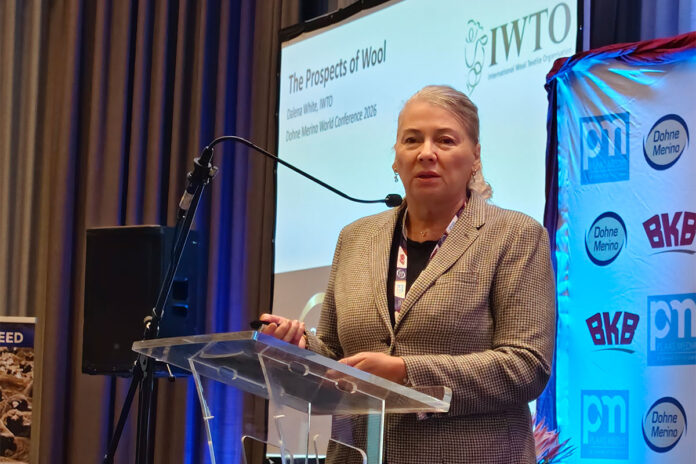
Dalena White, secretary-general of the International Wool Textile Organisation (IWTO), explored how wool’s environmental attributes are assessed and communicated. Dan Kriek, general manager of the National Wool Growers’ Association, highlighted communal flocks as a market for quality genetics.
Prof Johann Kirsten, director of the Bureau for Economic Research at Stellenbosch University, examined how origin gives Karoo Lamb a distinctive identity, while Prof Louw Hoffman of the University of Queensland explained how consumer preferences can guide improvements in lamb’s eating quality.
Together, their presentations connected breeding and production decisions on the farm with the qualities that persuade consumers to choose lamb and wool. For Dohne Merino breeders, their messages brought product development back to a practical question: are breeding and production decisions delivering what buyers need?
Making wool’s attributes count
A garment worn just seven to 10 times before being thrown away illustrates the disposable clothing culture against which wool must compete.
White cited this average in her presentation, alongside figures showing that global clothing and textile production doubled during the first 15 years of this century, outpacing population growth. She linked that expansion to low-cost polyester and a business model built around producing, buying and discarding increasing volumes of clothing.
She traced this throwaway culture to the promotion of disposable plastic products in the 1950s, when freedom from washing and reuse was marketed as a convenience. In fashion, she argued, cheap garments had helped turn that convenience into a pattern of overconsumption.
For wool, the opportunity lies in offering durable garments made from a renewable fibre that biodegrades at the end of its useful life. Yet White argued that the environmental assessment tools guiding retailers’ fibre purchases do not adequately recognise these attributes.
She singled out Ecobalyse, the European Union’s Product Environmental Footprint methodology, and the Higg Materials Sustainability Index, questioning whether their comparisons capture the full environmental consequences of choosing one fibre over another.
These tools effectively treat a sheep as a machine, she said, counting its greenhouse gas emissions and the resources used to grow its fleece without adequately recognising the natural carbon cycle supporting that production.
By comparison, she argued, the oil rig supplying raw material for synthetic fibres gets a “free ride”, with a much smaller share of its impact allocated to the fibre.
She said the assessments also fail to account adequately for microplastic pollution and the waste left when synthetic garments are discarded. These omissions, she argued, can make synthetics appear a better environmental choice and steer buyers away from wool.
“It does not reward natural textiles for being renewable and biodegradable,” she said of the current system.
These measurements also have commercial consequences because retailers use them to inform purchasing decisions, influencing which fibres reach clothing rails and consumers’ wardrobes.
White outlined IWTO’s involvement in Make the Label Count, which campaigns for fair comparisons between natural and synthetic fibres. She also discussed research into biogenic carbon accounting, distinguishing carbon circulating through plants, sheep and wool from carbon extracted from fossil sources.
IWTO’s Green Book, published in June 2026, brings together its sustainability framework and supporting research. White said further farm studies were underway internationally, with results expected in early 2027.
White urged the industry to communicate this work more widely, helping buyers understand wool’s attributes and its potential to meet consumer needs through garments that remain useful for longer.
Giving lamb a recognisable identity
Kirsten examined how origin can help consumers distinguish one product from another.
“When you want to sell something, you need to have a story, you need to have a reputation, you need to have an attribute,” he said.
His presentation traced the development of Karoo Lamb as a geographical indication, connecting its reputation to the region, its grazing vegetation and its production practices.
He explained that a geographical indication represents intellectual property shared by qualifying producers in a region. Its identity rests on the relationship between product, people and place. For farmers who can otherwise become anonymous suppliers, this offers a way to make their contribution visible.
Research involving grazing specialists, meat scientists and sensory researchers helped establish the relationship between Karoo vegetation and the meat’s distinctive flavour. Consumer research also showed that the name already carried meaning.
In the survey presented, 93,8% of 355 respondents associated Karoo Lamb with animals raised in the Karoo, while 88,5% recognised the link between grazing specific Karoo bushes and its characteristic taste.
Consumer recognition of Karoo Lamb has not yet translated into a consistent premium for farmers. Kirsten pointed to pockets of opportunity: some specialist butchers were willing to pay more, while an early retail experiment found that labelled Karoo Lamb outsold the comparison product despite a higher price. The potential was there, he argued, but securing a return for producers remained a challenge.
Measuring what consumers enjoy
Hoffman examined whether the characteristics used to trade lamb reflect what consumers enjoy eating. Weight, age, fat cover and conformation describe a carcass, he said, but do not necessarily predict tenderness, juiciness, flavour or overall enjoyment.
Australia’s experience showed the consequences of that gap. When the market rewarded heavier, leaner carcasses, breeders selected for those traits.
However, increasing lean meat yield reduced intramuscular fat, or marbling, compromising eating quality. Research involving 1 471 lambs found that selection for deeper eye muscle was associated with lower consumer scores for tenderness, flavour and overall liking.
Improving yield and eating quality together therefore requires measuring both.
Consumer testing laid the foundation for Australia’s sheep meat eating-quality programme. By 2010, it had accumulated more than 90 000 taste tests involving about 15 000 consumers, whose assessments of overall liking, flavour, tenderness and juiciness were combined into an eating-quality score.
The earlier Meat Standards Australia (MSA) pathways translated this research into controls covering farm management, handling, processing and ageing. They certified that a supply chain followed specified practices, but could not differentiate individual carcasses by eating quality.

Newer technologies help make that distinction possible. DEXA, an X-ray scanning technology, estimates the proportions of lean meat, fat and bone, while separate devices measure intramuscular fat. These measurements support predictions of eating quality for individual cuts and cooking methods.
Putting the technology into practice has proved expensive. Hoffman described Meat & Livestock Australia’s 2016 proposal for an A$150 million (about R1,7 billion) DEXA rollout across up to 90 processing plants. Disagreement over who should pay stalled the plan. An A$10 million (R117 million) co-funding offer in 2017 attracted strong interest, but only seven lamb abattoirs had installed DEXA by 2025, according to his slides.
Technical progress has also outpaced commercial rewards. Although 99,5% of lambs presented to MSA in 2024/25 met its minimum requirements, only 4,8% of Australia’s total lamb slaughter followed the full pathway. Most lamb payment grids did not reward MSA eating quality.
Hoffman also cautioned that consumers’ stated willingness to pay more does not necessarily translate into purchases: affordability still determines what they buy.
“For breeders, the challenge is to improve the qualities consumers value while securing a market that rewards the farmers delivering them,” he said.
Better genetics for a growing market
Kriek brought the product-development discussion back to the breeding animal. “A ram is also a product,” he told delegates.
He identified more than 45 000 communal farmers, managing an estimated two million to three million sheep, as a substantial market for quality genetics. Supported by years of training and advisory services, these farmers were well organised and already buying rams.
“They want access to breeders’ best animals, although financing those purchases remain a constraint,” he said.
With communal meat production still underdeveloped and room to improve both wool quality and quantity, Kriek saw a strong fit for the Dohne Merino’s dual-purpose genetics. Breeders could expand their customer base while helping farmers increase production and income.
Kriek illustrated the value of better genetics with a comparison of communal and improved rams. Improved rams produced 2,14kg of clean wool per fleece compared with 1,64kg, while fibre diameter was finer at 18,4 microns rather than 20 microns.
Together, the higher clean fleece weight and better wool price translated into clean wool income of R92,67 per fleece, compared with R60,09, a 54% increase in the figures presented.
He called for sustained funding and stronger partnerships to extend existing genetic-improvement work. This includes replacing home-grown rams with quality breeding animals and developing communal ram breeders through the Eastern Cape Stud Breeding Project, with flock competitions providing a platform for training and measuring progress.
Kriek invited Dohne breeders to help expand this work by supplying quality rams, mentoring developing breeders and supporting farmers to translate better genetics into higher production and income.