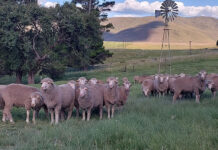

Van Kerken farms in the Makhanda district, Eastern Cape, where the Dormers run on extensive veld alongside the family’s Bonsmara cattle. He assists his father, Andrew, with the Frontier Bonsmara stud and commercial herds, and his father assists with the sheep.
The Dormers came to the farm through his father, who bought his first commercial ewes in 2004 and ran 200 of them on 10ha of irrigated pasture. Livestock theft cut the herd back to its top 25 ewes, all in lamb with twins, and these were moved onto the veld to breed rams for crossing over the family’s Merino flocks.
Van Kerken came to the farm in 2015 and was given the opportunity to register the animals and grow a stud from them. It now carries about 250 stud ewes.
The stud was built by multiplying the quality already present in those original ewes. “We didn’t need better quality ewes; we needed to multiply the good quality,” he says.
The stud ewes run on 650ha, which puts the stocking rate at roughly one sheep to 3,5ha. “It is one of the most extensively operated Dormer studs,” Van Kerken says. He regards the farming business as a stewardship and does not take the credit himself.

The breed on extensive grazing
The farm runs from mixed renosterveld through thick bush suited to goats, and up to sourveld on the higher ground. Although the area is better known for goat and game farming, the Dormer still performs.
The farm where Van Kerken works once carried around 400 Angoras. It is goat country, and that suits him. Their Dormers are adapted to these conditions and produce well with little supplementation. They are fertile in every month of the year, lamb easily and mother well, and leave strong, fast-growing lambs with useful parasite resistance that reach market weight young.
In his part of the Eastern Cape, Van Kerken says, the veld selects as hard as any breeder could, and condition score is one of his first measures when he classes ewes and rams. An animal either holds its condition on what the veld offers or it leaves.
The drought that ran from 2016 to 2019, the worst in a century of local records, did much of the selecting for him, and he now breeds from the line of ewes that came through it.
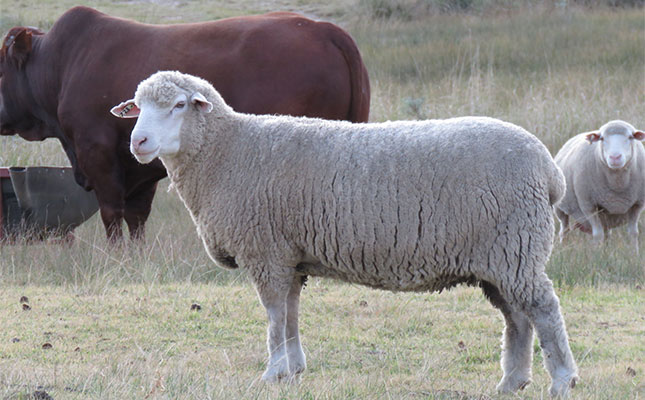
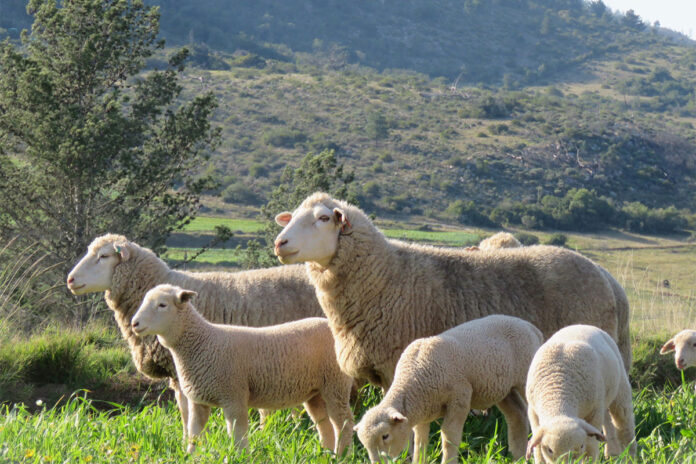
A good, functional Dormer, on his account, is a ewe that holds her condition on the veld, with a broad but feminine head carried proudly, big ears, a long body, strong legs, and a clean underline. Above all, he wants fertility.
“There is nothing more important to us than fertility,” he says.
The commercial goal is crossbreeding, and that is where Van Kerken dedicates most of his time and focus. His rams go over Merino ewes to produce slaughter lambs, and he runs Merino flocks on which no Merino ram is used at all. Young ewes are bought in, Dormer rams are put over them, and the cross does the rest.
On higher-quality grazing, the Dormer gives the strongest returns of any option he knows. On the drier, more extensive veld of the Karoo, it is used as a terminal sire over a hardy Merino ewe.
Lambing seasons
The stud runs on three lambing seasons a year, usually February to March, June to July, and October to November. The hot months from November to February are the one window Van Kerken avoids, since lambing then is too hard on ewes and lambs. Ewes born early in the year are ready to mate early the next year and lamb at its end, so the groups turn over steadily, with younger ewes coming in as older ones go out.
Mating runs for 34 to 42 days, kept as short as he can manage. He runs no multi-sire groups because the DNA testing needed to trace parentage is too costly, so each ram goes into a camp with its own group of 20 to 30 ewes. Van Kerken keeps a pedigree for every ewe on his computer and plans each mating against it, holding relatedness below about 10% to 11%.
He splits the ewes into five or six groups to put the right ram over the right ewe, which also lifts the number of ewes a ram can cover. Line breeding, he says, is worth doing on one trait only, fertility, and then only down the maternal line.
Young ewes go to the ram at around 12 months for 42 days, and any that fail to conceive are sold. Young rams are used from nine months, since Van Kerken is eager to see new genetics work. His culling is strictest on conception. A ewe that fails to lamb within 365 days is culled at once, as is a young ewe that has not lambed by 22 months. He is unequivocal in culling animals with poor fertility.
Lambing in the February-to-March season runs above 160% on phosphate licks alone, and Van Kerken has lifted the lambing percentage from around 130% to 160% through selection. Weaning percentages move with the season, predators, and heartwater. Ewes carrying triplets are managed by hand, and he almost always lifts the smallest of the three and fosters it onto a mature ewe.
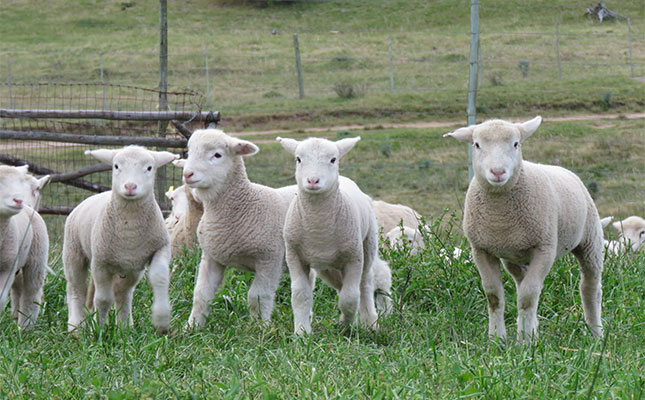
The cycle is kept flexible. If a season is poor, he holds ewes over and runs a 10 month interval rather than the usual eight. The exceptional season of the past year, the best since 1976, pulled many ewes forward onto seven- and eight-month cycles instead. When the first rain came in March, he pushed extra ewes into the group, including young ones two months shy of the usual age, and the farm was lambing heavily as a result.
“Flexibility has probably been our biggest key. You need to read the circumstances,” he says.
Feeding is kept low. The livestock are there to turn low-quality grass into a high-quality product, and Van Kerken relies on that rather than the feed trough. Ewes get a phosphate lick year round and a production lick while lactating, which the lambs learn to eat alongside them. A small area of dryland oats is held back for young ewes with twins and for young lambs, and a winter mineral lick is used only when it turns very dry.
“Supplementing ewes with basic requirements is acceptable, but buying in roughage and energy greatly reduces profits,” he adds.
That approach carries into how he grows out rams. They are not fed at all until nine to 10 months, so they build a skeletal frame before they carry weight, and he takes the same view he applies to the family’s Bonsmara bulls: an animal grazing naturally and gets mineral supplement does not get overfat.
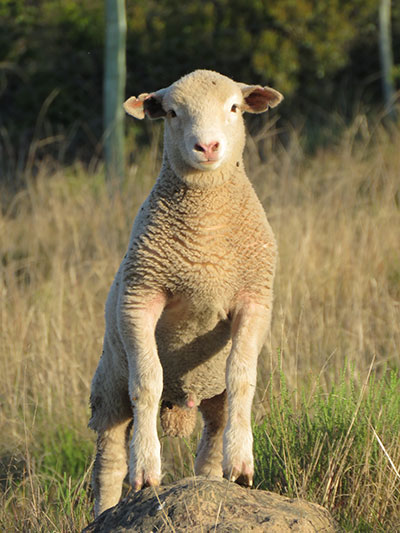
Lambs are weaned between 85 and 105 days at an average of 32kg to 36kg, off a production lick and with no creep feed, from a birthweight of 4,3kg to 4,6kg. Young rams are classed at weaning, run through an extensive veld test on a lick, then shorn, weighed, scored for conformation, and inspected by a breed representative at nine to 10 months.
Van Kerken uses breeding values as a check rather than a starting point, preferring growth values between 95 and 105 with a reproduction index above 100, but he trusts the ewe he knows over the figure on the page.
Health management
Heartwater is the heaviest health burden on the farm, and Van Kerken doses his small stock against it every 10 to 14 days. Disease otherwise stays well controlled.
He keeps risk low by not speculating on animals and buying only from reputable breeders. He has seen no disease carried across from the game farms that now surround him, though he notes that game keeps heartwater in the veld.
Predators are the larger problem and the main cause of lamb losses. The spread of game farming across the Eastern Cape has brought jackals and other predators with it, and van Kerken controls them himself, hunting several nights a week with thermal equipment on his own farm and on neighbouring ones.
He brought in helicopters and professional hunters when the family first moved to the farm, then learned to do the work himself, and keeps his skills current with courses.
“If you can’t shoot, you can’t make it with small stock,” he says.
Game also drives up fencing costs, since warthogs and other animals dig under the wire, and a staff team has worked on fences alone for more than a decade.
The road ahead
Van Kerken’s current breeding target is to bring his ewes’ mature weight down from 85kg to 78kg without giving up weaning or post-weaning growth, aiming for an earlier-maturing sheep that puts on condition well. On the veld itself, he works each year to lift carrying capacity by burning and spraying invasive species, and improving grazing. A young Boer goat herd, only two or three years old, is an early move into stock better suited to the bush.
The commercial side is where he wants the growth. Van Kerken sells 70 to 85 rams a year into Merino flocks, running from the Karoo around Graaff-Reinet and Steytlerville to the Winterberg Mountains near Bedford and Adelaide, and his stated aim is to double those commercial sales by 2031.
For now, the focus remains the same. Van Kerken keeps selecting for fertility, grows his rams out steadily on the veld, and sends them to do the job over commercial Merino ewes. This leaves more live lambs, and heavier ones, than the ewes would raise on their own.
For more information, phone Thomas van Kerken on 071 883 0620.