
Weed control is often presented as a choice between mechanical and chemical methods. But Louise Bestbier, agricultural scientist at Stellenbosch University’s Department of Agronomy, says successful weed management is rarely about choosing one approach over another.
Instead, it depends on combining different practices so that weeds are placed under pressure at several stages of their life cycle. Bestbier compares it with trying to lose weight.
“You can’t just eat less and expect everything else to fall into place. You also need to eat properly, exercise, get enough sleep and stay hydrated. Weed management works in much the same way – you need a holistic approach.”
This has become increasingly important with the switch to conservation farming practices.
The conservation farming challenge
Bestbier explains that under conventional cropping systems, cultivation itself contributes to weed control. Ploughing and other soil-working operations uproot weeds and redistribute weed seed through the soil profile, with some seed buried deeply enough to prevent or delay emergence.
As farmers move towards conservation agriculture, however, they deliberately reduce soil disturbance to protect soil structure, conserve moisture, limit erosion and keep crop residues on the soil surface. In doing so, they also remove one of the weed-control functions that cultivation previously performed.
Herbicides increasingly take over that role. They allow farmers to control weeds before planting, and within the crop without disturbing the soil, making them particularly well suited to conservation agriculture systems.

The problem arises when too much of the weed-control burden shifts onto chemistry. Repeated reliance on herbicides increases selection pressure for resistance, particularly in troublesome weeds such as ryegrass. This means farmers increasingly need to look beyond spraying alone.
The answer is not simply to return to intensive tillage. “Instead, farmers need to reconsider the range of tools available to them – from strategic cultivation and grazing to crop competition, cover crops and seedbank management – and use these alongside chemistry,” says Bestbier.
Old tools can still have a place
One option is to reconsider some of the tools that were largely sidelined with the move towards conservation agriculture, but to use them much more strategically.
Tillage is one example. Bestbier says this does not mean farmers should return to routinely cultivating entire fields. Rather, tillage can form part of the toolbox, where weed pressure or the seedbank becomes severe enough to justify intervention.
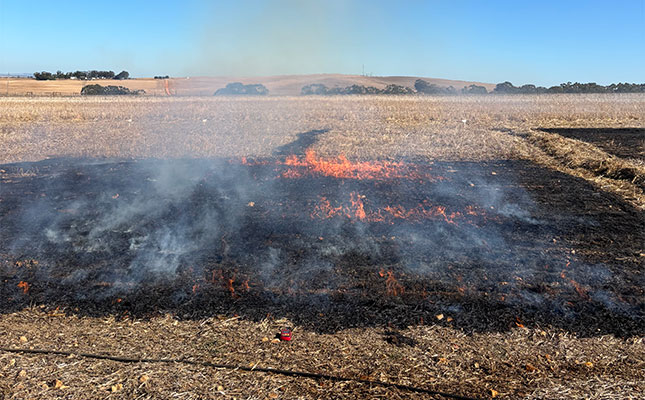
The same applies to burning. Instead of burning an entire land as in the ‘old days’, fire can be confined to narrow windrows to destroy weed seed while limiting the area exposed to heat and, in turn, the impact on soil health.
Stellenbosch University MSc student Kaylen van Wyk evaluated this approach at Langgewens Research Farm near Moorreesburg in the Swartland.
Her project, which ran over two seasons, included chaff tramlining and narrow windrow burning. So far, both treatments have shown visible differences in weed populations compared with the control, although the differences are not yet statistically significant.
The trials were conducted in areas with very high weed seed pressure, so Van Wyk says significant changes were not expected over just two seasons. The aim is rather to gradually reduce the seedbank through repeated intervention over several years.
Concentrating weed seed
For chaff lining or narrow windrowing, a chute fitted to the back of the harvester directs material containing weed seed into a strip roughly 500mm to 600mm wide instead of spreading it across the field.
Keeping the seed within a narrow band increases competition and overshadowing among emerging weeds, while making these areas easier to monitor and manage.
Narrow windrow burning takes the approach a step further by burning the concentrated residue to destroy the weed seed it contains. Van Wyk says temperatures above 400°C have been recorded in the windrows during their trials, which is sufficient to destroy ryegrass seed.
The research further revealed that the windrows accounted for less than 10% of the cropped area, meaning the amount of soil exposed to fire is substantially smaller than when an entire land is burnt.
“For a farmer who is worried about affecting soil health, narrow windrow burning is a better option than burning the whole land. So, if you are struggling with herbicide resistance this might be another tool to help you get weeds under control,” she says. Farmers wanting to burn windrows would need to acquire burning permits.
Harvest weed seed control
Chaff lining and narrow windrow burning form part of a broader group of practices known as harvest weed seed control.
The approach was developed extensively in Australia as herbicide-resistant annual ryegrass became increasingly difficult to manage. Rather than allowing weeds that survive the chemical programme to pass through the harvester and have their seed spread back onto the land, harvest weed seed control captures, concentrates or destroys that seed at harvest.
One of the best-known technologies is the Harrington Seed Destructor, which uses an impact mill to pulverise weed seed contained in the chaff fraction before the residue is returned to the field.
This does not form part of Van Wyk’s project but is also being investigated at Stellenbosch University. Chaff containing weed seed will be collected at harvest, milled to crush the seed, and then returned to trial plots to simulate the effect of the mill.
The research should provide an indication of whether this type of Australian seed-destruction technology could have a place under Western Cape grain-production conditions.
Bring back the animal factor
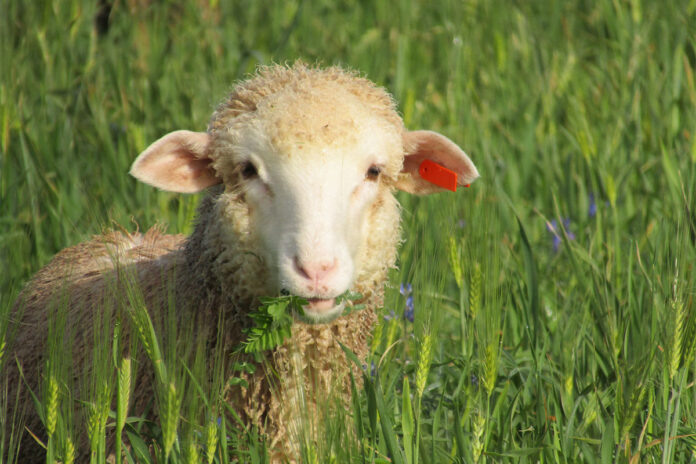
Livestock offer another way of doing this, reducing weed pressure. Many grain producers moved away from animals a decade or two ago, partly because of concerns over soil compaction and increasing specialisation.
That is changing now, with livestock being reintroduced to help with nutrient cycling, adding value to cover crops and crop residues, and suppressing weeds.
“Livestock not only allows farmers to diversify their income, but are excellent weed eliminators,” says Bestbier.
Timing, however, is critical. Weed seed can remain viable after passing through an animal’s digestive system and be deposited elsewhere in the dung. This risk is reduced if animals graze weeds while they are still young and before they set seed.
“You want the animals to eat the weeds before they shoot seed, which is actually not that difficult because they prefer the plants at that younger, more palatable stage,” she says.
Bestbier has seen this in her own research involving sheep in medic-wheat rotations, where grazing helps reduce ryegrass and other weed populations.
For farmers concerned about soil compaction from grazing animals, baling offers another option. Crop residues, chaff and weed seed can be collected and removed from the field at harvest, rather than being returned to the soil.
In Australia, so-called bale-direct systems attach a baler to the harvester so that straw and chaff containing weed seed are baled immediately. The material can then be used or sold as livestock feed, while removing a proportion of the weed seed that would otherwise replenish the seedbank.
Make the crop do some of the work
Farmers can also make the crop itself more competitive. Bestbier says planting density and cultivar choice can play an important role in determining how much space weeds have to establish.
A vigorous cultivar planted at a higher density can establish a canopy more quickly and compete more strongly with weeds for light, water, nutrients and space.
“You want your crop to outcompete the weeds,” she says.
This does not necessarily eliminate weeds, but it can suppress their growth and, importantly, reduce their ability to produce seed.
Competition from cover crops
Cover crops work on a similar principle. Bestbier says the goal in orchards and vineyards does not necessarily have to be bare soil.
Ryegrass is not indigenous to South Africa, and allowing a more diverse plant community to establish may create opportunities for other species, including indigenous plants, to compete with and potentially displace it over time.
This may be particularly useful where resistant ryegrass carries a fitness penalty, as some resistant plants can be less vigorous or competitive than susceptible ones in the absence of herbicide pressure.
Bestbier says resistance can still spread through pollen, but the chances of resistant and non-resistant ryegrass successfully reproducing are relatively low.
This nevertheless makes it important to control resistant plants before they flower and set seed, limiting both pollen movement and the return of resistant seed to the soil.
Cover crops offer a more deliberate way of increasing competition. Bestbier favours mixtures rather than a single species or natural vegetation, as different plants bring different benefits, and compete with weeds for light, water, nutrients and space.
Where livestock form part of the system, these mixtures can also be grazed, adding another layer of weed control.
Improved precision
Precision agriculture could make both mechanical and chemical weed control more targeted.
Weed mapping, camera-based detection and increasingly sophisticated application equipment can help farmers identify where weeds occur and treat only those areas, rather than applying the same intervention across an entire field.
But Bestbier says precision is also about getting the basics right. Farmers do not always spray weeds at the optimum growth stage or under favourable conditions. Wind, temperature and rainfall can all affect application and herbicide performance, making both timing and weather conditions critical to achieving good control.
Farmers can also be overly dependent on chemical representatives for advice and fail to spot when problems arise. For instance, when a product starts losing efficacy and the response is to increase the dosage or apply it repeatedly.
“If something is no longer working because of resistance, doing more of the same thing is not going to solve the problem,” she says.
This does not mean farmers are careless about chemical use. Bestbier says most producers are highly environmentally conscious, while the high cost of herbicides gives them little incentive to spray unnecessarily.
The aim should therefore be to use chemistry more precisely – applying the right product, at the right rate and growth stage, and under conditions that favour effective application, while recognising poor control early and bringing in other interventions where chemistry is no longer doing the job.
Don’t make chemistry do all the work
None of this means herbicides are becoming less important. They remain one of the fastest and most practical ways of controlling weeds across large areas, particularly within conservation-agriculture systems where farmers want to minimise soil disturbance.
Every weed removed by grazing, suppressed through crop competition, destroyed mechanically or prevented from setting seed is one less plant that has to be controlled by a herbicide.
Instead of asking whether mechanical or chemical control is better, farmers need to consider where each tool adds the most value, and how using several tools together can help preserve the effectiveness of those they still have.
Precision takes the pressure off chemistry
Precision technology could help farmers make the chemical component of integrated weed management far more targeted.
Instead of blanket-spraying entire fields, application systems are increasingly moving towards treating weed patches and, ultimately, individual plants, according to Nico Myburgh, CNH head of precision technologies for the Middle East and Africa.
He says precision spraying has evolved significantly over the past 15 years. The first major step was section control, which automatically switches off parts of a spray boom where product has already been applied, reducing overlap and chemical wastage by about 5% to 10%, depending on field shape and operator accuracy.
The next step is individual-nozzle control. Raven’s Hawkeye 2 system, for example, can control up to 192 nozzles separately and maintain application within about 5% of the target rate, improving accuracy across turns and changing speeds while reducing skips and overlaps.
From maps to real-time decisions
Precision spraying is now progressing towards real-time decision-making.
Satellite and drone imagery can identify areas requiring treatment beforehand, while newer systems such as Augmenta, which forms the foundation behind CNH SenseApply, uses a cab-mounted multispectral camera and artificial intelligence to assess field conditions and adjust applications as the sprayer moves through the field.
“The sprayer effectively becomes its own scouting platform,” says Myburgh.
Current commercial systems are particularly effective at green-on-brown detection, where green weeds stand out against bare soil or crop residue. Distinguishing weeds from a growing crop remains more challenging, although Myburgh expects machine vision to increasingly enable species-level identification.
“The industry is moving from spraying fields to treating individual plants,” he says.

Savings without compromising control
Importantly, he emphasises that selective spraying does not mean applying weaker herbicide doses. Herbicides should still be applied at the recommended rate where weeds occur. Savings come from leaving weed-free areas untreated, reducing overall chemical and water use without compromising control.
The actual saving will depend on weed pressure and field conditions, but Myburgh says even a 10% to 20% reduction in chemical use can create a compelling business case where spraying programmes cost several hundred rand per hectare.
South African farmers already have access to technologies ranging from section and variable rate control to individual nozzle systems, and drone scouting and spraying. AI-driven selective spraying remains at an earlier stage of adoption, largely because of cost.
Over the next five years, Myburgh expects closer integration between satellites, drones and ground-based machinery, along with better plant identification and greater automation.
“The long-term vision is that every droplet applied has a justified agronomic reason for being applied.”
Satellites turn ordinary sprayers into spot sprayers
South African farmers could soon turn an existing section-control sprayer into a spot sprayer using a weed map generated from space.
Tiaan Venter, co-founder of FarmLink Capital, says WeedSAT relies on an ultra-high ground resolution of 30cm by 30cm, which allows it to accurately detect weeds that are 30 cm or larger. The technology is also actively moving toward a finer 10cm resolution, rather than the 60 cm cited.
The Australian-developed technology converts this information into a map that guides the sprayer to areas requiring treatment.
“It is essentially a weed prescription-map generator,” says Venter.
FarmLink is the local implementation partner for Datafarming, the owners of WeedSAT, and is testing the technology under South African conditions. Commercialisation here is targeted for before the winter rainfall planting season starts around April/May 2027.
How the system works
The current system uses green-on-brown detection, making it suited to patchy weed control after harvest, before planting or shortly after planting. It cannot identify individual weed species or distinguish ryegrass from wheat or other crops once a crop is established.
Once a map is generated, it can be loaded onto a sprayer fitted with section control, which switches sections on and off according to where weeds occur. This avoids the need for additional cameras or sensors on the machine.
“If you already have section control, which has been around for more than 15 years, you already have much of the technology you need,” says Venter.
When spot spraying pays
The economics are strongest where weeds occur in patches and large areas can remain untreated.
“I will stick to blanket control if you still have to manage weed in 80% of the land,” he says.
Some Australian users report spraying-cost reductions of up to 80% thanks to the technology, but Venter says savings of around 50% to 60% have been more realistic in South African testing so far.
South African pricing has not yet been finalised and is expected to work on a sliding scale according to area mapped. In Australia, Venter says the technology costs around A$4 to A$7/ha (around R46/ha to R81/ha).
For more information, email Louise Bestbier at [email protected]