

Once a wheat crop is established, farmers face a crucial question: is the crop receiving enough nutrients to reach its potential, or is something preventing it from using the nutrients already available?
While nitrogen generally receives the most attention during the growing season, research suggests that the greatest limitation to crop performance may lie elsewhere. Applying additional nitrogen when other nutrients are out of balance can leave the plant accumulating nitrogen rather than converting it into protein.
According to Charles le Roux, commercial manager at Diagnosis and Recommendation Integrated System (DRIS), farmers need to look beyond the amount of nitrogen applied and consider how efficiently the crop uses it.
“The in-season nitrogen decision should start with conversion. A crop with nitrate and nitrite building up but a low conversion score needs its partners first: molybdenum, sulphur, phosphorus, potassium and copper in proportion. A crop that converts well and is short of nitrogen is the one that will pay for the next application.”
This conclusion emerged from DRIS’s analysis of paired sap and tissue samples collected from irrigated and dryland wheat during the 2026 season. One of the most significant findings was that in 85% of cases where a nutrient was identified to be among the three most limiting to crop performance, that nutrient was still within the published sufficiency range for wheat.
Le Roux notes that this raises an important question about how farmers interpret conventional leaf analyses. “A conventional analysis measures individual nutrients against established sufficiency ranges. If the concentration falls within the prescribed range, it is considered adequate.
“However, nutrients do not function independently. Nitrogen can only be converted into protein efficiently if sufficient sulphur, phosphorus and molybdenum are available. Similarly, excessive magnesium can restrict potassium uptake.”
DRIS therefore advises that farmers evaluate the ratios between nutrients in the leaf, comparing them with those found in high-yielding wheat crops. “It is important to look at which nutrients are most out of balance and rank them according to their potential to limit crop performance.
“A sufficiency test tells a farmer a nutrient is present. But they need to understand which nutrient is holding the crop back, in what order, and whether the plant is moving it now. Only once this information has been obtained, can a farmer make an informed decision about in-season nutrient applications,” Le Roux explains.
The DRIS system combines tissue analysis, which reflects nutrients accumulated over several weeks, with sap analysis, which indicates what the plant is currently transporting.
During the 2026 season analysis, the two methods agreed on whether a nutrient was deficient, adequate or excessive in only four out of every 10 readings. In half the readings, sap analysis identified a shortage that tissue analysis did not.
Calcium and manganese were particularly notable, with shortages detected in sap but not tissue in more than 90% of samples.
The nutrients farmers are overlooking
Although nitrogen, phosphorus and potassium generally dominate fertiliser programmes, Le Roux’s findings indicate that other nutrients frequently limit wheat performance.
Calcium emerged as the most common limitation, ranking first in approximately a third of samples and among the three most limiting nutrients in 65%. Yet calcium was within conventional sufficiency ranges in 99% of samples.
“Calcium maintains cell walls and membranes, supports root function and protects roots against aluminium toxicity. Because it moves through the plant with the transpiration stream, poor root activity or crop stress can quickly affect its availability. Crops with calcium levels better balanced against other nutrients generally recorded higher plant performance,” Le Roux explains.
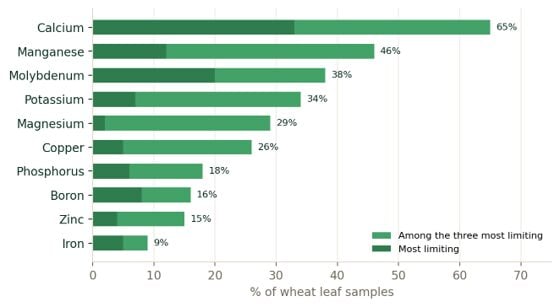
Manganese, molybdenum, potassium, magnesium and copper were also frequently identified as limiting nutrients, although their importance varied according to soil conditions.
On more acidic soils, molybdenum became a greater limitation. On an alkaline irrigated estate, manganese and phosphorus were more prominent, while molybdenum moved further down the list.
Le Roux says that the nutrient that limits a crop is often not the one the farmer is watching.
“Calcium rarely appears on an in-season programme because it reads ‘adequate’. DRIS ranks it in proportion to the rest, and in this season’s wheat it ended up first on the list of inadequate levels.”
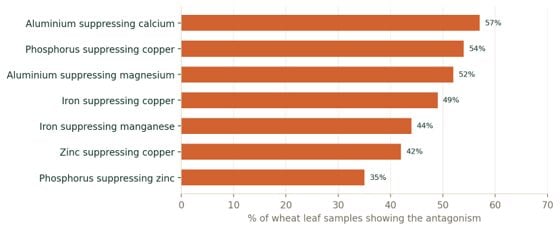
Another concern is the extent to which nutrients interfere with one another. Le Roux identified an average of six to seven nutrient antagonisms per wheat sample. An antagonism occurs when one nutrient, present in excess relative to another, restricts its uptake or use.
Aluminium suppressing calcium was identified in 57% of samples, while phosphorus suppressing copper occurred in 54%. Aluminium suppressing magnesium, iron suppressing copper and manganese, and zinc suppressing copper were also common.
Le Roux notes that these interactions have significant implications for corrective fertiliser applications. “For example, if copper is deficient because excessive zinc or phosphorus is restricting its uptake, applying additional copper may temporarily increase its concentration without resolving the underlying problem.
“On one estate, zinc supplied through seed treatment and several foliar products was suppressing copper in 63% of samples and phosphorus in 48%. A calcium-magnesium product applied at heading was also adding magnesium where it was already suppressing calcium in 92% of samples.”
Le Roux cautions against treating individual deficiencies without understanding what caused them. “Single-nutrient fixes can make the balance worse. It’s best to identify the antagonist and the nutrients around it, so the correction starts with what to stop, then lifts the whole profile. That is the practical difference between managing nutrients by balance and topping up whatever reads low.”
Correcting an antagonism therefore requires farmers to stop adding nutrients already in excess and improve the balance of those that work together.
Making nitrogen applications count
Nitrogen remains central to wheat production, particularly because of its influence on protein. However, Le Roux’s findings suggest that farmers should establish whether the crop is converting nitrogen efficiently before deciding to apply more.
“Wheat absorbs nitrogen mainly as nitrate, with some taken up as ammonium. Inside the plant, nitrate is converted into nitrite, then ammonium, before being incorporated into amino acids and ultimately protein. Each stage requires supporting nutrients.
“Molybdenum is necessary for converting nitrate to nitrite, while iron supports the next conversion step. Magnesium and phosphorus help convert ammonium into amino acids, while sulphur is essential for protein formation. Potassium assists in moving nitrate through the plant.
“If these nutrients are deficient, conversion can slow, leaving nitrate and nitrite accumulating rather than being incorporated into protein,” says le Roux.
To investigate this relationship, DRIS compared the quarter of wheat samples showing the best nitrogen conversion with the quarter showing the poorest conversion on the same farms. The better-converting crops achieved a nitrogen conversion score of 59, compared with 29 in the poorest-converting group.
They also had substantially better nutrient balance, with a DRIS balance index of 61 compared with 103, where a lower score indicates better balance.
Plant performance scores were 74 in the best nitrogen conversion group compared with 64 in the poorest conversion group, while protein indicators were 91 and 80 respectively.
The better-converting crops also recorded higher Brix readings of 9,5 compared with 7,9. Brix measures soluble solids in plant sap and, in this dataset, was associated with nitrogen conversion and plant performance within individual farms.
The poorer-converting crops had relatively lower phosphorus, sulphur, potassium and copper levels, alongside higher aluminium concentrations.
Despite nitrogen being relatively short compared with other nutrients, more of it remained in the leaves as nitrate and nitrite.
Nitrite accumulation was particularly closely associated with poor conversion and was higher where molybdenum was relatively deficient.
Le Roux explains that when a helper is short, nitrogen stalls at that step.
“Nitrate and nitrite build up in the sap, the conversion score falls, and protein lags behind the nitrogen the crop has taken up. Adding more nitrogen at that point adds to the backlog.”
The same principle applies to late-season nitrogen applications aimed at improving protein. DRIS found that protein was most closely associated with the balance between nitrogen, phosphorus and sulphur, followed by potassium and copper.
Sulphur is particularly important because it forms part of the storage proteins that influence wheat’s baking quality.
Where sulphur or phosphorus is inadequate, applying additional nitrogen may not achieve the intended improvement in protein.
This makes nutrient analysis particularly valuable before committing money to further nitrogen applications.
Adjusting nutrition as the crop develops
A wheat crop’s nutritional requirements change throughout the growing season. Nutrients that limit growth during tillering may no longer be the greatest constraint at heading, while new deficiencies can emerge as the crop develops.
Le Roux demonstrated this through repeated sampling on an irrigated wheat estate at three growth stages. During early growth, calcium was the primary limiting nutrient in 75% of samples. This declined to 51% during the middle of the season and just 5% at the late sampling stage.
Manganese followed the opposite pattern, increasing from the primary limitation in 5% of early samples to 43% at the late stage.
Phosphorus also became increasingly limiting, rising from 0% early in the season to 38% at heading.
At the same time, nitrogen conversion declined from a score of 43 early in the season to 37 during mid-season and 32 later.
Brix readings fell from 9,6 to 8,3, while magnesium suppressing potassium increased from 27% to 95% of samples.
These changes illustrate why a nutrition programme based on a single early-season analysis may fail to address limitations that develop later. Le Roux therefore recommends sampling at least three times during the season.
“The first sampling should take place during tillering to establish the crop’s initial nutrient balance and identify early limitations. A second analysis during stem elongation to boot stage provides an opportunity to identify changing deficiencies while there is still time for corrective action. A third sampling at heading can establish whether earlier corrections have worked and help guide final decisions relating to protein production.”
Samples should consistently be taken from the youngest fully mature leaf, at the same time of day and from the same zones within the field.
Le Roux notes that monitoring is what turns a leaf test into crop management. “Each sample shows where the balance is heading, so corrections can go on while the crop can still respond.”
Although these stage-specific findings were obtained from irrigated wheat, the pattern needs to be checked under dryland conditions, where moisture availability and seasonal development differ.
Another important consideration is whether apparent nutrient deficiencies are being caused by conditions that restrict root activity or nutrient uptake.
Le Roux found that the most-stressed quarter of samples recorded a nitrogen conversion score of 40, compared with 50 in the least-stressed quarter.
Plant performance scores were 67 compared with 75, while protein indicators were 84 compared with 89.
Higher aluminium concentrations and relatively lower potassium, sulphur and nitrogen were associated with greater nutrient stress.
Aluminium in leaf samples can indicate acidity in the root zone, including subsoil acidity that may not be evident from a topsoil analysis.
Excessive aluminium can damage root tips, reducing the plant’s ability to absorb water and nutrients. It can also interfere with calcium uptake.
Under these conditions, applying more fertiliser without addressing the underlying problem may be ineffective.
Le Roux advises that a rising stress index accompanied by elevated aluminium should prompt an investigation into root-zone acidity and calcium balance rather than another foliar application.
Similarly, potassium and sulphur deficiencies can reduce the crop’s ability to regulate water use and produce protein, increasing its vulnerability to environmental stress.
The practical value of nutrient analysis therefore lies in distinguishing between a genuine shortage, an imbalance and a problem that prevents the plant from accessing nutrients already present.
Across the 2026 samples, calcium was classified as clearly deficient in 49% of cases, molybdenum in 46%, manganese in 44% and copper in 34%. By comparison, nitrogen was clearly deficient in only 1% of samples, sulphur in 3% and phosphorus in 14%.
But Le Roux cautions that this does not mean nitrogen requirements can be reduced indiscriminately. “Wheat needs substantial quantities of nitrogen, and most samples showed nitrogen to be slightly deficient.
“Rather, the results suggest that nutrients required in relatively small quantities can be overlooked when programmes concentrate predominantly on major nutrients. For farmers, the first step after receiving an analysis should therefore be to identify the most limiting nutrient and determine whether its availability is being restricted by another nutrient.”
Nitrogen conversion should be assessed before deciding on further nitrogen applications, while elevated aluminium or nutrient stress indicators should prompt closer examination of root-zone conditions.
Importantly, corrections should be followed by another analysis to establish whether nutrient balance has improved and whether a different nutrient has become limiting.
Le Roux concludes that balance-based monitoring does not mean spending more.
“It means spending where the crop needs it: less on nutrients already in proportion or in excess, more on the ones the ranking puts at the top. Measure, diagnose, correct and measure again, and the programme improves each season with the farm’s own data.”
For more information, email Charles le Roux at [email protected].