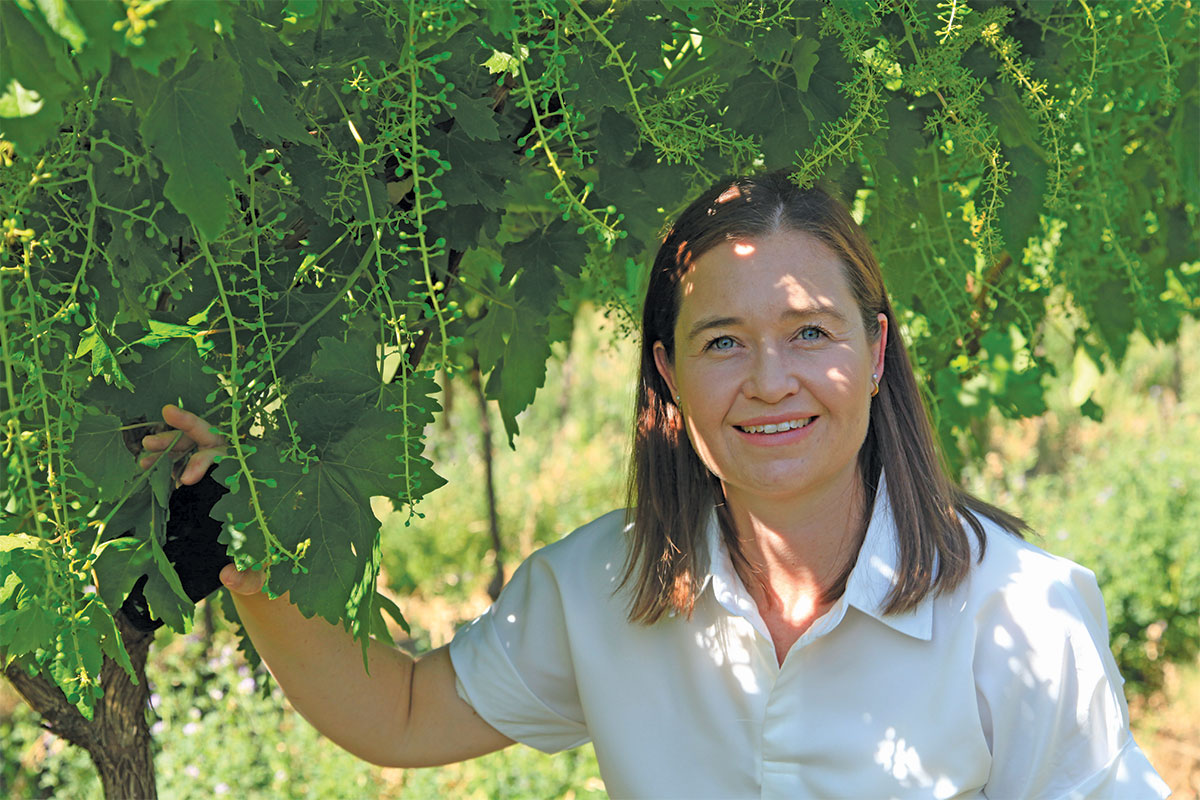
Alcois Blaauw never really thought of farming as a career, so she studied public relations after school. But when her husband, Wicus Blaauw, ended his rugby career due to injuries, she had to leave her high-flying corporate job in Edinburgh, Scotland, and find work back home in South Africa.
When she phoned her father, Francois du Toit, with the news, he responded that he was looking for someone to help with the administration at Du Toit Landgoed, their family farm, on Kanoneiland in the Green Kalahari, and asked if she would be interested in the job.
That first year, 2015, was like a baptism of fire.
“It was February, so we went from 1°C in Britain to over 40°C in a matter of days, and I was responsible for everything from paying wages and drawing up budgets to managing logistics, VAT, traceability and record-keeping. My father could not help much, as it was peak season and he was fully occupied in the vineyards,” Blaauw recalls.
Over time, she found her feet, and the farm invested in Xero accounting software, which automates much of the admin and budgeting. This made day-to-day operations far more manageable and allowed Blaauw to take a more active role in the farming side of the business, although the office remains her main responsibility.
Farming as a passion
What started as a job quickly became a passion she had never anticipated. “Farming was not a career I ever thought I would choose, but somehow it chose me – and it turned into a genuine passion for the land, the vines, and the rhythms of farm life,” says Blaauw.
She attributes much of her success and love for agriculture to her father, who involved her and her older sister, Marli du Toit, in farming activities from a young age. Marli also ended up following a career in agriculture, working at Lona Citrus as a food safety and compliance manager.
“On Saturdays and Sundays, we would go with my father to check the flood irrigation, and during summer holidays we helped wherever we could – whether in the vineyards, the packhouse or on the logistics side,” she recalls.

“I remember one Christmas Eve when I was in high school, wondering what other families were doing while we were checking all the keys and getting ready for the table grape season. It never felt like work, it was simply part of life.”
Alongside managing the farm, Blaauw and her father – like her grandfather and great-grandfather before them – are actively involved in the Kanoneiland community and regularly attend SA Raisins workshops, information sessions, and farmer days.
“These events allow you to stay up to date with market and production trends, learn from other farmers, and exchange ideas. They have helped me become a better farmer,” she says.
Blaauw also sees her connection with people as a contributor to her success: “I enjoy getting to know our workers, understanding what they need, and creating an environment where everyone feels valued. Farming is a team effort, and building good relationships helps the whole farm run more smoothly.”
Farming operations
Du Toit stopped producing table grapes around 2009 due to rising production costs, particularly labour and packaging. Since then, he has focused on wine and dried grape production, with about 50ha of vineyards and other crops, including lucerne and cotton , currently under cultivation.
To diversify income and balance the seasonality of grape production, Du Toit offers earthwork services, including laser levelling for flood-irrigated lands along the Orange River.
“Laser levelling ensures the water flows at the correct slope, typically 0,05% to 0,2%, which helps control the flow rate and ensures uniform coverage. It also improves infiltration and reduces run-off and erosion,” he explains.
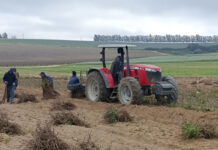
He was also the first in the region to purchase a mini excavator to dig holes for new vines, and rents out discing and ripping services to support land preparation.
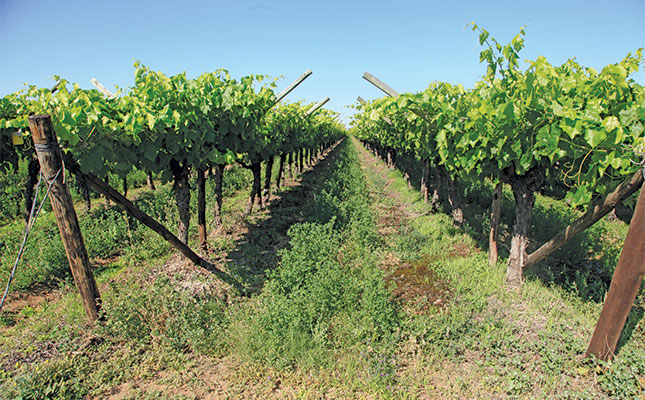
Between the vineyard rows, they plant lucerne as a cover crop, helping to keep the soil cool.
“You need a cover to protect the soil from extreme temperatures, which can easily exceed 40°C in summer.
We chose lucerne for its nitrogen-fixing ability and the extra income it generates,” says Blaauw.
She adds that the lucerne has significantly increased the nitrogen content of their soils, resulting in them no longer having to add any nitrogen to some of their lands.
“We do soil analysis and leaf analysis to identify nutrient imbalances, which are then rectified using foliage sprays or broadleaf applications of the desired nutrients.”
Lucerne is harvested once a month from October to March and sold as bales to livestock farmers in winter. It is re-established every three years.
Pruned vineyard material is also mulched and blown back onto the rows to retain moisture, keep the soil cool and increase organic matter.
Challenges
One of the greatest administrative challenges has been ensuring traceability.
“Market pressure is increasing for farmers to identify exactly when, where and how grapes used for drying and wine production were harvested. Keeping all the paperwork together was a challenge, so we now assign record-keeping to our truck drivers. They must record where and when they received each batch, along with volumes and other details,” Blaauw explains.
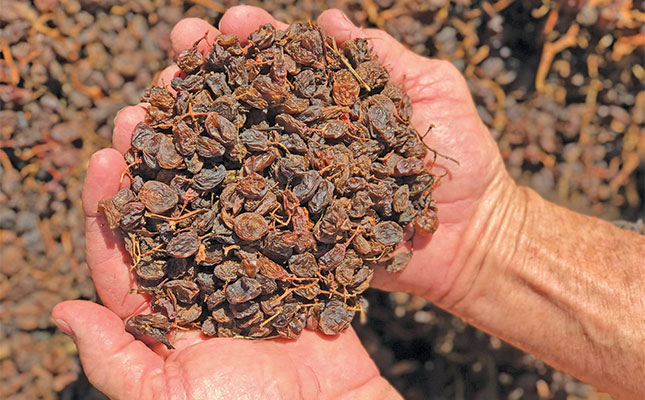
On the processing side, the key is to handle the grapes as little as possible to prevent bruising. Grapes are dried on nets laid out on cement. While some producers use very long nets of 20m to 30m, Blaauw and Du Toit use nets 12m or 15m long and 3m wide.
“The shorter length allows us to turn the grapes faster, by shaking the nets, than what it would have taken if longer nets were used,” she says.
Drying on the vine could simplify record-keeping and reduce handling, but they remain cautious due to theft risk in their region.
“Drying on the vine has helped some farmers increase capacity, but we are fortunate to have enough space to meet our production demand. We might dry grapes on the vine for a short period during high fungal risk and then finish the grapes off on the drying lanes,” she adds.
Advice
Blaauw’s role has expanded significantly over the years, complementing her father’s axtivities across the business. “If my father is in the vineyard, then I will be on the drying lanes – or the other way around.”
Asked for her advice to female producers, she instead offers guidance to fathers and grandfathers: “Expose your daughters to farming activities as you would your sons, and explain to them what you’re doing on the farm and why. Don’t shut them out if they become inquisitive and ask questions. That way you will cultivate a love for the land and farming – and who knows, they might be the ones who continue your farming legacy one day.”
For more information email Alcois Blaauw at [email protected].