
When Manjo Stiglingh arrived at Lucerne Fields farm in Botswana six years ago, the land that would become her food forest consisted of little more than veld and a scattering of trees.
The region’s average annual rainfall is between 250mm and 350mm, although exceptional years can bring more than 1 000mm.
“People often think we don’t get enough rain, but the reality is that when it does rain, a lot of that water simply runs off,” says Stiglingh.

With a background in organic agriculture and permaculture – a design philosophy that works with natural processes to create productive, resilient landscapes – she approached the site as a whole system.
Rather than trying to figure out how to bring more water to the land, she started thinking about how to hold on to the rain they were already receiving.
The solution was a network of swales, which are shallow, level channels dug along the contour of the land. Instead of allowing rainwater to rush downhill, the swales slow its movement, giving it time to infiltrate the soil where it can be stored long after the rainfall has stopped.
Making the most of swales
Stiglingh says careful planning and observation are key to making swales work effectively. She offers the following tips:
- Identify water flow patterns: observe how water moves across your property during heavy rain. At Lucerne Fields, the land slopes towards the Limpopo River.
“Don’t expect to get it right the first time. We followed our instinct at first and adapted the swales as our understanding of how the water moved across the landscape improved,” says Stiglingh.
- Determine swale locations carefully: swales must follow the natural contour of the landscape so that water spreads evenly instead of concentrating in one place. Position them to intercept run-off – typically in the upper or middle sections of a slope – before it gathers speed downhill.
Stiglingh says the spacing between swales depends on the gradient, with gentler slopes allowing for wider spacing and steeper slopes requiring swales to be closer together.
Also consider future access for maintenance, position swales where the captured water will provide the greatest benefit, and ensure each swale has a safe overflow to handle excess water during heavy rainfall.
- Start small: constructing swales requires earthwork and can be expensive. Rather than trying to transform an entire farm simultaneously, start with a small area and observe how the system performs through different seasons before expanding.
“It’s far cheaper to refine a successful design than to correct mistakes across a large area,” explains Stiglingh.
- Build effective berms: the soil excavated from the swale forms the berm, a raised ridge on the downhill side of the swale. This is what distinguishes a swale from an ordinary ditch.
“While a ditch is designed to move water away as quickly as possible, a swale and berm work together to slow, spread, and temporarily hold run-off so that it can infiltrate the soil,” explains Stiglingh.
Trees and other perennial plants are often planted on or just below the berms, where they can benefit from the stored soil moisture. A well-constructed berm also helps prevent erosion and ensures the swale functions effectively over the long term.
- Establish vegetation quickly: plant the berms as soon as possible to stabilise the soil and protect them from erosion. Deep-rooted plants help bind the soil, while grasses, groundcover, and mulch reduce the impact of heavy rain and wind.
Recycling water
However, the swales alone weren’t enough. Stiglingh explains that the region can go eight to 10 months without rain and, during that time, the trees will still need water.
The answer came from elsewhere on the farm. Water used in Lucerne Fields’ carrot washing and packing facility is recycled and reused to irrigate the food forest during prolonged dry periods.
“It made sense to use that water instead of letting it go to waste,” adds Stiglingh.
Building a food forest
Harvesting water, however, was only half the challenge. Capturing rainfall doesn’t mean much if the soil can’t store it or the landscape isn’t designed to make the best use of it.
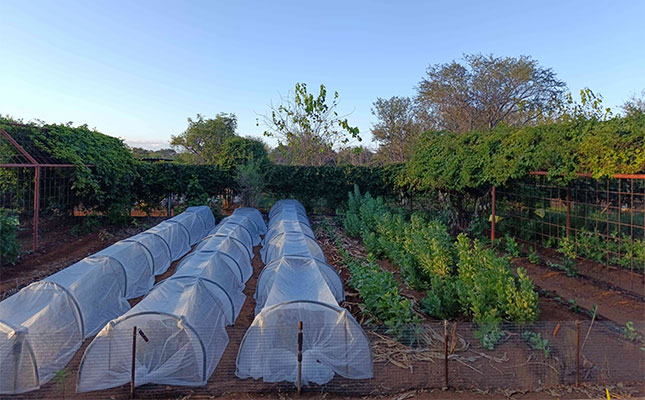
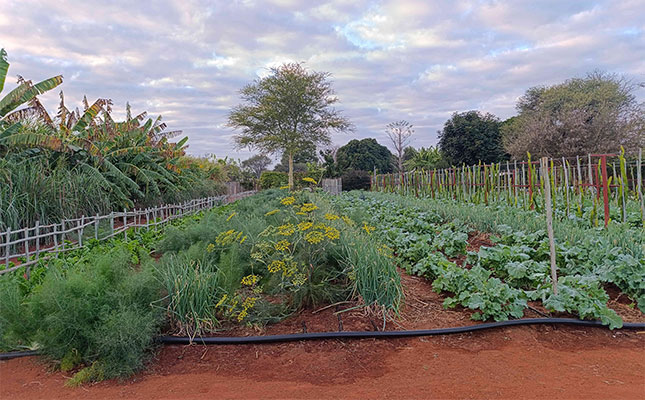
Rather than planting a conventional orchard and vegetable garden, Stiglingh designed the area as a layered food forest. Fruit and nitrogen-fixing trees form the canopy, while shrubs, vegetables, herbs, climbers, and groundcover occupy the layers below.
Building the food forest went hand in hand with rebuilding the soil. Swales harvest water, but healthy soil stores it. Increasing soil organic matter with compost, vermicompost, and living roots improves water infiltration and increases the amount of moisture the soil retains after rain. Earthworms improve soil structure, and livestock contribute manure and managed grazing.
Bare soil loses moisture quickly, so a protective layer of mulch or living groundcover is maintained to reduce evaporation, suppress weeds, protect soil life, and gradually improve soil structure.
As the system matured, so did the nursery where Stiglingh now propagates many of her own trees and companion plants, reducing expansion costs while creating an additional income stream.
Every element has a purpose
One of the guiding principles of permaculture is that everything on the farm should have more than one job. Likewise, important functions such as pest control, soil building, and water conservation shouldn’t rely on a single solution.
“Nothing is without a purpose,” says Stiglingh.
She says that in permaculture, every plant should have multiple functions, ideally three. Aside from producing food, plants can fix nitrogen in the soil, attract beneficial insects and pollinators, suppress weeds, provide mulch, create shade, or improve soil health.
Fruit and nut trees, including bananas, mangoes, citrus, pecans, and macadamias, provide food, shade the soil, and produce organic matter that’s returned to the system as mulch.
Other perennial crops, including dragon fruit, strawberries, granadillas, Jerusalem artichokes, turmeric, moringa, luffa, water chestnuts, and waterblommetjies, add to the diversity while producing food, protecting the soil, and supporting the wider ecosystem. Moringa is also processed into capsules, creating another value-added product.
Seasonal vegetables and herbs, including a wide variety of conventional and heirloom tomatoes, peppers, cucumbers, sweet potatoes, spring onions, squashes, green beans, parsley, coriander, and thyme, are planted where they best complement the surrounding species. In addition, spinach, kale, and turnips ensure a steady supply of fresh produce for the farmworkers.
Bees have also been introduced to the system to add biodiversity and pollinate the crops while producing honey, adding yet another product to the food forest.
“Observe the land; it will tell you what it needs,” says Stiglingh.
Livestock component
The same philosophy extends to the animals.
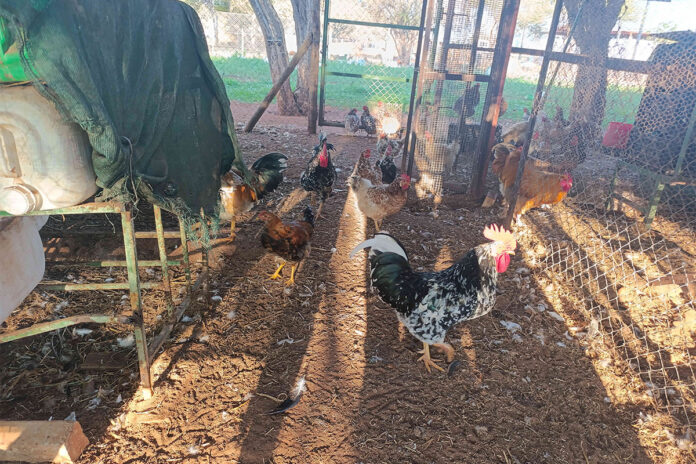
Boschvelder chickens, chosen for their hardiness, help keep grasshoppers under control. They are also run behind the cattle, where they feed on flies, ticks, and other parasites, reducing pest pressure while spreading manure.
Ducks, meanwhile, have become an effective biological control for fruit flies and tomato leaf miner (Tuta absoluta).
“I haven’t had any problems with Tuta absoluta on tomatoes since introducing the ducks,” says Stiglingh.
“The ducks, however, love tomatoes, so they need to be removed once the fruit starts developing.”
She laughs as she recalls another lesson: “The ducks also love flowers. They ate all the flowers off my green beans one year, leaving me with nothing.”
Geese act as the system’s early warning alarm, alerting the family when predators such as meerkats approach or when baboons and monkeys raid the food forest.
Stiglingh adds that everything has a time and sequence. “The challenge is to identify and tune into that. You have to learn this for yourself. Theoretically, there are lots of solutions, but they’re not always practical in real life.”
For instance, she tried incorporating rabbits into the system but soon realised they weren’t a good fit, because nobody wanted to buy them.
“When producing anything, or introducing any new enterprise, make sure you have an offtake for it. It doesn’t help to produce something that nobody wants,” she explains.
Closing the loop
It took about three years to establish the swales and transform the veld into a functioning food forest. Today, the once-barren patch of veld hums with life. Ducks chatter as they weave between vegetable beds, chickens scratch through the mulch in search of insects, and geese patrol the pathways, while fruit and nitrogen-fixing trees cast welcome shade over herbs, vegetables, and flowering plants.
“To see the success is absolutely amazing. In the areas where we don’t have swales, the land and grass dry up quickly after the rain, whereas the areas with swales stay green for two to three months longer,” says Stiglingh.
The food forest provides much of the household’s fresh fruit, vegetables, eggs, and meat. Surplus produce is shared with farmworkers and sold, while the nursery generates an additional income through the sale of propagated trees and companion plants.
Stiglingh hopes the food forest will inspire others to establish gardens of their own and become more food secure, extending its impact far beyond the boundaries of Lucerne Fields.
“One of my greatest joys is sharing my knowledge and experience to help others and their families thrive,” she says.
For more information, email Manjo Stiglingh at [email protected].