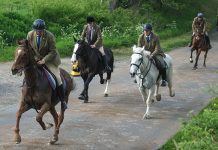
More and more equine sports such as dressage, jumping and reining are being held in sand arenas, as horse show organisers realise these are cheaper to maintain than expensive lawn arenas. Stables will have to build sand arenas, because horses, like other athletes, need to build up different muscles for working on different surfaces.
Arena building
As the demand for sand arenas has increased, several experts with the knowledge to build them to the required specifications have emerged. The depth and type of sand, and the underlying surface, are different for dressage and jumping. At major international shows, arenas are cleaned out and sand replaced for each discipline. Such extremes aren’t necessary to keep a competition horse fit for ordinary shows.
If you’re lucky enough to live in a sandy area, simply mark out a level area to ride on. Otherwise, flatten a level piece of ground with a bulldozer and roll it with a compactor. Place stones around the edge and fill the space with sand. Although economical, this type of arena can become waterlogged after rain and needs to be dried out.
For a weatherproof arena, it’s best to consult the experts. A sand arena, with drainage, for dressage can set you back about R180 000, with the cost of the sand taking up a major portion of the investment.
Maintenance
Building a sand arena is not a once-off expense and maintenance must be factored in. In Canada, indoor sand arenas are essential in winter with snow a metre deep and temperatures plummeting to -40°C. Riders take a ‘groom’ (usually a mom, dad, wife or husband) to pick up the manure with a horse-size poop-scooper. In SA, riders have to remove dung after each ride as plant and grass seeds grow easily in sand ‘fertilised’ in this way.
In time and with hoof pressure, the sand compacts and becomes uneven. In the US, reining horse trainers condition the arena every two hours, raking and spraying it with water to keep the surface even. In SA, major venues such as the Parys Afridome rake and spray the surface during shows. However, the average riding school does not have access to the machinery needed for this sort of work.
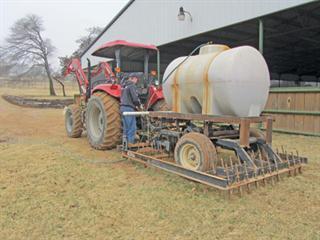
For a jumping or dressage arena, use a harrow pulled by a ‘dune buggy’ or small tractor. Water carriers can be pulled along to water the arena. Small-scale arena conditioning equipment available commercially currently costs about R20 000.
Contact Dr Mac at [email protected]. Please state ‘Horse talk’ in the subject line.