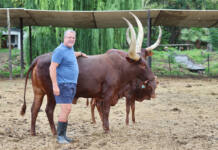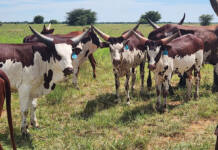

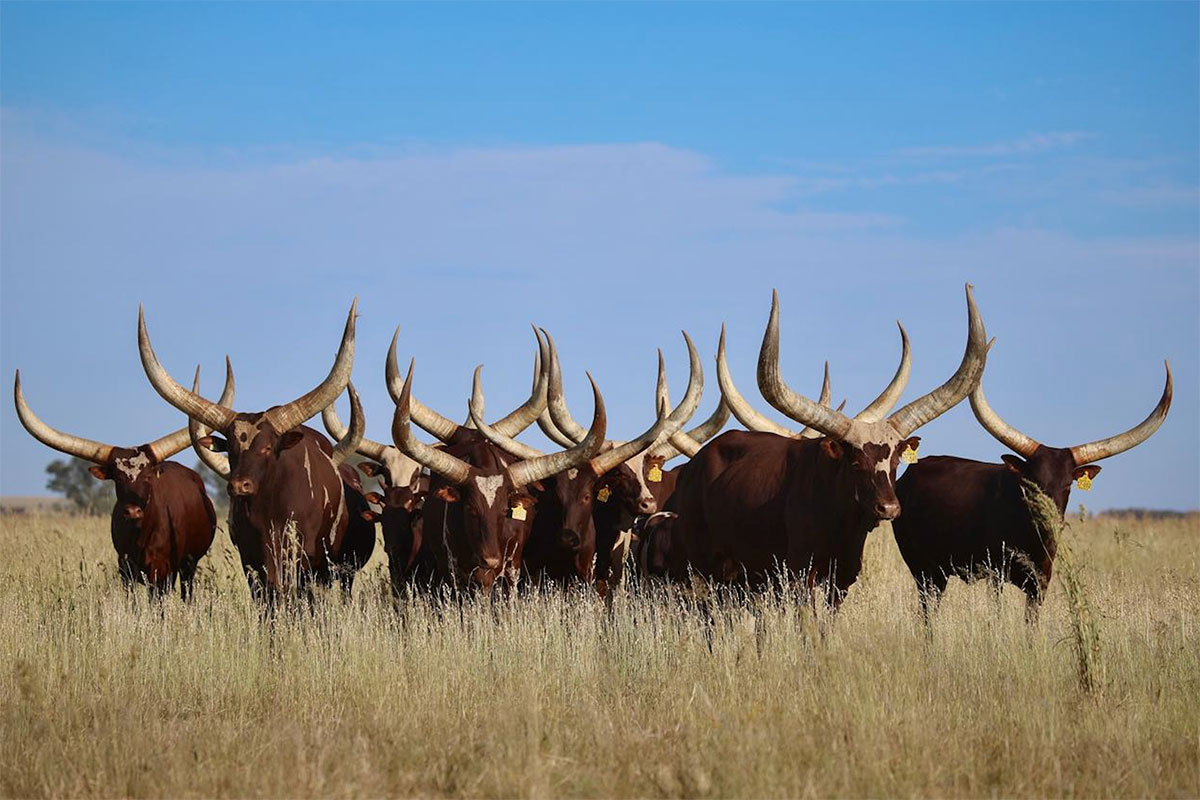
“We farm Angus, Tuli, and Ankole, and I’m genuinely fond of all three breeds, but I find myself going back to the Ankole time and time again,” he says.
For Ernst, this attraction lies in something deeper than economics or novelty. The Ankole’s towering horns may be what first catches the eye, but he believes the breed’s appeal runs much deeper.
“Our family has been involved in wildlife since 1991. The Ankole is almost like a bridge between wildlife and conventional cattle, and that’s probably why the breed got under my skin so quickly.”
Today, Bona Bona runs about 180 registered Ankole, alongside its other cattle breeds, as well as Kalahari Red goats. But despite growing interest in the Ankole, Ernst says expansion has been deliberate rather than rushed.
“It’s still a relatively small herd and we’re very much in a growth phase, but we’re not trying to grow too quickly,” he says.
“We prefer to build the herd naturally.”
From American Watusi to South African Ankole
Ernst’s fascination with long-horned cattle began long before the Ankole arrived at Bona Bona. During a visit to the US in 2008, he encountered Watusi cattle, a breed related to, but distinct from, the purebred Ankole.
“I immediately fell in love with these cattle and their massive horns,” he recalls. “When I came back from America, I told my father we should go looking for these longhorn cattle.”
The family eventually found Watusi cattle in South Africa, but Ernst says their entry into the world of the Ankole came years later when President Cyril Ramaphosa hosted the first Ankole auction at Phala Phala in 2016.
“That was where our real Ankole journey started. We bought our first purebred animals there,” says Ernst.
According to him, many of South Africa’s Ankole breeders trace at least part of their foundation genetics to those early Phala Phala auctions.
“President Ramaphosa played an important role in introducing the breed to South Africa. There were partners involved, but he hosted the first Ankole auction in the country, and that really sparked local interest. Word spread quickly after that.”
The Ernst family formally registered their Ankole stud in 2017 and have steadily expanded since then.
Building a herd… carefully
Although embryo transfer technology forms part of Bona Bona’s breeding strategy, Ernst says it’s used carefully and selectively.
“We do embryo transfers and use surrogates, but definitely not on a large scale. We reserve that for our best bloodlines. After almost 10 years with the Ankole, you learn what works and what doesn’t.”
That doesn’t mean they don’t experiment: “You still need to test things sometimes, but today I focus mostly on bloodlines I know are successful. Most of our embryo work centres on those animals.”
At the centre of this strategy are cows like Burungi and Nahema, animals Ernst speaks about with obvious pride.
“I bought Burungi when she was a calf, and from her very first pregnancy, she proved herself to be an exceptional breeder,” he says. “I’ve retained a lot of her offspring for myself, while others have sold at very good prices.”
Burungi, bred from one of South Africa’s most prominent Ankole bloodlines, already boasts a 127cm horn span.
“She proved her pedigree through performance. Her calves consistently grow out strongly,” says Ernst.
Nahema joined Bona Bona with her mother while still a calf. She is the daughter of Sebastiaan, an influential herd sire purchased in 2021.
“Nahema already has a 52-inch [132cm] horn span, and Sebastiaan has become one of the real cornerstones of our herd,” he says.
Still, if pushed to identify a favourite, Ernst answers quickly: “If I have to single out one animal, it’s probably Burungi.”
More than just impressive horns
To outsiders, the Ankole is often defined by its enormous horns.
“The horns are obviously the main attraction,” says Ernst. “They’re the first thing people notice.”
But he argues that serious breeders quickly learn that the breed cannot be defined by appearance alone.
“People think it’s only about horn size, but for serious breeders, it’s about much more than that. Genetics play a huge role.”
For now, Bona Bona doesn’t breed Ankole primarily for beef production, as there are still too few animals in the country, and the genetics remain highly valuable.
“Generally, cattle breeds have three markets: slaughter, commercial, and stud. With Ankole, there isn’t really a slaughter market yet. Numbers are still too low, and the animals are too valuable,” he explains.
Purebred females destined for the stud market can sell for anything between R200 000 and R2 million, depending on horn size, skin quality, and, most importantly, genetics.
Still, Ernst believes the future of the breed will eventually extend beyond exclusivity.
“At the end of the day, a cow is meat,” he says. “I’m trying to breed larger-framed animals because eventually I want to see a proper calf enter the beef market.”
For him, the long-term opportunity may lie in crossbreeding.
A breed built for hard country
If there’s one trait Ernst believes sets the Ankole apart, it’s adaptability.
“At a time when farming input costs are constantly rising, a breed that asks very little from you becomes very attractive,” he says.
He notes that Ankole perform across vastly different production environments. “They adapt almost anywhere – from humid KwaZulu-Natal to the dry Karoo. I honestly don’t think there’s anywhere in South Africa where Ankole don’t perform.”
This resilience, he says, makes the breed especially promising for tougher production systems and extensive farming environments.
“I’m thinking of informal farming systems in particular, where people don’t necessarily have the infrastructure, finances, or labour to bring animals in every day for treatment or injections. If you breed Ankole genetics into cattle under those circumstances, the offspring could thrive while still giving you a calf every year.”
At Bona Bona, this resilience is evident. The lodge runs a commercial Ankole herd that roams freely among 45 wildlife species.
“I released that herd into the reserve in 2019, and we’ve hardly touched them since. They aren’t dipped or dosed, and they run with wildebeest and blesbok. In our experience, they simply do exceptionally well,” says Ernst.
Several Ankole from the reserve herd have since been sold to luxury lodges.
“Some five-star lodges keep them grazing in front of reception areas,” he adds with a laugh. “We’ve even heard of tourists skipping game drives because they’d rather watch the Ankole.”
Even through South Africa’s ongoing foot-and-mouth disease (FMD) outbreak, Bona Bona has remained unaffected.
“We were fortunate to get vaccines early and vaccinated the herd more than two months ago. Thankfully, we haven’t had a single case of FMD.”
Personality, hierarchy, and herd instinct
Spend enough time among Ankole, Ernst says, and it becomes difficult not to notice their temperament.
“This breed has attitude and personality. I don’t really see it in the same way with my other cattle.”
The herd operates with a strong social hierarchy, where rank is clearly established.
“The horns determine status. A quick nudge here and there soon teaches an overconfident youngster that he still has to stand back.”
They are fiercely herd-bound, too, with a strong instinct to protect one another.
“They’re almost like buffalo. If one animal leaves the herd, the others go looking for it. You can’t easily work among calves because the herd protects them. If one animal lies down sick, the others gather around it protectively.”
Growing a breed, and a market
Despite the enthusiasm surrounding the breed, Ernst believes Ankole breeders must remain realistic.
“There are just over 2 000 registered Ankole in South Africa and around 62 registered breeders that I know of. That tells you how small the breed still is [in the country].”
Ernst has served as a council member of the Ankole Society of South Africa since 2022 and oversees auctions and helps organise the National Ankole Auction, which alternates location annually between Phala Phala and Bona Bona.
“We’re proud of the platform we create for breeders, as it gives people access to top genetics and allows breeders to achieve strong prices,” he says.
The annual auction has become one of the highlights of the Ankole calendar.
“Our national auction is a major event for breeders every year. This year, it takes place on 20 June at Phala Phala.”
He explains that the auction is designed not only to market elite animals but also to encourage balanced herd growth and stronger breeding programmes.
“If you want to sell animals at the auction, you need to enter three female animals for every bull,” Ernst says.
“Because roughly equal numbers of bull and heifer calves are born, everybody naturally wants to market bulls, so we had to apply the brakes a little through that rule.”
He says Bona Bona itself offers relatively few bulls at auction, largely because demand from the hunting market absorbs many of the farm’s standout males.
“I usually breed only two or three exceptional stud bulls for sale and, quite often, they are sold privately before the auction even takes place.”
While the auction attracts interest from across the country, foot-and-mouth disease (FMD) restrictions have made exports more difficult.
“At the moment, most buyers are South African. The disease situation has complicated exports, and elsewhere in Africa Ankole are more common and therefore not necessarily regarded as something special. Interest tends to come from elite breeders looking for top South African genetics,” notes Ernst.
However, he warns against assuming the breed’s growth will continue unchecked. “Like any commodity, the market will eventually reach a saturation point. Supply and demand always become a balancing act.”
For that reason, he believes Ankole breeders can learn from others.
“The Boran is a good example. They had highs and lows and eventually stabilised again. Wildlife went through the same cycle.”
Exclusive, but not inaccessible
The Ankole market remains highly specialised, with strong demand for stud breeding, hunting, and even lobola purposes.
“There’s definitely a lobola market, and horns carry status,” explains Ernst.
High prices often make headlines. Bona Bona purchased Sebastiaan for R3 million, while the farm’s heifers sell for an average of around R500 000 each.
“But high prices aren’t unique to Ankole. Worldwide, people pay serious money for elite genetics.”
At the same time, Ernst is quick to dispel the perception that getting into the breed requires enormous wealth.
“You don’t have to start with 20 expensive animals. There are more affordable ways to start. Some breeders began by buying semen at auction and partnering with breeders using donor cows to develop embryos.”
If the breed is to thrive, he believes collaboration and exclusivity must go hand in hand.
“We all try to help breeders grow. The market will develop as the breed develops. We’ll learn as we go.”