
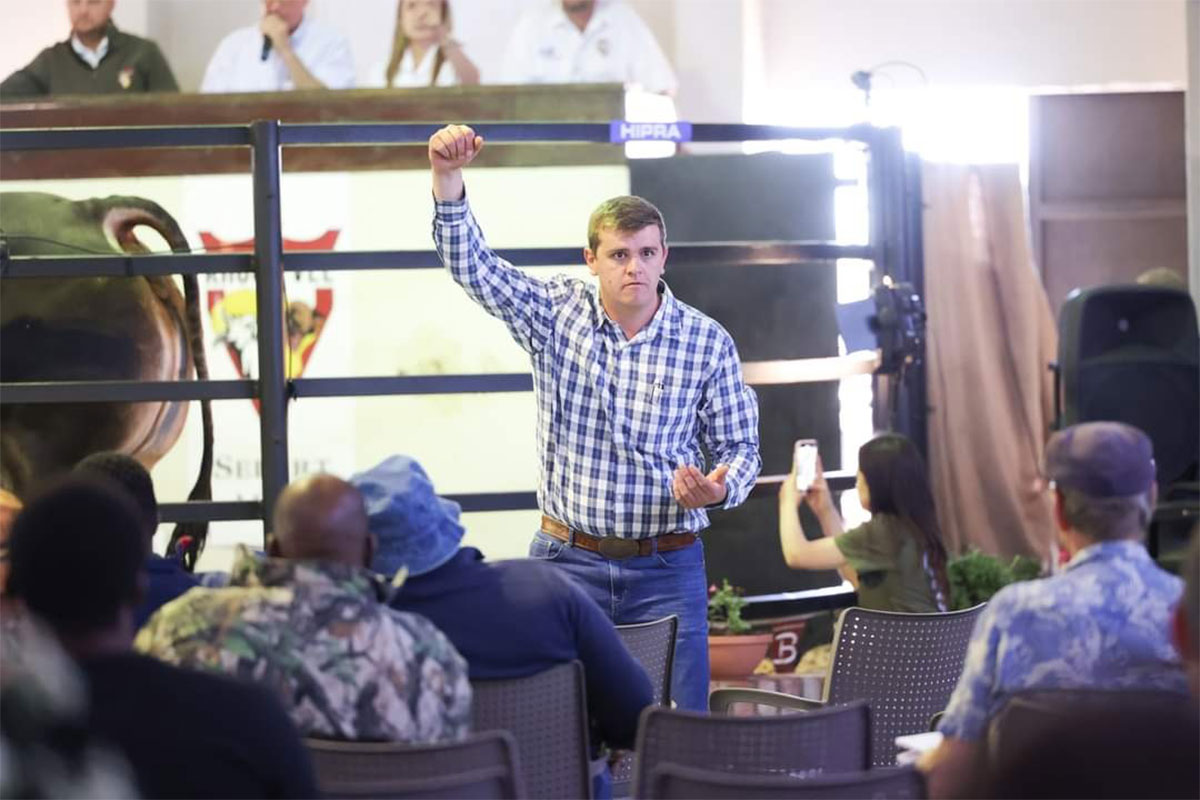
Based in Upington in the Northern Cape, Goosen operates as a freelance livestock auctioneer, stud breeder, and trained animal scientist, positioning himself at the intersection of genetics, production, and livestock marketing.
Goosen’s entry into agriculture was not a calculated career decision but rather a natural progression shaped by family tradition. Both his grandfathers were stud cattle breeders, and his father continues in the same field. This multi-generational exposure meant that livestock farming was embedded in his daily life from an early age. He notes that he cannot recall ever wanting to pursue a different career, describing agriculture as something “in his blood”.
This early immersion provided more than just familiarity; it cultivated a practical understanding of animal behaviour, breeding systems, and farm operations. As he matured, his involvement deepened, particularly in the operational aspects of farming, laying the groundwork for a career that would later integrate science and commerce.
Academic foundation in animal science
Recognising the increasing technical demands of modern agriculture, Goosen pursued formal education to complement his practical experience. He enrolled at the University of the Free State, where he completed a BSc in Animal Science and Agricultural Economics.
He then advanced to a Master of Science in Animal Breeding, a decision that significantly shaped his professional trajectory. During his postgraduate studies, Goosen participated in a Professional Development Programme facilitated by the Agricultural Research Council and Red Meat Research and Development South Africa.
Under the supervision of leading figures in the field, including Prof Frikkie Neser, Prof Michiel Scholtz, and Dr Mike MacNeil (US), he gained exposure to applied research and genetic evaluation systems. This experience provided him with a strong analytical framework, particularly in livestock genetics and breeding value estimation, which remains central to his work today.
His academic contributions have also extended to the global stage. An article derived from his MSc thesis has been accepted for presentation at the World Congress on Genetics Applied to Livestock Production, underscoring the scientific credibility of his work.
Entering the auctioneering arena
While his academic path was clearly defined, Goosen’s entry into auctioneering was driven by observation and imitation. As a young boy, he was fascinated by an auctioneer who was a friend of his father, often mimicking the rhythm and cadence of livestock auctions on their farm.
This early interest evolved into a professional pursuit in 2020 when he entered the competition and won. The competition proved to be a critical inflection point, offering both technical exposure and industry recognition.
From 2022 onwards, while still completing his postgraduate studies, Goosen began conducting auctions more regularly. Concurrently, he assisted breeders with marketing livestock and promoting sales, gradually building a network within the industry.
Operating under the banner “Goosen Broers Bemarking” on social media, he shares information and marketing material for auctions where he serves as auctioneer. This digital presence reflects a broader shift within agriculture toward more initiative-taking and visible marketing strategies.
A hybrid model: science, farming, and marketing
What differentiates Goosen from many of his peers is the breadth of his exposure across three critical domains: scientific research, practical farming, and livestock marketing.
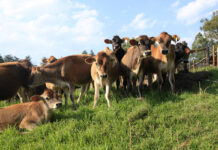
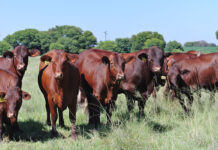
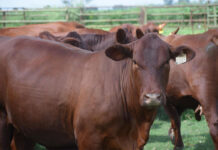
On the farming side, he participates in the family’s stud operation, Kalari Meatmasters and Droughtmasters, where the focus is on breeding animals that are well-adapted, fertile, and commercially viable. The objective is clear: to supply livestock that enhance profitability for commercial producers.
From a scientific perspective, his training in animal breeding equips him with the ability to interpret genetic data, evaluate breeding strategies, and communicate technical value to clients. This is particularly relevant in an industry that is increasingly data driven.
In the auctioneering and marketing space, he leverages both his technical knowledge and communication skills to position animals effectively in the marketplace. This integrated approach allows him to “translate” genetic and production value into economic value for buyers and sellers.
He notes that this combination often helps to overcome initial scepticism from breeders who may be hesitant to collaborate with a younger auctioneer. Once his background is understood, their confidence typically increases.
Market dynamics and relationship-driven access
As a freelance auctioneer, Goosen operates in a highly relationship-driven environment. His client base includes stud breeders and livestock owners seeking to market their animals, particularly through auctions.
Market access remains one of the key challenges. Unlike established auction houses with entrenched networks, independent auctioneers must continuously build credibility and relationships to secure opportunities. Goosen’s strategy has been to engage directly with breeders, offer marketing support, and demonstrate value through performance.
In farming, his focus remains aligned with commercial producers who require functional, adaptable animals. This reflects a broader industry trend in South Africa, where profitability and resilience are increasingly prioritised over purely aesthetic breeding traits.
Challenges and professional discipline
One of Goosen’s most significant personal challenges was completing his MSc degree. Transitioning from a practical farm environment to the demands of academic research required considerable discipline. He describes the process as difficult, particularly the extended periods spent working behind a computer.
However, the experience reinforced key professional lessons: persistence, delayed gratification, and the importance of structured effort. He emphasises that success in agriculture, whether in research, farming, or business, rarely yields immediate results.
Another critical lesson has been the value of relationships. He highlights that many individuals within the agricultural sector are willing to offer guidance and support, provided one is open to learning and actively engages with the network.
Opportunities for youth in agriculture
Goosen is notably optimistic about the prospects for young people in agriculture. He points to strong employment outcomes among his university peers as evidence that opportunities do exist within the sector.
He identifies several key growth areas:
- Science and data-driven agriculture: The sector is becoming increasingly analytical, creating opportunities for individuals with technical and scientific expertise.
- Marketing and value differentiation: As economic pressures intensify, producers must differentiate their products more effectively. Goosen notes that industries such as wine have already demonstrated strong capabilities in this regard.
- Innovation during crises: Events such as the foot-and-mouth disease outbreaks create space for innovation, including systems for compartmentalisation and animal health tracking.
- Digital platforms: The rapid adoption of online auction platforms illustrates how quickly the industry can evolve in response to external pressures.
However, he also acknowledges a significant barrier – the excessive cost of entry into farming. Capital requirements remain a major constraint for new entrants, limiting access to production-based opportunities.
Personal motivation and long-term vision
At a personal level, Goosen’s motivation is rooted in passion. He describes livestock breeding as intellectually stimulating and deeply rewarding. The process of planning matings and seeing the results in the form of a calf or lamb is, for him, one of the most satisfying aspects of farming.
Similarly, in auctioneering, he derives satisfaction from achieving strong prices for animals, particularly when he can identify and communicate value that may not be immediately apparent to buyers.
A reflective question he encountered, whether he would continue his work regardless of financial circumstances, reinforced his commitment to the sector. His answer was unequivocally yes, indicating a level of intrinsic motivation that is often associated with long-term success.
Looking ahead, Goosen aspires to become one of the leading auctioneers, breeders, and animal scientists in South Africa. While he acknowledges that this may be an ambitious goal, it reflects a clear direction and commitment to continuous improvement.
Positioning within a changing agricultural landscape
Goosen’s profile aligns closely with broader structural shifts within South African agriculture. The sector is increasingly characterised by:
- Integration of science and practice
- Greater emphasis on data and genetics
- More sophisticated marketing approaches
- Increased reliance on networks and relationships
His ability to operate across these domains positions him as a representative of a more integrated, multi-skilled agricultural professional.
For the “30 Under 30” cohort, this combination of technical expertise, practical experience, and market engagement is likely to become the benchmark rather than the exception.
Conclusion
Goosen’s career trajectory illustrates how traditional farming backgrounds can be effectively combined with modern scientific training and entrepreneurial initiative. His work in livestock auctioneering, stud breeding, and animal science, reflects a holistic approach to agriculture, one that recognises the interconnectedness of production, genetics, and market dynamics.
While challenges remain, particularly in terms of market access and capital barriers, his progress to date suggests a strong capacity to navigate these constraints. More importantly, his outlook, grounded in both realism and optimism, offers a credible perspective on the future of young professionals in the agricultural sector.
If his current trajectory is sustained, Goosen is well positioned to become a significant contributor to South Africa’s livestock industry, both in practice and in thought leadership.
This is psrt of our 30 Under 30 segment.