
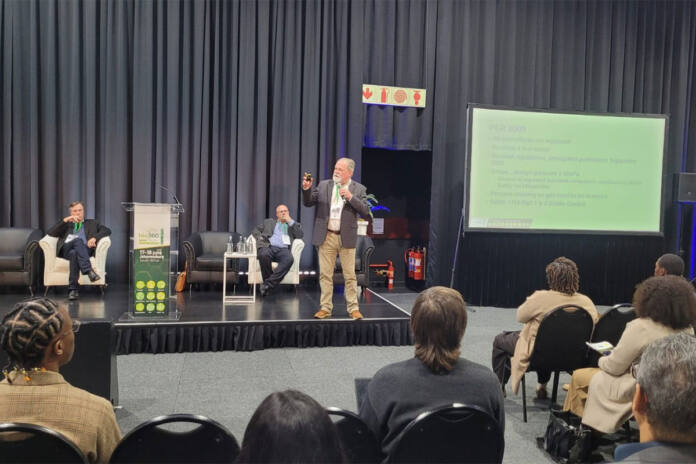
Speaking at the Bio360 Africa expo and conference at Gallagher Convention Centre in Johannesburg this week, industry experts warned that a failure to comply with existing regulations could undermine confidence in an industry that holds significant potential for farmers, municipalities, and industry.
Roy Lubbe, chairperson of the Southern African Gas Association, said biogas operators are already subject to a comprehensive regulatory framework.
He explained that South Africa follows the European Pressure Equipment Directive of 2009 through the country’s Pressure Equipment Regulations and the SANS 347 standard, which govern all gases and fluids under pressure, including biogas.
“Persons working on gas, including biogas, need to be licensed. If it is regulated, it is compulsory, not optional. It’s about safety and compliance,” Lubbe said.
Eddie Cooke, gas consultant for Gas for Africa, cautioned against assuming that low-pressure biogas systems pose little risk.
“Just because biogas is at a low pressure does not mean it is not dangerous. Unlike some other gases, biogas could contain corrosive and toxic components, requiring specialised equipment and operating procedures. For example, [liquefied petroleum gas] appliances cannot be used with biogas because the gas composition differs significantly,” he explained.
Lubbe noted that revised regulations, expected to be published in September, will broaden the scope of regulation even further by removing pressure thresholds that previously determined whether certain installations fell within the regulatory framework.
However, he stressed that regulation alone will not be enough: “We need an education campaign to get everyone on board so they are licensed and able to operate.”
Cooke added that the industry has considerable potential. For example, biogas could help address both South Africa’s energy shortages and growing waste problem, with opportunities ranging from rural communities and farms generating their own energy to large-scale industrial waste treatment projects that divert biodegradable waste from landfills while producing renewable energy.
“But the only way to build the biogas industry is to have reliable, plant-safe systems,” he said.
Cooke believes there is still a significant knowledge gap within the industry regarding standards that already apply to biogas, while some industry-specific standards remain under development.
“A lot of people don’t have knowledge of the existing standards that apply to biogas, and there’s a gap where standards were planned for development but haven’t been finalised.”
Cooke noted the Southern African Biogas Industry Association is working towards publishing dedicated biogas standards by the end of the year, while also training practitioners for registration with the South African Qualification and Certification Committee for Gas, and establishing systems for registering biogas equipment and appliances.