
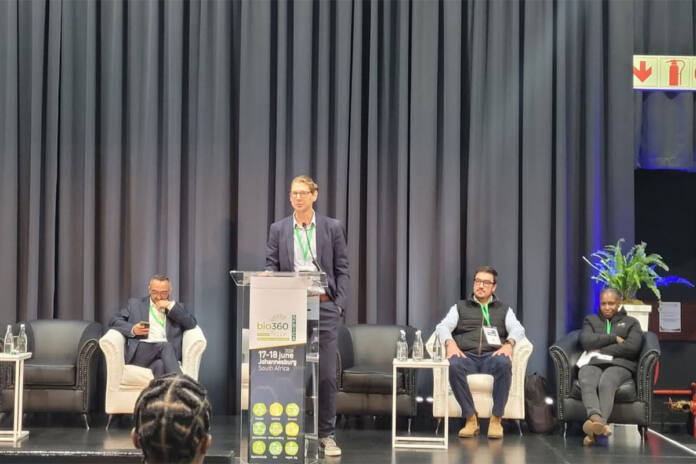
This was according to Gordon Ayres, secretary of the Southern African Biogas Industry Association, in his opening address on the first day of the Bio360 Africa expo and conference, held at Gallagher Convention Centre in Johannesburg on 17 and 18 June.
He noted that biogas production could help address some of the challenges society faces. “The industry can generate jobs, organic fertiliser, and energy. Our waste is just lying around waiting to be harnessed.”
Providing a real-world example, Marc Reinhard, international affairs manager at the German Biogas Association, said Germany has buses that run on biomethane produced from human waste.
He added that anaerobic digestion presents an opportunity for low-cost, decentralised waste management that produces valuable by-products, including renewable energy and organic fertiliser.
According to Reinhard, biogas and biomethane offer multiple benefits, starting with climate protection. By diverting organic waste from landfills, methane emissions can be reduced while simultaneously replacing fossil fuels.
The technology also enables energy recovery through the production of electricity, heat, and biomethane, which can be stored and dispatched when required, unlike some other renewable energy sources.
In addition, the digestate remaining after the anaerobic digestion process can be returned to agricultural land as an organic fertiliser rich in nitrogen, phosphorus, and potassium, helping farmers reduce input costs at a time when fertiliser prices continue to rise.
Reinhard added that a wide range of feedstocks can be used, including energy crops, animal by-products, and food waste. However, the success of a biogas plant is heavily dependent on the quality of the material entering the system.
“Feedstock is key. Waste streams need to be separated at source and contaminants removed before transportation to a plant. Failure to do so could make projects financially unviable and increase operational problems,” he explained.
He noted that public participation is critical to the success of biowaste recycling programmes.
“People need to know how to separate their waste. We have 30 years of experience, and we still need to do education campaigns. Impurities and oversized materials cause mechanical failures in biogas plants. Plastic bags in particular are problematic because they clog pumps and valves.”
Providing a local perspective, Primrose Magama, a research engineer at the Agricultural Research Council, said more than 600 million Africans still lack access to electricity.
She said the circular bioeconomy offers a framework through which biomass resources can be used to address such development challenges while also creating economic opportunities.
Although Africa already has several successful commercial biomass projects, adoption remains limited due to policy constraints, high capital costs, and a shortage of technical skills. Magama identified poor resource mapping and quantification as major barriers to growth.
“Africa has biomass resources, but we haven’t done the studies to determine how much there is, where these resources are located, or what the potential is to convert them into biogas.”
She added that market development is equally important, with project viability dependent on matching biomass resources to nearby demand, as transporting feedstock over distances greater than about 30km generally renders projects uneconomical.
Looking ahead, Magama said the next generation of biogas plants will need to process a broader range of biomass feedstocks.
“Anaerobic digestion is a key technology because it allows for a diverse stream of feedstock and can turn it into a range of products, from energy to chemicals,” she concluded.