
The farmers’ day attracted between 150 and 200 Sasol-supported farmers from Mpumalanga, the Free State, and Gauteng.
The event served as a practical platform aimed at equipping emerging farmers with the knowledge, tools, and industry connections needed to build compliant, market-ready, and sustainable farming businesses. It catered to crop, vegetable, poultry, and other livestock producers.
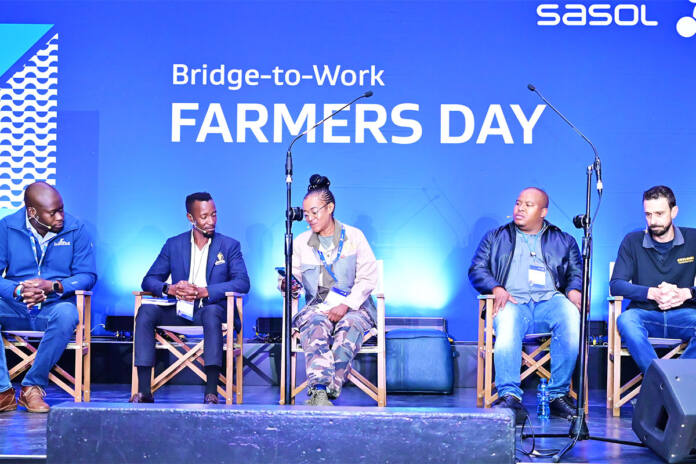
A highlight was a panel discussion featuring young commercial producers, who shared candid insights into their farming journeys, outlining the challenges they have faced and the strategies that helped them achieve commercial success.
Valuable lessons
Panellist and young commercial farmer Sizo Tshabalala, founder of Tshabalala Farming in Elukwatini, Mpumalanga, reflected on the valuable lessons he has learnt from his mentors throughout his farming journey. According to him, their guidance helped him overcome the fear of failure when establishing his business.
“They taught me not to fear failure but to turn failures into opportunities. From those failures, I learnt how to better manage myself and my business.”
Responding to a question about the biggest financial mistake he has made, Tshabalala said he learnt early on not to expect substantial profits from the outset but rather to focus on starting small and growing steadily.
“When you start small, you make small mistakes, and through those mistakes you build experience. Young people often want to start big because their dreams are big, but I learnt to simplify the dream, start small, learn, and then grow.”
Drawing on his experience as a Bonsmara breeder, Tshabalala emphasised that successful livestock production extends beyond simply selling animals.
“In breeding Bonsmara cattle, I realised we are not only selling animals; we are selling genetics. People get excited about breeding because of the higher prices these animals achieve, but they do not always realise the effort that genetic improvement requires.
“We lost many cattle that were introduced from different environments, but some adapted and survived. Those adaptable animals possess the genetics that are truly valuable,” he explained.
Industry trends
The event focused on exposing smallholder farmers to the latest industry trends while facilitating access to markets, buyers, and financiers critical to transforming farming enterprises into sustainable operations.
Through knowledge-sharing sessions, supplier demonstrations, and direct engagement opportunities, participants gained practical insights and access to resources aimed at supporting the next generation of commercial farmers.
Among those in attendance were former Bridge to Work (BtW) trainees who have since established successful poultry, cattle, and crop farming enterprises. Delivered through Sasol’s Iphepe programme, the Sasol BtW farming stream equips local community members with the skills and training needed to establish sustainable, income-generating agricultural businesses.
“The farmers’ day reflects our commitment to empowering local communities through knowledge-sharing and strategic partnerships that help transform farming operations into viable businesses.
“Our BtW programme has created a diverse pool of farmers who are equipped with the skills needed to make a meaningful impact in this strategic area of the economy,” Gao Mothoagae, vice-president of Corporate Social Investment at Sasol and the Sasol Foundation, said.
Held during Youth Month, the event further demonstrated Sasol’s commitment to empowering communities, particularly young people, with skills that enable meaningful participation in the economy and support job creation.
To date, the Iphepe programme has trained more than 311 farmers across Mpumalanga, the Free State, and Ekandustria, a government-owned industrial park located outside Bronkhorstspruit in Gauteng, with Mpumalanga accounting for the largest share of active farmers. The programme is primarily targeted at unemployed youth, including women.
Exhibiting partners at the event were Land Bank, Joburg Market, the Agricultural Development Agency, Rainbow Chicken, Pannar, Farmer’s Weekly, Agrisure, Afrivet, Agri Skills Transfer, AgricultSURE, AgriSure Brokers, Eggsellent by Lebo, Epol, Ezulwini Aquaponics, Kynoch Fertilizer, Potatoes SA, PrysWys, Red Meat Industry Services, Sakata Seed Southern Africa, Tshabalala Farming, TWK Agri, and Zamukele.
Celebrating commitment, discipline, and hard work
The farmers’ day also celebrated the winners of the Sasol Iphepe Farmers’ Day Competition, which recognises outstanding farmers in the programme and provides financial support to help accelerate their growth.
Mfanizile Maseko of Inkaba Farming Project in Badplaas, Mpumalanga, took first prize; Tsholofelo Sibisi of Mswamarawa Pty Ltd in eMbalenhle, Mpumalanga, came in second; and Tsholofelo Mokwele of TCM Squared Farming Projects in Bronkhorstspruit, Gauteng, came third.

“These [financial] rewards represent an investment in people, entrepreneurship, and the future of agriculture in South Africa. Through this support, we hope to strengthen their operations so they can increase productivity, invest in infrastructure and equipment, and improve market access,” Themba Mazibuko, senior manager of skills and economic inclusion programmes at Sasol, said.
Participating farmers must submit comprehensive information on their enterprises, including business plans, evidence of farming activities, and supporting documentation showing business growth potential.
This is followed by an extensive screening and shortlisting process, culminating in the assessment of each applicant by an independent panel of agricultural specialists, enterprise development practitioners, and experienced industry professionals.
The farmers are evaluated on several criteria, namely business viability and growth potential, productivity and operational performance, innovation and adoption of agricultural best practices, financial sustainability, contribution to local economic development, and the broader social impact of their farming operations within their communities.
“The standard of entries [this year] was exceptionally high, making the work of adjudicators particularly challenging. The entrants demonstrated remarkable perseverance in an industry often affected by adverse weather conditions, fluctuating input costs, pests and diseases, and changing market dynamics.
“Despite these challenges, they continued to produce, innovate, and contribute to South Africa’s food security. They are proof that agriculture remains a powerful vehicle for transformation and prosperity,” Mazibuko said.
“The winners’ achievements are a testament to their commitment, discipline, and hard work. The rewards they received today are not merely recognition of past performance but also an expression of our confidence in their future success.”
Knowledge transfer sessions
Farmers’ day attendees were given the opportunity to gain practical insights into production and management practices through three specialised breakaway sessions focusing on poultry production, animal health management, and the fundamentals of vegetable production.
Farmer’s Weekly attended the vegetable production session, where Solly Legodi, course facilitator at Agri Skills Transfer, outlined the key principles of successful vegetable farming. He emphasised that effective enterprise planning is the foundation of a profitable farming business.
“When starting a farming business, you actually have to start at the end by researching and understanding market needs,” he said.
Legodi explained that selecting the right crop and variety is critical, not only to meet market demand but also to ensure suitability to the climatic conditions of the production area.
Throughout his presentation, he repeatedly stressed the importance of soil health. “I always refer to how our ancestors related to soil. They understood how critical it is to see soil as a living entity. If you don’t treat it well, it can become endangered and can promote pests and disease.”
Legodi also highlighted the importance of soil pH in vegetable production. He explained the process of soil sampling and emphasised the value of understanding soil analysis reports to ensure that fertiliser and irrigation programmes are applied corretly.