
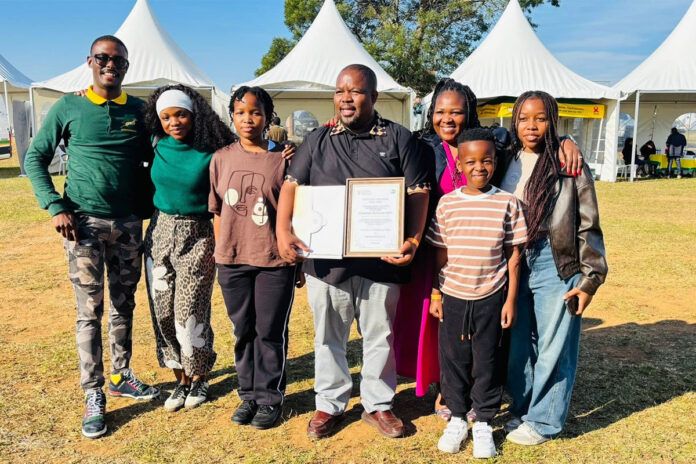
Properties and farming implements, with a combined value of more than R50 million, were handed over to the land reform beneficiaries of several farms, namely Waterways Farms, Qalakahle Farm, SNAMPRU, Ozone, and Khuseka.
Restoring dignity through land ownership
The title deeds relate to state-owned farms that were previously acquired through the Proactive Land Acquisition Strategy (PLAS) programme and have now been officially transferred to qualifying beneficiaries.
In addition, the Emakhasaneni Community Trust, Entembeni Community Trust, Isizwe Sakwa Dludla Trust, and Entembeni Royal Community Trust also received farming implements through the Land Development Support Programme.
Speaking at the event, KZN MEC for Agriculture and Rural Development Thembeni Madlopha-Mthethwa said the handover was part of government’s ongoing efforts to strengthen agricultural production, provide secure land ownership, and support emerging farmers.
Nyhontso said that the handover was about strengthening food security, and ensuring that land reform beneficiaries have the resources they need to succeed.
He described the initiative as restoring dignity to the communities: “Families who had farmed these lands for generations were reduced to labour tenants, squatters, or encroachers on their own ancestral ground.”
Call for stronger support structures
Nyhontso also called on government departments, municipalities, financial institutions, and the private sector to work together to support land reform beneficiaries, adding: “Everyone in the land ecosystem has a role to play.”
He urged the KZN Department of Agriculture and Rural Development to continue providing extension services to farmers, while municipalities and the provincial Department of Cooperative Governance and Traditional Affairs should ensure that infrastructure reaches rural farming communities.
Financial institutions, he said, should recognise newly formalised land tenure projects as legitimate collateral, while all stakeholders should include land reform beneficiaries in poverty alleviation programmes.
Madlopha-Mthethwa added that land ownership must translate into productive farming and economic growth.
“Land is not just soil; it is the foundation upon which we build food-secure and self-reliant rural communities.
“As these state farms are being transferred to you today, I urge you not to see this land only as a place to build houses but to work it. Let us work the land, produce food, and create jobs,” she said.
She also appealed to traditional leaders to make more land available for agricultural production.
Land reform success stories
According to Nyhontso, the Mthonjaneni cluster of farms, which comprises Emakhasaneni Community Trust, Entembeni Community Trust, Isizwe Sakwa Dludla Trust, and Waterways, has emerged as one of South Africa’s land reform success stories.
He said that while many land reform projects across the country have struggled with underutilised land, these farms have continued to operate productively and are regarded by government as a model for successful land reform implementation.
Among those receiving title deeds was Siyabonga Madlala, executive chairperson of the South African Farmers Development Association, who farms at Waterways. He and his family officially received the title deed to the 240ha property, securing ownership after years under a leasehold arrangement.
“We are extremely grateful. Succession has always been a problem under a leasehold arrangement, and this is now a family legacy that will transcend to other generations.
“I am grateful to finally own the land I have cultivated for a long time. This is a real milestone for us as farmers. I hope to see more initiatives like this going forward,” Madlala told Farmer’s Weekly.