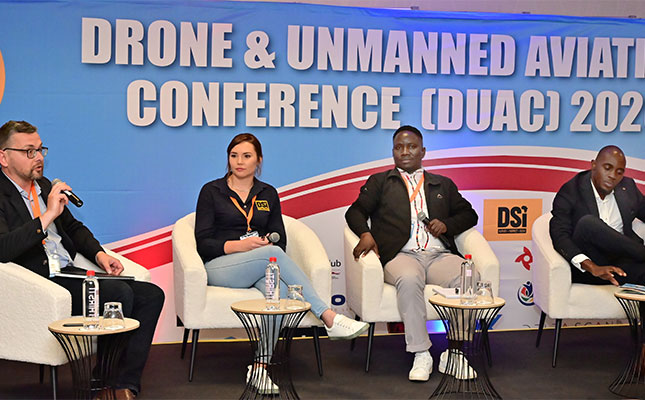
This was according to a panel of industry specialists at the two-day Drone & Unmanned Aviation Conference (DUAC) 2026, held in late June at Southern Sun OR Tambo International Airport in Johannesburg.
The panel, moderated by Arie van Ravenswaay, assistant director of innovation, technology design, and transfer at the Western Cape Department of Agriculture, comprised Monique Heydenrych, head of sales and agricultural specialist at Drone Solutions International; Vice Phiri, founding CEO of Africa Drone Kings; and Prof Mbulisi Sibanda, associate professor in the Department of Geography, Environmental Studies and Tourism at the University of the Western Cape.
Their discussion explored how drones are improving agricultural and forestry operations through crop monitoring, precision spraying, environmental management, data analytics, and support for smallholder farmers.
The DUAC itself brought together regulators, researchers, technology providers, and industry leaders to examine how drones, artificial intelligence (AI), and autonomous systems are reshaping numerous sectors across Africa.
Proven technology, but uneven adoption
From a research perspective, Sibanda said there is little doubt that drones have demonstrated their value.
“We are seeing quite an increase in research across Africa, Europe, and elsewhere, and the number of applications of the technology is also increasing,” he said, adding that while drones’ ability to monitor crops, assess fields, and collect valuable information is well established, commercial adoption remains inconsistent.
Heydenrych agreed, noting that misconceptions about the technology continue to weigh on uptake.
“People feel drones are taking over their jobs. They’re not; they’re simply making the work quicker and more accurate. You still need quality control and people signing off on the work,” she explained.
Phiri drew on operational experience to illustrate why successful drone adoption involves much more than purchasing equipment. He recalled how his company secured a major spraying contract only to crash a drone within the first two weeks.
“In agriculture, you realise that it’s not just about the drone. Delivering a comprehensive service to farmers is about the full infrastructure: trained pilots, client relationships, technical support, and having people ready to respond quickly during those critical spraying windows,” he said.
Selling data, not drones
One of the recurring themes throughout the discussion was that farmers should not view drones as aircraft alone but also as decision-support tools.
“We’re not selling the drone; we’re selling the end result, the data,” Heydenrych said.
She argued that once producers understand how accurate spatial information improves decision-making and reduces long-term costs, the return on investment becomes much clearer.
Van Ravenswaay agreed that many farmers still underestimate the scale of drone adoption already taking place.
“There are so many drones in agriculture that are hidden from our view because users are not licensed and registered with the SA Civil Aviation Authority or the Department of Agriculture, Land Reform and Rural Development,” he observed, noting that many producers who initially dismissed the technology have since incorporated multiple spraying drones into their operations.
Smallholder realities differ
The panel stressed that discussions around drone adoption cannot treat all smallholder farmers as a single group.
Sibanda explained that some smallholders cultivate backyard plots for household food security, while others farm commercially on larger holdings, and that each group has different information needs, financial capacity, and technological readiness.
“If a smallholder farmer isn’t technologically advanced, then drones and multispectral data simply don’t make sense to them,” he said.
Rather than expecting individuals to invest independently, he suggested co-operative ownership and shared services as more practical models for smaller producers.
Phiri added that, from a commercial perspective, purchasing a drone only begins to make financial sense beyond a certain farm size.
“For someone farming three to 10ha, it’s actually cheaper to use a knapsack sprayer. The economics only start changing once you’re operating at a much larger scale.”
Precision saves more than chemicals
Several panellists highlighted the efficiency gains made possible through drone-based spraying, with Heydenrych explaining that technology use significantly less water and chemicals than conventional blanket spraying while delivering precise application where needed.
Many growers mistakenly assume that the drone operator has done something wrong when there is chemical left over after a spraying operation.
“In reality, that’s where the saving comes in,” she added.
Phiri added that farmers often become sceptical when drones use substantially less of a chemical than traditional methods, because the reduced volume conflicts with decades of farming experience.
Throughout the discussion, the speakers emphasised that drones should be viewed as another management tool rather than a replacement for agronomic expertise.
“Drones are just tools. You still need to go into the field. You need to know what’s happening in the soil and on your plants,” Van Ravenswaay said.
Sibanda echoed this view, saying the real challenge lies in transforming large volumes of drone-generated information into practical recommendations that support informed management decisions rather than simply collecting more data.
AI still requires human expertise
AI featured prominently during the discussion, although panellists cautioned against unrealistic expectations.
Heydenrych pointed to AI-driven crop monitoring platforms that can count trees and identify stressed plants, but she emphasised that farmers still require experienced people to verify the findings.
“If your original dataset isn’t accurate, you’ll still be making decisions based on poor information,” she explained.
Sibanda noted that while research has produced sophisticated algorithms capable of analysing crops, translating those academic models into practical farm tools remains a significant challenge.
Economics is the deciding factor
While the technological benefits of drones and AI applications were widely acknowledged, the discussion repeatedly returned to economics.
Phiri argued that government policy will play a critical role in accelerating adoption, particularly for smaller producers.
Drawing comparisons with international examples, he noted that subsidies have helped accelerate drone adoption elsewhere in the world, while South African farmers continue to face rising production costs.
“When farmers hear about AI and [other] new technology, many simply see another cost,” he added.
Van Ravenswaay agreed that without appropriate funding models, the technology gap between commercial and smallholder farmers could widen even further.
Beyond crop production
The discussion also explored broader environmental applications. Heydenrych explained that bathymetric drone surveys use unmanned aerial vehicles equipped with echo sounders to map underwater terrain, measure depths, and monitor sediment build-up. They allow farmers to accurately calculate dam capacity after floods have deposited silt, helping to improve irrigation planning.
Thermal sensors can also identify leaking irrigation systems before valuable water is lost.
Sibanda added that research is showing promising results in monitoring water quality, evapotranspiration, and other environmental indicators, although further calibration work is still required before many of these applications become routine on farms.
Collaboration will determine success
As the discussion concluded, panellists agreed that the future of agricultural drone technology depends on stronger collaboration between researchers, service providers, regulators, and farmers.
Sibanda observed that the sector currently lacks a fully integrated ecosystem in which different specialists work together seamlessly, while Phiri called for a review of regulatory requirements, arguing that lengthy certification processes are slowing technology adoption.
Van Ravenswaay concluded that improved collaboration around research, policy, funding, and data sharing are essential if drone technology is to deliver its full potential across the South African agriculture sector.
“The value is in the data. We need to start getting everyone into one room and discussing it,” he said.