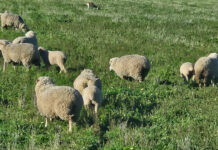

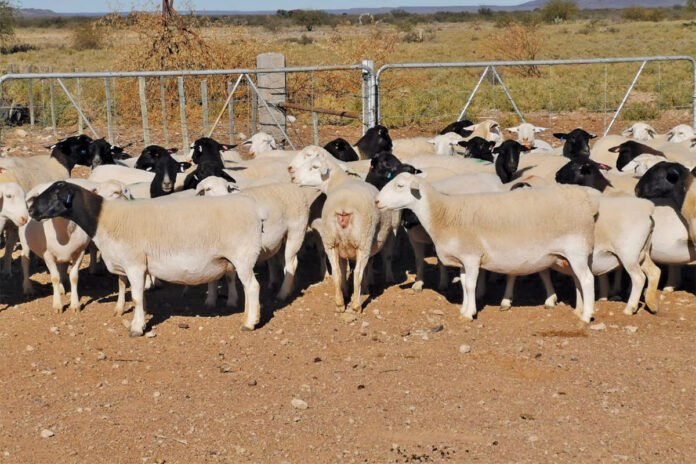
As you head west from Prieska in the Northern Cape, you reach a section of big sky country where it feels like you can see all the way to the end of the world.It is here at Hoekplaas that fifth-generation farmer Johannes Human runs a stud and commercial Dorper operation in partnership with his father that markets roughly 3 000 lambs per year.
The family first started farming here in 1916, and Human returned to the farm in 2007 to start farming permanently in partnership with his parents HG and Maria Human.
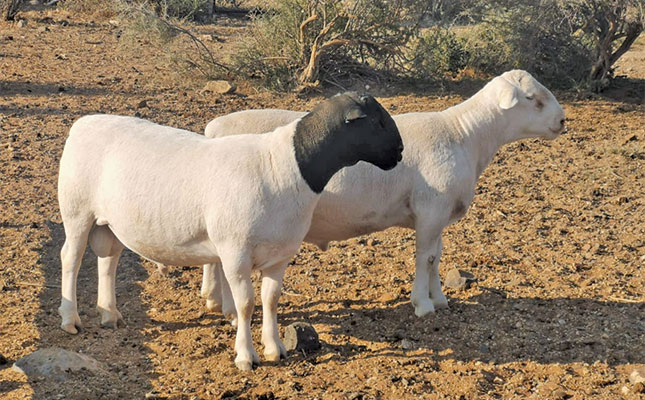
They farm both white Dorpers and black-headed Dorpers, with the white Dorper stud registered under Johannes’s name (JJ Human) and the black Dorpers under his father’s name.
In addition to the Dorpers, they also keep a small herd of Afrikaner sheep specifically for the production of teaser rams.
Human has also leased a small herd of cattle from another farmer who has had to find other work due to ongoing drought pressures in the area.

Why dorper?
Human tells how his grandfather first began converting the family Merino flock to Dorpers in 1975.
“Our family had always farmed strong wool Merinos and we still have a deep love for the breed, but it wasn’t working for our world and type of operation,” he says.
At that stage, his grandfather embarked on a five-year programme, first crossbreeding existing ewes with Afrikaner rams (to introduce traits like milk production, herd instinct and mothering ability for which the breed is recognised), and then crossbreeding those offspring with Dorper genetics.
Human describes it as a very emotional time for his grandfather, who had realised he needed a breed more adaptable to their conditions with lower input costs and maintenance inputs. The self-shedding nature of Dorper sheep and their lack of a need to be shorn fed right into this, along with adaptability traits, mothering ability, fertility rates, and carcass quality.
“It is a sheep that can walk, and ewes can rear their lambs on the veld. I don’t make excuses for lambs lost to jackal, that a ewe needs to look after her lamb and must take a ram (conceive) when she needs to.”
He says the Dorper produces high-quality lambs that have a reputation for good growth.
“There is also uniformity: the one looks like the next in terms of size and grading, and so on.”
Farming conditions
Human describes his farm as a mix of bossieveld and grassland areas comprising tall and small bushman’s grass species spread across harde bultveld as opposed to leegteveld.
He says it is a hard, dry area with limited annual rainfall. The benefit is that it is also a healthy area with low levels of pests or diseases.
He works on a three- or four-camp system, depending on the composition and condition of the veld. With the four-camp system, for example, he actually needs eight camps in total. He divides the year into three periods, and the sheep will graze each camp for four months before they are rotated to the next one. The aim is to allow a camp to rest for a full year after it has been grazed, and this approach facilitates that.
The past few years have presented below-average rainfall, a characteristic for the region of late.
“This year has started out dry, but we are hopeful we will still get good rainfall during our most important part of the season (February/March),” he says.
Because of increasing climate variability and over the past 10 years, Human has often asked himself whether this is where he wants to farm.
As mentioned, though, the area has its benefits in terms of lower pest and disease burdens, and he continues making the best of the terrain available to him, focusing on breeding sheep that can perform and adapt to all the variability presented by both climate and the natural environment.
Production and reproduction
Human follows a production system that is as close to natural as possible, with his one concession being the use of teaser rams to aid in getting the ewes ready.
“That is why I use the Afrikaners as teaser rams. It’s proven to be one of the only breeds that gives off something (a scent or hormone) to help make an ewe come into season. Some people say it is unnatural, but it increases the chance of multiple twins by up to 22%,” he says.
The stud component comprises roughly one-fifth of the entire operation and is run on an eight-month reproduction cycle. This is timed to coincide with three important annual sales under the Northern Cape Veld Ram Project calendar.
“It’s a tough cycle that is hard on the ewes, but it also helps sort the wheat from the chaff.”
Commercial ewes are run on a 10-month lambing cycle, with about four months to rear their lambs and a month off to recover before being put to the ram again.
All ewes lamb on the veld, although stud ewes are brought to smaller camps nearer the homestead during this time.
“Every four days, we walk the ewes that have lambed further away from the homestead and place them in larger camps again.”
Ewes are also closely monitored for the first period after lambing, and this is the time that Human uses to sort out the ‘repeat offenders’ that are not producing lambs.
“Between 8% and 10% of all ewes that were successfully covered arrive back at the kraal without lambs. They are then tagged, and if it happens again, I get rid of them,” says Human.
This applies to both their ability to look after and protect and feed their lambs, as well as to whether or not they are taking ram. Two strikes and they are out.
Rams are used in the stud for a period of about two years and then moved out to the commercial herds until they are ‘old rams’.
“We will use them on the commercial herd for a minimum of four seasons if their teeth hold,” he says.
In the stud, Human runs roughly one ram to 60 ewes, with the commercial ratio at about one ram to 50 ewes.
“That ram must be prepared to cover the ewes I am giving him.”
He says he performed a trial some years back where he put one ram with 156 ewes. Of those, only four did not conceive. The bulk had been impregnated by around the 17-day mark and the rest by 35 days.
To measure is to know
Human’s lambs are ready for weaning by about 90 to 100 days, and are then either selected for replacement stock (ewes) or potential sale rams, with the rest, both male and female animals, finished off for slaughter. These will be run on the veld, and if necessary, be sent to a feedlot on the farm for roughly three to six weeks until they are slaughter-ready.
Ram lambs considered for sale will be entered into the Northern Cape Veld Ram Project.
The testing period usually begins when the rams are about four to six months of age. All the rams that are entered are run at the same location for five to six months as part of the test, and only after that go over onto a feeding phase.
Human avoids feeding, except when rams are being finished for sale, starting eight weeks before the sale, or when whethers and ewe lambs are being finished for slaughter if necessary due to veld conditions being poor, or if lamb growth rates are being negatively compromised.
He does not often market female animals at sales, preferring instead to send those not kept back for replacement stock directly to abattoirs in his area and further afield, along with whethers held back for this purpose.
Rams deemed worthy and that pass the performance and precision testing are put up for sale. He will then purchase rams bred by himself or other breeders participating in the project in line with specific goals for his herd. This is about being part of the greater community of Dorper breeders who are aiming to better the breed consistently.
“It is not a ‘me’ business. It is an ‘us’ business, and I am breeding and selling stock that I would be willing to farm, animals meant to adapt wherever they go and to add value to my own or another farmer’s operation.”
Important traits
As an entirely extensive farmer, Human aims for a sheep that is adaptable and fertile, with good mothering ability and a carcass that is acceptable to the market.
“I want well-adapted sheep with the ability to walk, with fertile ewes that are good mothers.
Important measurement criteria for me include growth up to and including weaning (important for extensive conditions), as well as post-weaning growth rates. Post-weaning growth rate is just as important as this determines adaptability.”
He utilises a ‘growth percentage’ approach running over a one-year cycle starting on 1 March to determine the performance of his lambing ewes. He explains that this refers to the number of lambs marketed over the cycle being converted to the ratio of the number of lambing ewes, with his average over a one-year cycle amounting to between 120% and 140%. This would equate to between 1,2 and 1,4 lambs per ewe per year.
“The best we ever achieved was 158% for the stud component, and the best overall figure (stud and commercial combined) was 148%,” he says.
When it comes to daily growth up until weaning, over the first 100 days of the lamb’s life, Human is aiming for an average of around 380g/day off the veld. If this starts dropping below 300g/day, such as in winter when it could go as low as 250g/day, he will start supplementing feed to prevent growth loss.
He aims to breed a smaller-framed animal that can hold its own in the extreme extensive conditions and provide a slaughter percentage of 50%.
“We market our slaughter lambs at a live weight of about 38kg minimum, and a carcass weight of 19kg to 20kg,” he says.
The bulk of these will grade as A2 or A3, but when there are dry times requiring feedlotting, he will have some A1s ‘in the package’. Build on his sheep is scored at a four.
Dorper for the future
Human is excited about the Dorper going forward, saying it is in demand locally and internationally.
“The Dorper does not have to stand back for any other sheep breed.”
He says this applies to its carcass quality, but also to its adaptability to perform both extensively and under intensive conditions.
Although a relatively new breed, having first been created in South Africa around the 1940s, the Dorper has spread across the world and is prevalent in Australia, the US, China, South America, various African countries, and even colder areas like Europe and Russia.
Human has himself exported Dorper genetics to other parts of the world and says he considers this a big responsibility.
“It is not just about making money – the genetics you send over there need to promote the best attributes of the breed.”
He also reminds breeders to continue to listen to commercial farmers and strive to fulfil their needs by breeding hardy, adaptable sheep that are good mothers and produce lambs with good-quality carcasses.
For more information, email Johannes Human at [email protected].