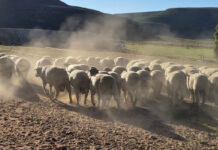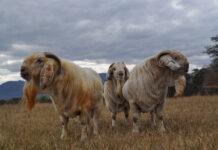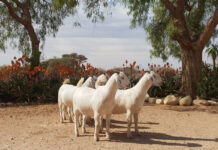

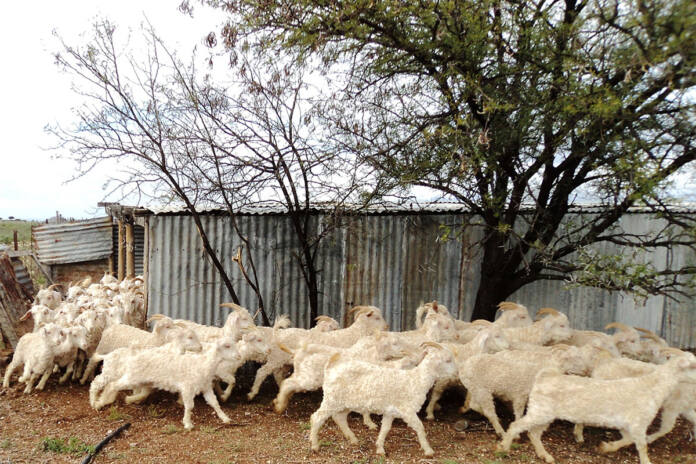
All goats, but particularly newly-shorn Angora goats, are highly sensitive to cold, wet conditions. This makes it essential for mohair farmers to watch weather forecasts when their flocks are at a vulnerable production stage. Drought conditions that lead to any degree of feeding stress are especially dangerous.
In the case of Angoras, shearing times must be carefully planned to avoid exposure to severe climatic conditions and to fit in with kidding seasons. But, with weather seemingly becoming ever more unpredictable, cold, windy and wet storms lasting for more than a day can happen at any time, even during midsummer. Unexpected early spring rains can also wreak havoc.
Goat farmers should always have smaller paddocks that are well-covered with natural protection such as trees and bush that act as windbreaks, as wind dramatically decreases the body temperature of a wet animal. Better still is to have leakproof sheds that are easily accessible.
The other non-negotiable is to ensure your Angora goats are in good condition, so keep them on good veld. Never chase newly-shorn Angoras that have stood in the shearing pen all day into the veld on empty stomachs, and always keep them close by until at least six weeks after shearing. Then they are usually quite safe.
The role of genetics
There is more to this, from a scientific point of view. Some Angora flocks have been found to be less prone to cold, wet conditions than others. Research has shown an interrelationships between fibre production potential and physio-endocrine mechanisms’ underlying hardiness.
Some flocks, it seems, have been bred solely for hair mass and quality while neglecting the hardiness factor. In addition, some flocks have higher growth rates and lower abortion rates than others, indicating the importance of selection for desirable traits.
This includes the ability to maintain themselves on natural veld without extra feed and to withstand adverse conditions. Regularly overfeeding your animals can work against this because it basically overrides the role of genetics.
When fibre prices are high (as is currently the case) the temptation is great to increase production via extra feed. But when prices slump again, you could find that you’ve bred a weak type of animal. Under extensive farming conditions, the best advice is to select breeding stock from animals that do well off the veld, and not out of a feedlot. This is true for reproduction as well as survival.
Energy deficiency and cold stress
Regarding cold stress, researchers looking at the physiological responses to bad weather found that a drop in blood glucose concentration, indicating an energy deficiency, played a major role in mortalities. Angoras can die very quickly when exposed too cold.
It is now accepted that selection for mohair production only results in a reduction of adrenal function and the secretion of adrenocorticosteroids. Research at the Grootfontein Agricultural Research Institute in Middelburg in the Eastern Cape, found this leads to the following metabolic adjustments:
- Decreased ability to maintain blood glucose concentration under stressful conditions;
- Increased gluconeogenesis;
- Decreased fat deposition;
- Decreased ability to mobilise fat reserves;
- Decreased voluntary feed intake;
- Decreased resistance to cold stress;
- Increased fibre production;
- Increased fibre diameter.
Furthermore, it was estimated that the energy cost of fibre production is approximately four times higher than the requirement for body growth. It was concluded that the problems associated with this breed, are without exception, related to an energy deficiency, which is displayed in reduced blood glucose levels.
The safe, sustainable way to go seems to be to breed a low-input type of goat. However, as has often been said, the stud breeder is forced to feed his or her animals since many flock farmers still appear to prefer well-fed rams.
Shelter and feed are critical
When bad weather threatens it would be foolhardy not to boost your shorn goats’ energy levels with some starch, or any available feed, and get them into a warm shed for the night or until the danger has passed. And, when summer comes, it’s equally important to keep them in camps with enough shade.