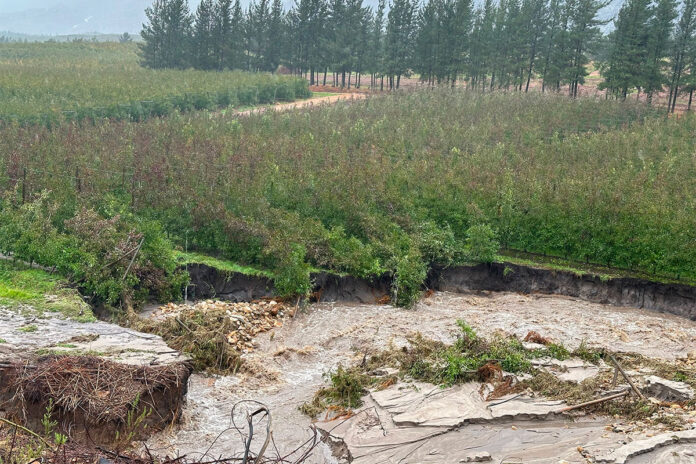
Agri Witzenberg Chairperson Heinie du Toit said the severity of damage varied markedly across the region. Farms in the higher-lying Op-die-Berg and Koue Bokkeveld areas escaped relatively unharmed, while lower-lying areas from Ceres through Mitchell’s Pass to Wolseley and from Tulbagh to Rawsonville sustained extensive losses.
He said flood damage across the Western Cape had already been estimated at about R5,2 billion, but warned that the final cost would only become apparent as repairs continued and production losses became clearer.
“The impact on next year’s pome fruit, stone fruit, and wine season is still uncertain. Some trees and vines have been lost, and farmers are struggling to get into orchards and vineyards where crucial work needs to be done. We will only see how severe the impact is when we start picking and packing,” he told Farmer’s Weekly.
The floods also exposed the vulnerability of the region’s electricity supply. Some farms went without power for between seven and 21 days before being placed on a rotational system that provided only about eight hours of electricity per day. Supply only normalised towards the end of June.
Keeping the fruit industry operating after the floods has come at a significant cost. Du Toit estimated that farmers in the region collectively burnt through about R2 million in diesel per day for around 50 days to power cold stores and processing facilities after widespread electricity outages.
According to a Tru-Cape press release, more than 300 000t of freshly harvested export fruit were sitting in cold storage at the time of the floods.
Business under pressure
The extent of the damage is perhaps best illustrated by the experiences of individual producers.
Hortgro Chairperson Nicholas Dicey said his farm near Wolseley received 260mm of rain in two days, the highest two-day rainfall recorded in the area since records began in 1933.
His own losses were largely confined to infrastructure. Irrigation lines, pumps, and farmworker housing were damaged, while his farm manager’s house was flooded to chest height.
More than a month later, Dicey is still relying on an excavator to restore parts of the farm.
“Last Friday [3 July] was the last day that I had to rent an excavator. From now on, I have equipment to do most of the work myself,” he said.
The damage on some neighbouring farms was far worse. According to Dicey, one blueberry producer lost about 60% of an orchard, while other farmers lost orchards, vineyards, roads, pumps, and expensive netting infrastructure. Some even had to remove sections of orchards simply to create temporary access roads.
Dicey said the floods were another setback in an already difficult period for fruit growers: “The storms hit everybody, but not equally hard. For some, it could be business-changing. I don’t know if they will be able to survive the fallout, as some are still recovering from last year’s fires and February’s hailstorms, while weak stone fruit prices and rising input costs have been squeezing margins this year.”
He added that the financial burden of rebuilding will largely fall on farmers themselves, as government is overwhelmed by the scale of damage to public infrastructure.
“Those who have the financial means will have to redirect money earmarked for maintenance and new orchards or vineyards towards repairing damaged infrastructure,” Dicey said.
Prioritising recovery
Sakkie Hanekom, co-owner of Welgemeen Boerdery in the Witzenberg Valley, said that although their farm was not as severely affected as those in the Robertson Wine Valley, it still sustained damage to roads, pumps, and orchards. In addition, a landslide filled one of the farm’s dams with sand, rendering it unusable and requiring it to be rebuilt.
Floodwater also damaged riverbanks and swept away a shipping container, although it was later recovered.
“Our first priority is to repair what we can so we can continue with the essential work in the orchards,” Hanekom added.
He said rebuilding washed-out orchard drains, restoring riverbanks, and levelling damaged orchard blocks will require significant investment.
“You have to be selective. You choose what is essential and what you can afford to fix, and whatever you decide to repair, you do it properly.”
Better together
Looking ahead, Du Toit said the floods had reinforced the need for farmers to prepare for more frequent extreme weather events, while also highlighting the importance of collaboration during disasters.
More than 900 electricity faults were reported across the Witzenberg Valley following the floods, and he credited the joint efforts of farmers, Eskom, government, and the private sector with restoring power and other critical infrastructure.
“Without doubt, we need to work together to solve our problems. We experienced that first-hand in the Witzenberg Valley,” Du Toit said.