
Financing Gauteng’s agro-processing vision
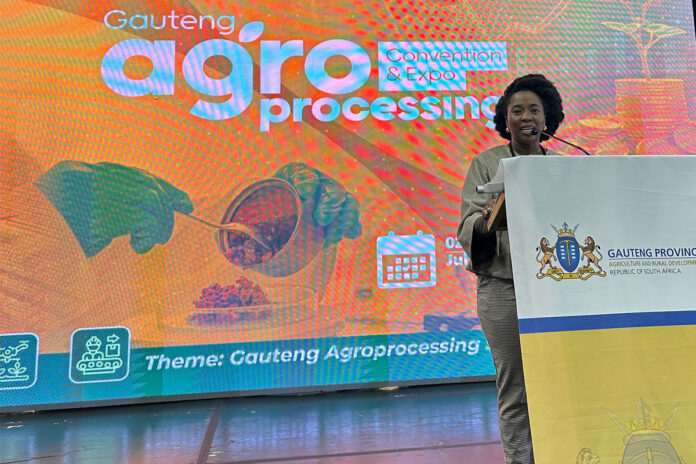
In her keynote address, Gauteng MEC for Agriculture and Rural Development Vuyiswa Ramokgopa, highlighted progress made under the R100 million Gauteng Department of Agriculture and Rural Development (GDARD)/National Empowerment Fund (NEF) Blended Finance Programme, launched at the 2025 Agroprocessing Convention & Expo.
“The purpose of the fund is straightforward. It is [aimed at improving] access to finance for agro-processing enterprises with the potential to grow but that are struggling to secure appropriate commercial funding,” she explained.
Ramokgopa noted that, of the initial 188 applications received since the programme’s launch, three enterprises had been approved for funding, with this year’s call for applications attracting 31 qualifying applicants, 11 of whom were at the final due diligence stage of the programme application process.
Motlatjo Makaepea, GDARD chief director of agro-processing and economic services, added: “Every 2% increase in agro-processing output has the potential to generate a 10% increase in employment.”
According to him, to date, nearly 500 agro-processing enterprises have benefitted from almost R20 million through CASP, while R5,8 million has been disbursed to qualifying enterprises through the national Department of Agriculture’s AgriBEE Fund.
He also highlighted Krugersdorp-based Shumbaset Egg Packhouse, which received support through the Gauteng Equitable Share Programme and Comprehensive Agricultural Support Programme (CASP) to set up an egg aggregation facility, which enables small-scale egg producers to aggregate, grade, and package eggs in compliance with the Agricultural Product Standards Act (No. 119 of 1990) before supplying formal retail markets.
Entrepreneurial journeys
Beyond the updates on funding and support initiatives, the entrepreneurs’ own stories provided insight into the realities of building an agro-processing business.
Ramokgopa noted that P and M Fresh Produce, based in Johannesburg South and one of 60 exhibitors at this year’s convention, is a model of a successful agro-processing enterprise.
The 100% black-owned, women-led company received funding via CASP to expand its fresh fruit and vegetable agro-processing, packaging, and distribution operation.
Soweto-based Zazi Juice and Midrand-based Kenokatha Farms, trading as Veg & More, also exhibited at the convention, showcasing the outcomes of the government support they had received.
Zazi Juice founder Thobeka Ndabula produces ready-to-drink fruit juices, along with dried fruit, biltong, olive oil, and coconut oil, and sells her products at the Joburg Market.
She ventured into agro-processing in 2021 and received financial support though the Gauteng Equitable Share grant to set up production equipment in 2023. Today, she markets her products through a wholesale agent and several retailers, including Spar.
“In my journey, I have learnt that compliance does not have colour and it does not have gender. So, you have to be compliant [with regulations] in order to trade,” Ndabula said during a panel discussion on agro-processing entrepreneurs’ business experiences.
Veg & More founder Quinty Rabophala started on a 3ha farm in Midrand six years ago, with the intention of moving into agro-processing because “that’s where we lose value as farmers”, she explained.
A former banker, Rabophala’s approach was to build a strong business before seeking funding, which, in her case, came through AgriBEE.
Today, her business produces high-value crops such as baby marrows, broccoli, green beans and sugar snap peas.
“It’s possible to make success of [an agro-processing business],” she concluded, encouraging aspirant agro-processing entrepreneurs.