
When the Agricultural Research Council announced the winner of the 2025 National Beef Cattle Improvement Herd of the Year award, the recipient was not from a cattle farming region, but an area rather known for its small-stock.
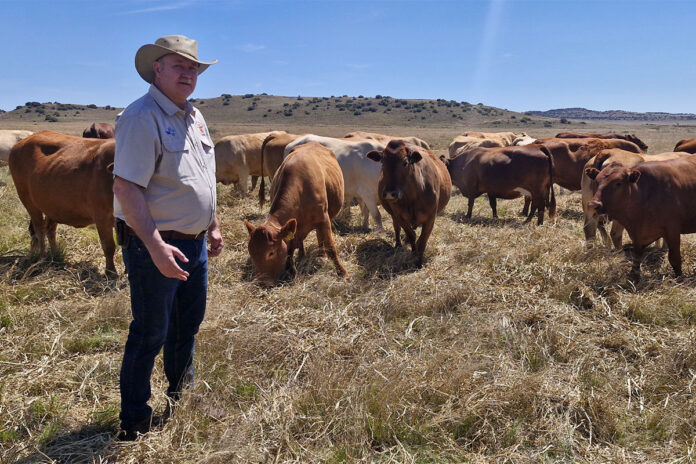
Christo Rothmann, operating Bushman’s Mountain Tuli out of the Nama-Karoo near Venterstad in the Eastern Cape, says that a need arose to move away from sheep due to stock theft and high concentration of predatory animals. This left him facing an enormous challenge: maintaining cattle in high-heat, low-feed-availability conditions. The answer: Tuli cattle.
Rothmann established the Bushman’s Mountain Tuli stud on his farm, Dankbaar, in 2004 after evaluating several breeds, including Bonsmara, Beefmaster, and Nguni, against his primary criterion of calving yearly and producing cattle that have consistent profitability regardless of what the Karoo conditions might throw at them.
“My operation relies on a set of requirements that allow you to identify and eliminate cattle that will not produce in the long run. As time goes by, your herd adapts, and you are left with the top genetics that are incredibly adaptable and keep producing calves year after year,” he says.
Rothmann explains that there are four breeding goals that he must accomplish for the stud to remain at optimal production: keeping a stringent inter-calving period, weaning heavy calves, getting calves up to feedlot condition, and balancing maintenance costs with output to remain profitable.
Selective breeding
Rothmann follows a strict breeding programme that ensures only the most productive cows and heifers remain. To achieve this, he implements one breeding season where calving must occur between 1 October and 31 December.
“If a cow calves on the 1st of January, I remove it and send it to the abattoir. For the operation to remain in balance, the herd must produce in harmony,” he says.
He adds that his inter-calving period must remain under 385 days.
His breeding programme does not just aim to retain the most productive female animals, but also focuses heavily on bull characteristics. Rothmann mates all his cows and heifers in one large camp with all his breeding bulls, using exclusively natural mating.
Rothmann’s herd currently consists of 250 bulls at various stages of growth, 200 females held back for further breeding, and an additional 250 females currently in calf.

“The bulls compete to mate the females. The females also seek an ‘alpha-male’ among the bulls who can produce offspring with the best characteristics. Facilitating this can allow you to do DNA tests to determine which bulls are actively mating each year,” he says.
Dankbaar Farm is about 8 000ha in size, with camps averaging 600ha. When the mating season arrives, the bulls must endure harsh terrain and steep elevation to seek out females. This plays a crucial role in determining which bulls have the capability to persevere in challenging conditions to mate, and therefore possess the desirable bull characteristics for further breeding.
Rothmann applies a similar method to his feeding programme. He utilises high-density grazing as an additional factor that contributes to seeking out the hardiest, most reliable Tulis. Despite the size of his camps, he grazes large herds within these 600ha camps with an average stocking rate of 12 LSU/ha that allows him to not only retain soil health, but also determine which animals are most determined to seek out pasture.
Rothmann does not provide any supplementary feed and only provides a salt lick with trace minerals.
Due to the constant rotation of stud animals in Rothmann’s herd, traceability and measurable evaluations are crucial. He has created his own database, which contains records and metrics for growth and feedlot performance values gathered from Phase D testing.
Rothmann uses these metrics to determine which animals are retained and which are sold. He immediately markets about 40% of his male cattle to the feedlot, and the remaining 60% are then put through Phase D testing, during which at least 5% are removed based on results.
The remaining 55% are then grown out up to two- and-a-half years old, at which point Rothmann puts them through a selection process, and another 5% are removed to be sold. On average, he ends up marketing 50% of the males he started with. His female cattle go through the same process, but Rothmann sells about 75% of his females to the commercial and stud markets.
In addition to Phase D metrics, he utilises best linear unbiased prediction (BLUP)figures to provide a data foundation to evaluate animals against benchmarks that extend beyond his own herd, and to identify breeding values in prospective purchases.
“Data within my own herd is easily accessible through the personal record keeping I implement, but BLUP plays a crucial role as a comparative tool with other Tuli herds and other cattle breeds. I mainly utilise BLUP figures when considering prospective genetics I want to buy in,” he says.
Rothmann adds that the most important BLUP figures are closely tied to his breeding goals, which mainly focus on optimal birthing, weaning weight ratios in relation to the dam, and production indices that use cow values to help determine how productive the offspring will be.
Weaning ratio and conditioning
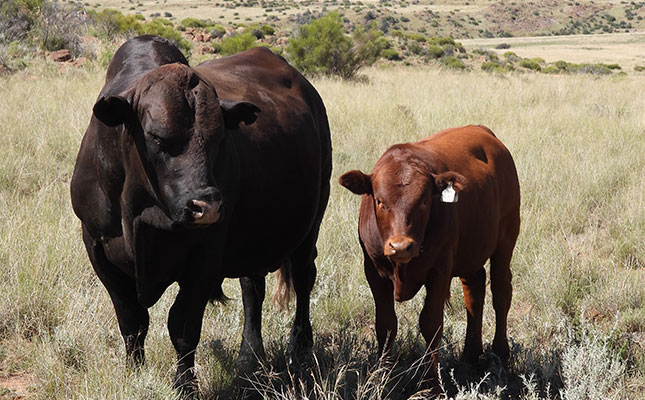
Rothmann’s cows must wean calves at more than 50% of their own body weight at 205 days. He says this benchmark is feasible due to the Tuli’s maternal characteristics and their adaptability despite varying feed availability.
The average weaning weights have settled at 210kg for heifer calves and 240kg for bull calves. He highlights that these numbers were maintained through an eight-year drought that reduced many surrounding operations to a shadow of their former size. The mortality remained low throughout and he now maintains a weaning percentage of 92%.
“Calves must reach feedlot condition at weaning; you are simply not competitive with the market average. Your income-per-kilogram metric is essential,” he says.
Rothmann adds that if his weaner calves reach condition, the feedlot pays a premium for above-average feedlot performance and average daily gain. He adds that this is crucial to remain profitable and plays an important role in constantly striving to improve the herd’s capabilities as a top-performing feedlot beef breed.
Maintenance and future goals
The last of Rothmann’s foundational goals entails finding a careful balance between input and production output. His drive to keep a strict calving season allows for zero discrepancies in overall weaner growth progress, and ensures that any unproductive cattle in the herd can be removed before they become a potential risk factor in the future.
“If your operation does not produce every year and reach the minimal growth conditions, your profitability is immediately affected. Not just in the short term; it can have a ripple effect in the future. We rely on a strict inter- calving period and a competitive environment to bring the best genetics forward. The pursuit to identify and utilise the best of what the Tuli breed has to offer allows us to farm in harsh conditions without compromise,” he explains.
Rothmann hopes to better optimise his high-density grazing approach in the near future, with plans to add more water sources and expand camps to facilitate better grazing availability, while retaining a competitive factor for his breeding season. His future marketing goals will allow him to host his own online auction, where fellow farmers can experience some of the best Tuli genetics on offer.
Rothmann takes a unique approach to producing hardy, adaptable Tulis that allows him to continue striving for optimal growth and competitive breeding even in the most challenging conditions.
For more information, email Christo Rothmann at [email protected].