
While Balgowan Beef Company’s (Co) farm-to-fork route to market is the exception rather than the rule, their circumstances are all too familiar.
As first-generation farmers, access to land remains a major hurdle, and limited capital has meant leasing land rather than buying.
Land available for rent is seldom in prime condition, and typically requires significant investment in supplementary feed to sustain a productive beef operation, a cost that can quickly erode profitability.
Yet, through a different approach, Balgowan Beef Co in the KwaZulu-Natal Midlands has shown that building a viable beef business on such land need not come at the expense of profitability.
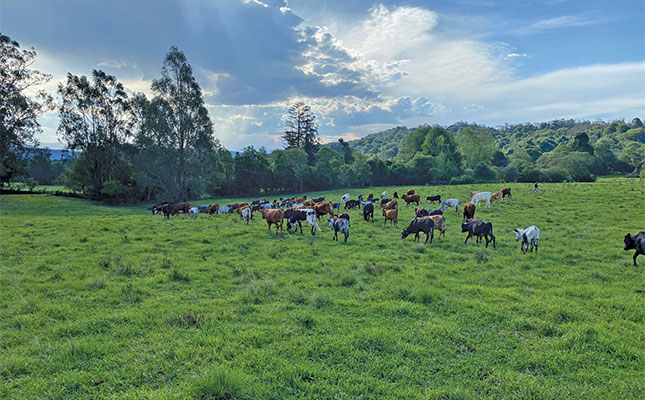
Farmer Justin Crawford has bucked the norm, implementing regenerative agriculture practices to boost the veld to the extent that 90ha of natural grass is sufficient to feed his herd of 250 cattle.
Justin was drawn to renowned cattleman and advocate for veld-raised cattle Johann Zietsman’s farming philosophy early in his career. Deciding to forgo the conventional beef farming practice of raising weaners for feedlots, Justin raises his cattle on the veld until they are ready for slaughter.
Balgowan Beef Co includes a butchery that processes and packs all the meat, run by Kerry Schultz, Justin’s sister-in-law. Justin’s wife and Kerry’s sister, Brenda, do the meat deliveries and lend a hand across the divisions as needed.
Brenda explains that the conventional process of producing weaners for feedlots did not sit well with the family.
“We are passionate about our animals and don’t want to subject them to the stress of feedlots, so we decided to see the whole process of producing beef to the end. Our cattle are slaughtered in a small, private abattoir close to the farm. They arrive in the morning and we can collect the meat in the afternoon, so they don’t have to spend the night there. We then process and pack the meat at our butchery.”
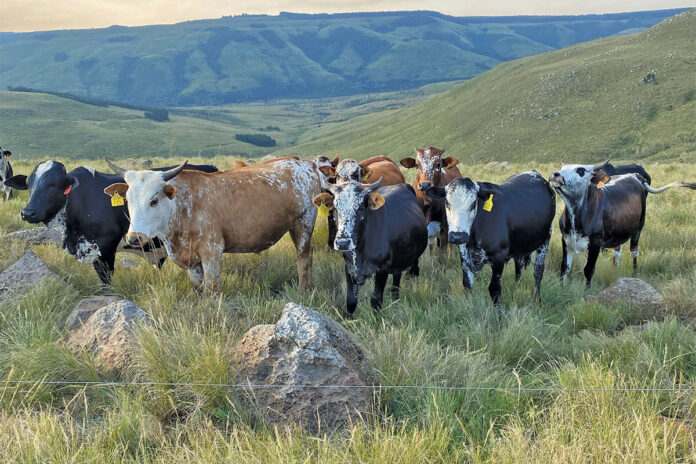
Justin follows a farming philosophy of keeping it simple, believing that the less inputs the animals require, the better. The mixed herd is therefore dominated by the Nguni breed, known for its hardiness.
Hardy Ngunis
Balgowan Beef Co is not set on a specific breed, focusing instead on animals that thrive without being pampered. The herd is not vaccinated, and dips are limited to around twice a year, despite being in a high tick area.
“Animals that are constantly riddled with ticks are culled, as are any that require frequent medical intervention. We only keep animals that can cope and adapt to our environment. We have cattle that haven’t been dipped in five years, because they just don’t get ticks,” says Brenda.
Temperament is an important factor in selection, with breeds that generally produce unruly animals avoided.
“If we produce any animals that are highly strung we cull them, because we know every time we try to handle them they go berserk. The adrenaline pumping through the animal then makes their meat very tough,” explains Brenda.
Kerry notes that the strict selection process on the farm has led to a Nguni-dominated herd, since this breed has proved least fussy.
“Ngunis result in very low production costs, so the return on investment is high, even through they yield less meat than traditional beef breeds since their frames are smaller.
“Our view on selection is cost driven, but it is also about ethics. Animals that struggle to cope on the farm should not be here.”
Brenda quips that Justin is loathe to spend money on prize bulls.
“The best bull we have is a Nguni cross that was bought for R11 000 at an auction where he was meant to be bought for slaughter. He can cover 100 cows in 60 days and breeds exceptionally strong animals. The most expensive bull is not necessarily the best bull.”
The herd is split across two farms in the Balgowan area of KwaZulu-Natal. One farm is for finisher cattle and has around 60 animals. The other contains around 190 animals of mixed ages. The three bulls are kept apart and placed in the main camp towards the end of February for 60 days.
Brenda notes that because of the veld-raised system, the heifers generally only conceive at age four, as opposed to two years of age in conventional systems where the heifers are boosted with supplementary feed. Thereafter, they are expected to calve every year, or they will be culled. A conception rate of around 80% is achieved.
Restoring degraded veld
The finisher farm contains a high percentage of kikuyu grass, which helps the cattle to fatten up before slaughter. The camps are also larger than those on the main farm to allow the cattle to be more selective in their grazing. Liquid molasses is provided to give the cattle extra energy, since maize is not fed.
The main farm follows a high-density grazing system where cattle are moved up to six times per day. It is this practice that has led to the restoration of the veld.

Electric fencing is used to keep the cattle in their camps. The size of the grazing strips and the frequency at which the cattle are moved is carefully calculated by Justin. Decisions take into account the season, types of grass, condition of the veld, and that of the herd.
If the cattle appear to be losing condition, the camps are expanded or grazing time in the particular camp is reduced. If the cattle are putting on excessive weight, the camp sizes are reduced, or grazing time in that camp is increased. Kerry notes that it is not a clear-cut calculation, and decisions are based on experience and gut feeling.
“This process makes it very difficult to delegate moving the cattle to staff. Justin spends most of his day analysing the veld and moving the cattle accordingly. This is how we’ve not only managed to run so many cattle on such a small piece of land, but rejuvenate the veld.”
The high-density grazing has resulted in veld where a variety of grasses thrive. Brenda explains that conventionally, cattle would be placed in a large camp for a few weeks, where they would only eat palatable grasses, leaving unpalatable grasses to flourish. “Eventually, the whole farm will be covered in less desirable grass and the farmer would need to find more land to provide adequate feed for the herd.
“With the high-density grazing system, we force our cattle to eat everything. We have a lot of Ngongoni grass (Aristida junciformis) on the farm and cattle would rather starve than eat it. Placing the cattle in a smaller area means that although they don’t eat it, they trample it. The Ngongoni grass grows quite high and doesn’t allow a lot of sunlight on the ground around it, which means other grasses struggle to grow. By trampling the Ngongoni, it allows other grasses to get enough sunlight so that they can grow and compete with the Ngongoni.”
The farm’s veld consists of mostly paspalum, kikuyu, and Mooi River mix, which contains Smuts finger (Digitaria eriantha), Rhodes grass (Chloris gayana), and small buffalo grass (Panicum coloratum). The veld is entirely rainfed and does not receive any fertiliser apart from the manure and urine from the cattle. Rainfall in the area is around 1 000mm/annum.
Brenda notes that although soil health on the farm is not measured, the vibrancy of the veld is a clear indication that the high-density grazing system is working. There has also been an improvement in the time it takes for the veld to recover after it has been grazed.
A challenge with frequent moving between grazing camps is water supply. Ample water pipes have had to be laid across the farm and water troughs strategically placed. Brenda explains that cattle should never have to walk too far for water as this depletes their energy.
The main farm has two portable troughs of water that are moved using a quad bike and trailer to camps where water pipes have not been laid.
The camps are structured so that the water trough can be placed in the middle, with the electric fencing fanning out around the trough to create strips that always have access to the water trough.
No supplement feeding is provided for the animals on the main farm apart from a mineral and protein lick.
To ensure the cattle have sufficient grazing in the winter, many camps are closed off in January so that they can grow out until winter and provide enough food for the dry, cold season.
Having such a positive effect on the land has its downside for farmers who rent their land.
“We put so much love and energy into the land, but we are at the mercy of the landlord, who can decide not to renew our lease. A few years ago, we took over a farm that was severely overgrazed, and restored it to where the grass was waist-high. When the lease came up for renewal the owner declined, opting to bale the grass and sell it himself instead. It’s heartbreaking to walk away from that,” laments Brenda.
While it would be ideal to sign longer leases, Brenda notes that landowners are often hesitant to do so, not knowing what kind of tenant they are tying themselves down to.
Breeding strategy aligned to the veld
Because the herd relies only on the veld for nutrition, the breeding season coincides with summer when more grass is available. Brenda explains that most farmers in the area calve in winter, but since the grass availability is limited then, it would place added strain on cows in milk.
A calving rate of around 100% is achieved. Brenda says that the smaller bulls produce smaller calves, which means that the operation rarely loses a calf during birth.
The downside to calving in December is that joint ill (septic arthritis), a bacterium that thrives in wet, warm conditions, is more prevalent. The bacteria are present in the soil and transmitted through the calf’s navel.
Brenda explains that calves that have not been adequately mothered and who experience stress are more susceptible to the disease.
Ngunis are generally good mothers, and the farm therefore achieves a weaning rate of around 98%. This, however, requires the breeding season to be adjusted.
“The first year we calved in September, on a farm up in the Karkloof mountain near Howick. We had up to half of our calves eaten by jackals. We then realised that our cows were giving birth at the same time as the jackals, so when their pups were learning to hunt, they had easy pickings of our calves.
“We then moved the birthing season to December, and bought a donkey to protect the herd. We haven’t had a problem since,” says Brenda.
Initially, the calves were weaned at six months, but seeing the strain the youngsters took, calves are now weaned at between seven and eight months.
Mothers and calves are not separated, but nose rings are placed on the weaners to prevent them from suckling. The calves have a weight of around 150kg to 180kg when weaned.
Because Balgowan Beef Co processes and sells all their meat, they are limited to two animals per week that can be slaughtered. Animals that are about six years old, weighing around 350kg to 380kg, are chosen for slaughter.
Brenda says that cows preferably need to produce at least one to two calves before exiting the herd. Any animals that need to be culled from the herd are sent to the front of the queue.
Before slaughtering, the cattle are kept on the finisher farm for six months. Breeding their own cattle rather than buying in weaners has been a necessary option considering cash flow constraints, but has resulted in slow progress.
“We need to get out of breeding. It’s our passion, but it’s not our bread and butter,” says Brenda.
Kerry adds: “Demand for our meat is exceeding supply, and ideally we would reduce the breeding herd, keeping only the top genetics and then buy in weaners. This is the reality of a new business – we know where we need to be, but we don’t necessarily have the cash flow to get there right now.”
High demand for healthy beef
Finding a market for this high-value beef is one challenge that Balgowan Beef Co has not had to contend with.
The value of veld-raised beef over grain-fed beef is increasingly being recognised by consumers, and the farm can’t keep up with demand.
“There is a big movement among consumers to know where their food comes from. One of the most frequent questions we get is whether we vaccinate our cattle. Since COVID-19 there has been a heightened awareness about vaccines, and consumers are very nervous about consuming meat from animals that have been vaccinated,” says Brenda.
The success has not come overnight, and the business did face uncertainty over price points when they first started marketing their beef.
“Veld-raised beef is produced at a much higher cost as it takes longer to get to market, so we need to get a premium for the meat. That requires market education and brand building,” explains Kerry.
“As a start-up it’s very difficult since no one knows who you are, and you haven’t built up any trust in the brand. Initially, we kept our prices the same as that of conventional beef, and as we built our brand, gradually raised the prices. We lost a few customers every time we did so because there are those who just buy your meat because it’s cost-effective,” she says.
Ultimately, Balgowan Beef Co’s system is still a work in progress, with careful management of the veld shaped as much by financial realities as by a regenerative farming philosophy.
Their journey reflects the realities faced by many new entrants, where ideal systems must often wait on cash flow. Yet, they have shown that even under constraint, it is possible to build a viable, regenerative beef enterprise on rented land.
For more information, email Balgowan Beef Co at [email protected], or visit balgowanbeef.com.