
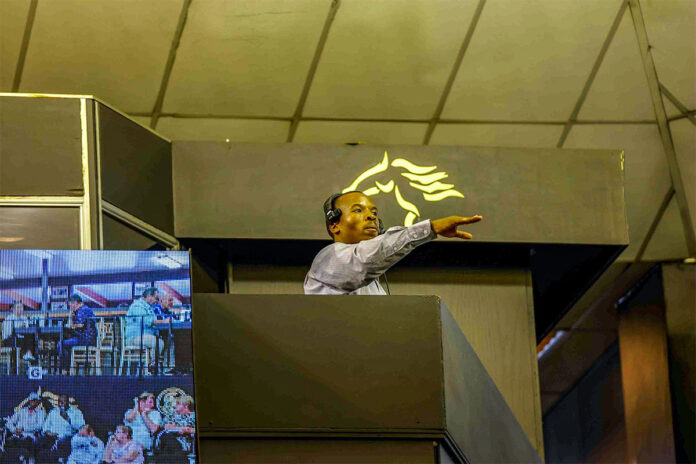
There is a familiar rhythm in the voice, with the rise and fall reminding one of maskandi (popularly known as Zulu blues), while a small crowd gathers around an auction pen to assess the horses on offer. The bidding moves steadily, controlled and unhurried.
Calling the sale is 26‑year‑old Fiso Hadebe, part of a new generation of South African livestock auctioneers carving out a space for themselves in a profession traditionally shaped by age and long tenure.
Hadebe is one of nine siblings who grew up on rural communal land in the KwaZulu-Natal Midlands.
His parents were subsistence farmers, and thanks to the passion they inspired in him for agriculture, Hadebe attended Weston Agricultural College, a specialised boys high school situated on a 1 200ha working farm along the Mooi River.
It is here that Hadebe was given a solid foundation in agriculture that today aids him in his budding career as a livestock auctioneer.
“We were exposed to different areas of farming at Weston, from livestock, crops, and other farming systems, so we could get a practical taste of what suits us and what doesn’t. That helped shape my knowledge and who I am today, and it made applying theory in real life much easier,” says Hadebe.
Hadebe’s father also provided him with a lot of real-life practice on the family farm, and it was during high school that he was introduced to auctioneering. In 2017, his school entered an auctioneering competition designed to identify young talent to address the shortage of young auctioneers in South Africa.
“At first, I entered purely for the prize money to buy something at the tuck shop. My first time [calling] was nerve‑racking, but I was very determined to place well. I placed third at my first competition, which allowed me to progress to the junior national round. That’s when I started realising this could be more than just a competition.”
Mentors and local farmer support
After school, Hadebe took a gap year and completed a course in human resources. He continued developing his skills and stayed in touch with the auctioneers he had met. He credits the role of mentors who helped shape his early career.
“We had guest auctioneers at the competitions, including the likes of Andrew Miller and Alan Sinclair, amongst others. Watching them was unbelievable. They sounded like machines. I remember thinking: one day I want to sound like that. I never imagined it would turn into a career.”
Hadebe says he pushed himself hard to develop as an auctioneer, while also gaining the support of local farmers.
Thankfully, his talent was spotted early on by Bloodstock South Africa, the country’s premier Thoroughbred (racehorse) auctioning platform, and the auctioning house for whom he now works.
“Angus Williamson is a farmer and an auctioneer by profession. He has been mentoring me from high school.
I also had the opportunity to learn more about the Thoroughbreds from Steve Davis, an international auctioneer, and the Australasian representative for Bloodstock South Africa, jointly with Graeme Hawkins.

“I learnt from them about horses’ pedigrees, conformation and what traits it takes to complete a racehorse, which you should be able to identify as an auctioneer. So, while it’s been a personal journey, there have been people who helped me along the way.”
Bloodstock South Africa, under the auspices of the Thoroughbred Breeders’ Association, holds and administers auctions for Thoroughbred racehorses. These auctions are generally held across three provinces: the Western Cape, KwaZulu‑Natal, and Gauteng.
“We move between these provinces, running auctions and sales. This experience has been incredibly valuable,” says Hadebe.
After only a few years, Bloodstock South Africa has entrusted Hadebe with the extra responsibility of running the auction yards and the logistical side of these operations.
“This allows me to be closer to the trainers and breeders and ask the right questions to learn more about the pedigree of the animals. It enables me to be a better and well-informed auctioneer.
“It’s needed for those moments when the floor goes silent, and I need to be a trader.”
Through Bloodstock South Africa, Hadebe has gained valuable international experience, and was selected to represent South Africa and Africa at the International Livestock Auctioneer Championship in July 2025 in Calgary, Canada.
“It was incredible. I spent over a week there, visiting barns and learning how auctioneering works in North America. Out of around 40 international competitors, I placed mid‑field, between 22nd and 25th. For a first international appearance, with different livestock and systems, I was proud of that outcome,” says Hadebe.
What it takes to be an auctioneer
Hadebe warns that auctioneering takes a lot of hard work and commitment. Besides knowing the market really well, including the animals and their pedigrees, buyer behaviour is another key aspect of which the auctioneer must be aware.
“People are just as important. If buyers aren’t enjoying the process, they may as well just go shopping at retail prices. An auction needs energy and momentum, and that’s the auctioneer’s responsibility. When the crowd goes quiet, that’s when your instincts as a trader kick in. You have to read the room, lift the mood, and create urgency. Small things like tone, timing, and confidence can make a huge difference.”
He says auctioneering isn’t just about calling numbers.
“It’s about professionalism, trust, and relationships between buyers and vendors. Over the years, I’ve learnt that character matters just as much as skill.”
Breeders, farmers and vendors place great trust in him as an auctioneer. Their expectation is not only to reach high prices, but for Hadebe and his team to take exceptional care of their animals.
“There’s also a deep responsibility. Farmers invest years of work and money into raising animals. Their livelihoods depend on that moment in the ring. Even if a reserve isn’t met, the farmer must know you gave it your all.”
The highlight of his seven-year professional career was breaking the R1 million mark during a sale when he sold a horse to a local buyer.
Making a name for himself
While auctioneering is not traditionally a space where we yet see many black South Africans, this has not stopped Hadebe from pursuing this career path.
“[Black representation] is still in the minority, but I don’t focus on that as a barrier. Personally, I’ve had a very positive experience. I’ve always been judged on my work ethic and performance, and not on my background.”
Hadebe describes the auction environments he works in as supportive and professional.
“What matters most is the work you put in. Your results will speak for you. It’s exciting to see young black auctioneers starting to come through,” he says.
He enjoys creating awareness in his community and showing young people that auctioneering is a career option.
“Giving back is important to me. I often help with charity auctions and local events, and I believe in starting small and opening doors where possible. I aim to inspire the younger generation coming through the ranks to believe that everything is possible as long as you have the willingness.”
Hadebe’s personal goal is to get more local and international exposure and become a top competitor.
“That includes winning the World Championship competition, and learning from the best in the game to reach those ranks in the near future,” says Hadebe.
This is part of our 30 Under 30 segment.