
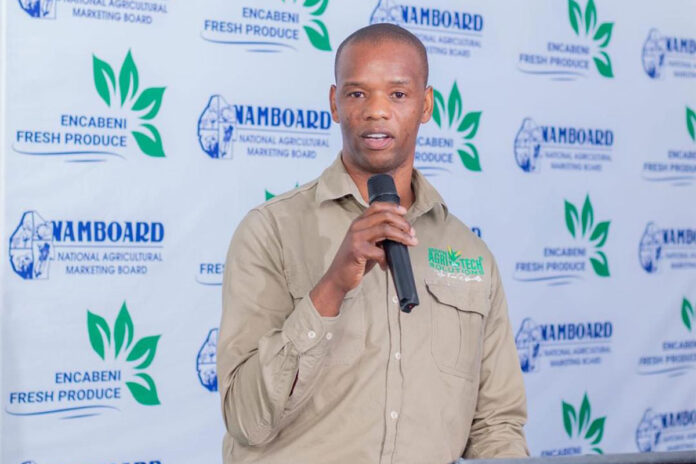
“I first noticed about five years ago that seasons are changing and actually shifting forward,” says Vilakati, who farms maize, tunnel tomatoes, cucumbers, broccoli, and cauliflower in the village of Ngonini in northern Eswatini.
“We started receiving prolonged rainfall even in January, while it normally rains in December. Hailstorms have become an annual feature, too. We also experience an increase in mean temperature and heatwaves, but I’ve also noticed more instances of frost.”
Vilakati’s experiences are not unique. Across Eswatini, smallholders are experiencing changing weather patterns that are reshaping their farming practices.
A farming foundation under strain
Smallholders play a vital role in Eswatini’s agriculture sector and wider economy.
“Smallholder farmers form the backbone of rural livelihoods and, like in the rest of the world, produce 70% of the food consumed in the country,” says Minister of Agriculture Mandla Tshawuka.
He adds that these producers are under increasing pressure as climate change affects how they use their land.
Research supports this observation. A 2025 report titled ‘Rural adaptation and resilience to climate change in Eswatini’, published in Environmental Science & Policy, found that climate change is already causing declining and increasingly erratic rainfall, greater water stress, and reduced crop yields and livestock production in a country where most people rely on agriculture for their livelihoods.
Changes to farming
Thirty-year-old farmer Boniswa Phumlile Dlamini from Phophonyane grows maize, baby marrows, green beans, peas, tomatoes, green peppers, chillies, and spinach, and runs goats and cattle.
She says she first began noticing changes in weather patterns around 2015.
“The rain doesn’t come when it used to. The rainy season is shorter and less predictable. Sometimes we get heavy rain all at once, like from November to January just past, which washes away soil and nutrients, and then long periods of no rain at all,” she explains.
The changing weather has taken a toll on production.
“My harvests have reduced significantly. The maize does not grow well without consistent rain, and sometimes the heat dries it out before it can mature,” adds Dlamini.
She says traditional weather indicators are no longer as reliable as they once were.
“My father used to predict the time of rains by observing nature, but now even those signs don’t align with the weather.”
Farming in an age of extremes
According to Tshawuka, recent seasons have highlighted how increasingly erratic weather is making farming more difficult.
“This year, for instance, the maize and bean crops have been decimated by three climatic events,” he explains.
“Firstly, we had hailstorms, and then we had excessive rainfall, where we got 80% of our total [annual] rainfall in just one week. We then had a dry spell and a heatwave, which is still gripping us.”
A 2025 UNICEF report titled ‘Investment Case: Strengthening Climate Resilience for Children and Communities in Eswatini’ shows that increasingly erratic rainfall, recurrent droughts, and flooding are placing growing pressure on the country’s water resources, agricultural production, and livelihoods, underscoring the urgent need for climate-resilient investments.
For Dlamini, these conditions have changed how she spends her time each day.
“My daily routine now is looking for water. I spend more time looking for water and ensuring my crops and animals have enough to eat and drink,” she explains.

Adapting to change
The changing weather has forced Dlamini to rethink how she farms.
This season, she says she lost half 0,5ha of green beans, 6 000 green pepper plants, and a 0,25ha of Swiss chard spinach.
“I plant less now because I cannot afford to lose everything to bad weather. It is better to plant smaller areas that I can control.”
Meanwhile, Vilakati has responded by changing his planting dates.
“We have shifted planting dates. Now, there is no open-field production from the end of November to the end of January. We don’t reduce production; we just stop it. I have lost a lot of produce because of climate change, and it is devastating,” he says.
Finding practical solutions
“We have tried using climate-smart technologies like tunnels and shade nets. Tunnels help protect crops from frost, prolonged rainfall, hailstorms, strong winds, and droughts, but we face challenges with heatwaves,” explains Vilakati.
“Water management is key. We use drip irrigation, which is the most efficient form of irrigation. We also irrigate our crops at night, as the plants absorb most of the water and store it.”
Dlamini, on the other hand, has adopted different measures on her farm.
“I have started digging small pits to trap rainwater. I have also bought water tanks to store water, and I have started buying drought-resistant seeds, though they are more expensive.”
The Eswatini government is promoting climate-smart agriculture through conservation and minimum tillage, investing in irrigation and rainwater harvesting systems, introducing drought-resistant and early-maturing seed varieties, and strengthening extension services to help farmers manage climate-related risks.
The high cost of survival
Adapting to climate change comes at a cost that most Eswatini smallholders struggle to afford.
“Climate-smart structures are expensive,” says Vilakati. “Drip irrigation helps save water, but it is costly, and smallholder farmers can’t afford it.”
Dlamini faces the same challenge: “I don’t have a proper irrigation system because it’s too expensive. I make the most out of the water I have available.
“My income has reduced significantly; we lack food before the next harvest season. We even skip meals at times,” she says.
“It’s much harder to feed my family; we have to buy from the market, which is very expensive.”
Vilakati concludes: “Hunger will surely be the order of the day. With so many losses in production, farmers won’t be able to provide balanced diets for their families.”