
Everybody in Turkey (now Türkiye), even Syrians in that country, advised me against travelling to Syria due to cross-border violence between the Kurdistan Workers’ Party’s (PKK) armed wing and the Turkish army.
However, at 21, one is armed with a sense of invincibility and, a week later, I was in, Antakya Turkey on a bus on route to the nearby Turkish and Syrian border post.
Turkish tanks decorated with fluttering red flags rumbled along the border while military choppers kicked-up clouds of dust as they touched down in hastily erected military camps jam-packed with soldiers and military hardware.
Turkish passport control was extremely stringent and I was therefore astounded at the contrast in attitude when I eventually entered Syria. Immediately a group of soldiers in safari suite type-uniforms with AK47’s slung over their shoulders welcomed me with a slap on the back, a smile and, one, even offered me a smoke.
The road to Aleppo
Soon I was meandering through the countryside towards Aleppo in a battered old Mercedes Benz taxi. The city has a history spanning over 5 000 years during which time it was controlled by various powers including the Hittites, Romans, Greeks, Arabs, and Ottomans.
My taxi dropped me off near the huge covered souqs in Aleppo, dating back to the 13th century. These magnificent markets were smothered by a scent of aromatic spices, leather goods, mutton, jewellery, textiles, and furniture. As the call to prayers echoed across the old city I was pleasantly overwhelmed by a sense of other-worldliness, that western scholars referred to as Orientalism.
Although Aleppo is rich with incredible historical sites including the Citadel, a massive medieval fortified palace sitting on a 50m hill (usage of the hill dates back to the third millennium BC, the Great Mosque of Aleppo (715 CE), and the Saint Simon Citadel (Sam’an Citadel, Qalat Samaan), I think there is worth in uncovering less obvious stories.

For example, Christian Armenian Orthodox communities settled in Aleppo as a direct result of the Armenian genocide that took place between 1915 and 1916, where it is estimated 1,2 million Armenians were killed by the Turkish state. Naturally a refugee crisis developed and Aleppo welcomed who ever cared to settle in Aleppo. The Christian Armenian Orthodox churches were to be seen in most streets and the Armenians have adapted to life here with enthusiasm.
Another expat community in Aleppo was the Russians, a community that had grown significantly since the 1970s thanks to a textile trade with merchants from Moscow. Hearing Russian being spoken on the streets of Aleppo, at first startled me, but like the Armenians they were part and parcel of the broader Aleppo society.
Then there is Englishman T.E. Lawrence, also known as Lawrence of Arabia, acting as a British liaison between Arab leader Emir Faisal and British General Allenby who helped fuel a successful Arab uprising against the Ottomans.
Based on accurate intelligence gathering Lawrence helped initiate organized raids against Turkish supply lines, specifically the Hejaz railway, and in October 1918, they captured Damascus, a pivotal moment in the liberation of the region from the Ottoman Empire in the early 20th century.
But there was a lot more to Lawrence than just politics and war, and he is said to have loved Aleppo. He was a serious scholar, archaeologist and artist (who sketched Aleppo’s famed architecture), and author of the celebrated book Seven Pillars of Wisdom. Much of his time in Aleppo was spent in Room 202 at the famous Baron Hotel, in which an alleged unpaid bar bill of 76,70 Ottoman piasters was (and I hope still is) displayed in the foyer.
The oasis city of Palmyra
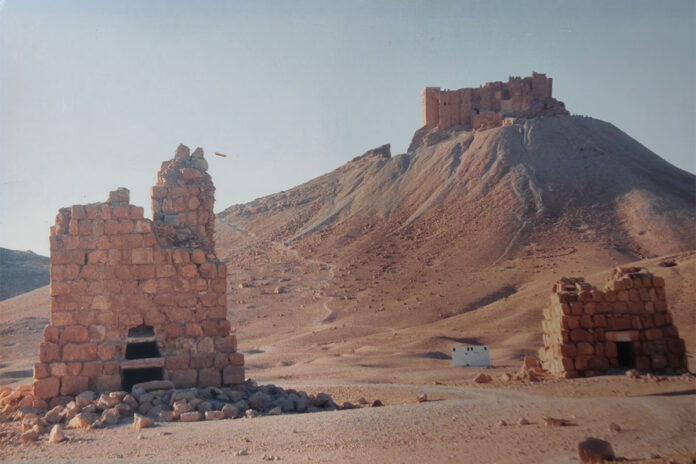
The Syrian oasis city of Palmyra in the deserts of eastern Syria was settled from at least 2300BC and was controlled by a succession of empires, caliphates, and regional leaders due to its strategic position linking east and west.
Palmyra’s isolation was apparent during an agonizingly long bus trip through a desolate desert radiating over 45-degree heat. In front of the bus was a plastic 50l drum of water from which passengers could help themselves. Every-now-then I would see a shepherd through the bus windows herding fat-tailed sheep, goats or camels in the desolate desert. “What do these animals eat?’’ is all I could wonder.
As we eventually neared Palmyra the Greco-Roman ruins for which it is so famous, rose up from the desert and beyond a sea of palm trees disappeared into the hazy distance. Palmyra was especially prosperous under the Roman Empire from the first to the third century CE, but following the capture of Roman Emperor Valerian by the Sassanids, Palmyrene leader Septimius Odaenathus took control of the region.
After Odaenathus, was assassinated, Queen Zenobia (c. 240 – after 274 AD) reigned as regent for her son, Vaballathus, expanding her kingdom to include much of Syria, Egypt, and Asia Minor.
But Queen Zenobia was eventually captured by Emperor Aurelian, who sacked Palmyra in 273 CE and as tradition demanded, she lived out her years under house arrest near Rome. She remains a potent symbol of especially female resistance to the Roman Empire, and coins of the time that bear her likeness, underscore her once immense influence in the region.
Arguably the most destructive force to ever have been unleashed on Palmyra was that of a 21st century terrorist organisation, ISIS, that in 2015 took control of the city and promptly began to eradicate pre-Islamic, ‘polytheistic’ structures.
For example, ISIS dynamited the Temple of Bel and various elaborate funerary towers in the surrounding desert and publicly beheaded 82-year-old Khaled al-Asaad, the retired head of antiquities for Palmyra on 18 August, 2015 who they had tortured for a month to reveal hidden artefacts.
The capital city Damascus
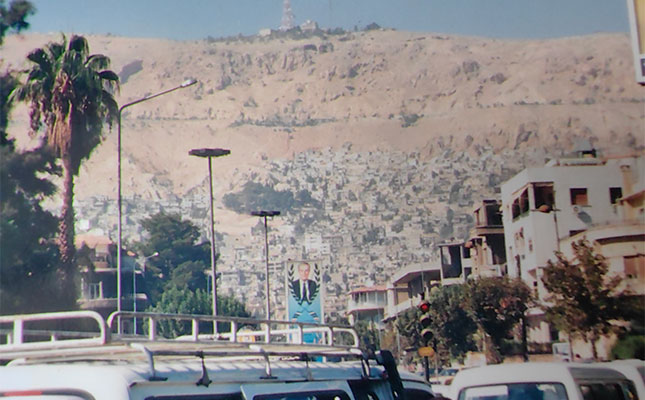
Inhabited for more than 11 000 years Damascus is one of the world’s oldest continuously inhabited cities and flourished as the capital for conquering powers, including the early Semitic Kingdoms, the Assyrians, Babylonians, Persians, Greeks, Romans, Byzantines, various Islamic Caliphates, Mongol, Mamluk, and the Ottomans until their defeat in the First World War in 1918.
Although the old city of Damascus is spectacular and features numerous iconic landmarks including the eighth-century Umayyad Mosque, the Roman-era Straight Street, a 1 500m-long Roman-era street running through the old city, the Azem Palace, a magnificent 18th-century Ottoman Palace, and the Al-Buzuriyyeh Souq, the historic Damascus spice market.
My interest was also piqued by an extraordinary story of international espionage in Damascus during the 1960s. Since the creation of Isreal in 1948 Syria was one of the Jewish State’s most bitter enemies. The Israeli Mossad was therefore continuously looking to place spies in Syria, and one of their greatest was a man called Eli Cohen.
Born in Alexandria, Egypt, on December 26, 1924, he was a Jewish-Egyptian native who posed as a wealthy Syrian businessman returning from Argentina and through charm, he gained access to the very highest Syrian military and political officials. In fact, at one stage, he was even considered for the post of the Syrian Minister of Defence and was deeply respected for the critical information he gathered about Syrian military fortifications in the Golan Heights.
However, on 24 January, 1965 aided by cutting-edge Soviet surveillance equipment, Cohen was located while sending Morse code messages to Israel from his apartment in the heart of Damascus. He was arrested, interrogated, tortured and later publicly hung in Damascus’s Martyrs’ Square on 18 May, 1965, aged 40.
Damascus was my last stop in Syria so I boarded a bus for the Jordanian border to continue my journey to Cape Town, South Africa. There was no country on this epic journey that captured my imagination as much as Syria and its three magnificent cities did – ancient, complex and ever-changing in the crucible of the Middle East.
Other Sources: lonelyplanet.com; world-middle-east-14703856 and Syria and britannica.com.