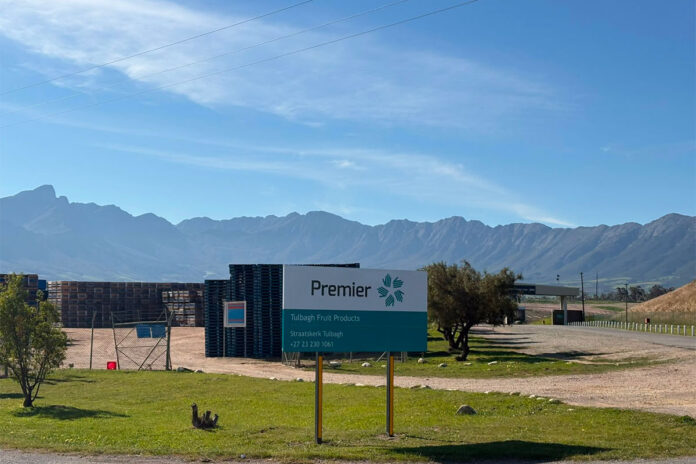
Farmer’s Weekly requested an interview with Premier Group CEO Kobus Gertenbach but was informed that, because a Section 189 consultation process under the Labour Relations Act (No. 66 of 1995) was under way, the company could only provide its official statement. The process requires employers to consult affected employees before implementing retrenchments.
In the statement, the company confirmed that it had “commenced a Section 189 consultation process with affected employees and recognised representatives regarding the proposed controlled closure of its FPWC [Fruit Products Western Cape] business in Tulbagh”.
It said FPWC was no longer financially viable.
“FPWC is no longer economically sustainable in its current form. The business has been affected by sustained pressure in the canned fruit market, including declining global demand, changing export market conditions, pricing pressure, rising input costs, and the need for greater scale in an increasingly competitive global industry.”
Premier added that, because approximately 90% of FPWC’s canned fruit production is exported, the operation is heavily dependent on international markets, where year-on-year demand has declined sharply.
It also said it had explored other options, including approaching Langeberg Foods about acquiring FPWC, before proposing the closure.
“Premier has evaluated a range of alternatives, including seeking a buyer for the operation, reducing operating costs, and assessing other measures to improve the sustainability of the business,” the statement read.
Addressing concerns raised by producers over Premier’s acquisition of the Rhodes Food Group (RFG) last year, which included FPWC, the company said the proposed closure was unrelated to the merger.
“This is a separate business sustainability matter driven by the standalone operating position of FPWC and the structural pressures facing the canned fruit industry. It is not related to the Premier/RFG merger or any merger-specific conditions.”
The company said it was engaging with farmers during the consultation period to address fruit offtake for the current season, including exploring alternative processing arrangements and possible support measures where practical.
Value chain at risk
Speaking to Farmer’s Weekly, Jacques Jordaan, CEO of the Canning Fruit Producers’ Association (CFPA), said the issue extended far beyond the closure of a single factory.
“This is not simply the closure of one factory, but a decision with far-reaching consequences for an entire agricultural value chain,” he said.
Jordaan added that while Premier had the right to restructure its business, how the restructuring was implemented was of equal importance.
“It should be conducted with fairness, good faith, and with responsible corporate conduct, while taking the interests of all stakeholders into consideration. There is no good faith in the way producers and workers have been treated, nor in giving Langeberg Foods only one week to decide on buying the factory,” he said.
“Closing the Tulbagh factory immediately, only three months before harvest, without meaningful consultation and despite existing rolling three-year supply agreements, is neither commercially responsible nor fair to the producers, workers, and communities that have built this industry over generations,” he said.
According to Jordaan, the Tulbagh facility processed between 55 000t and 60 000t of fruit annually, purchased approximately R300 million worth of fruit from producers, and supported annual exports valued at R1 billion to R1,2 billion.
He said the factory supported about 200 commercial producers, approximately 2 000ha of orchards, around 3 500 permanent and seasonal factory jobs, and more than 2 000 permanent farmworkers. It also sustained transport companies, packaging suppliers, engineering businesses, and numerous rural enterprises throughout the Witzenberg region.
“The proposed closure therefore affects an entire regional economy, not merely one processing business,” he said.
Jordaan added that growers had already incurred up to 60% of their production costs through pruning, fertilisation, irrigation, labour, and financing for the upcoming season.
“Unlike a manufacturer, producers cannot stop production three months before harvest and rip out R500 million to R600 million in investments made for this factory. Premier’s decision therefore transfers virtually all commercial risk onto growers after those costs have already been incurred,” he said.
He questioned why producers had not been informed earlier if the closure had been under consideration, particularly after Premier had recently invested more than R200 million in upgrading the Tulbagh facility with new fruit pulp and purée processing technology.
Jordaan said the CFPA was calling on Premier to suspend any immediate closure, honour the upcoming processing season, engage meaningfully with producers and industry stakeholders, and pursue a managed transition to protect producers, employees, and rural communities.
Insufficient time for a deal
Meanwhile, Edwin Kriel, CEO of Langeberg Foods, confirmed that discussions had taken place between the company and Premier regarding the Tulbagh facility’s future.
However, he said there had not been enough time before the new processing season to complete the extensive due diligence required or secure the substantial funding and working capital needed for the acquisition.
“Our immediate priority is to utilise the available capacity at our Ashton factory,” Kriel said.
He added that Langeberg Foods would continue reviewing customer demand and market opportunities to determine its processing requirements for the 2027 season.
Kriel said the company would do its best to support the industry by taking in additional fruit where sustainable market demand existed.
Producers face uncertain future
Charl Herbst, Hortgro stone fruit director and a mixed-fruit farmer from Tulbagh who supplies Premier, said producers were facing an impossible situation.
“If the factory closes, we have to look for alternatives. The only realistic options are Langeberg Foods or the local fresh produce market, but neither can absorb all the fruit currently processed at Tulbagh,” he said.
Herbst added that diverting significant volumes into the fresh produce market would inevitably depress prices, leaving many growers unable to recover production costs.
He echoed Jordaan’s call for Premier to honour existing contractual obligations.
“We understand the canning industry is under pressure, but shutting the doors immediately is not the right way to do it.”
Herbst added that fruit orchards represented decades of investment and could not simply be removed because processing capacity had disappeared.
He also called for greater involvement from government and the Competition Commission, saying discussions should include all affected stakeholders.