

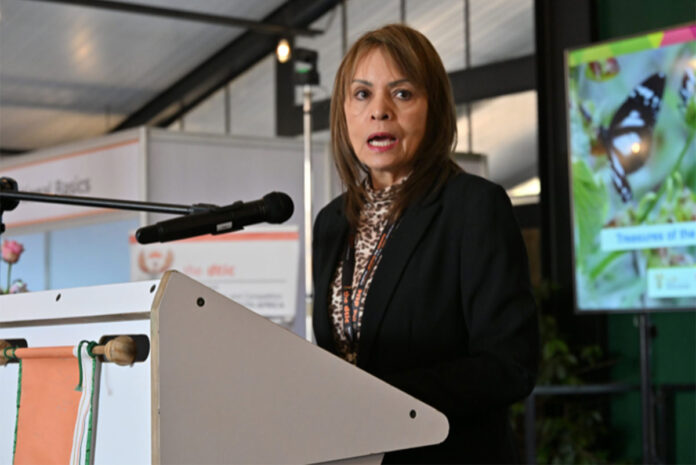
This was revealed at the 4th South African Essential Oils Producers’ Association (SAEOPA) Conference, held at Rosemary Hill, east of Pretoria, on 23 and 24 July.
The two-day conference attracted approximately 200 delegates, including producers, researchers, processors, exporters, government officials, entrepreneurs and industry support organisations, all united by a common goal: positioning South Africa’s essential and vegetable oils industry for sustainable growth.
Opening the conference, Claudy Steyn, chief director for chemicals, cosmetics, pharmaceuticals and plastics at the Department of Trade, Industry and Competition (the DTIC), said the essential oils sector occupies a unique position at the intersection of agriculture, manufacturing, innovation, and export development, making it an important contributor to the country’s industrialisation agenda.
Steyn said producing and processing essential oils locally creates opportunities throughout the value chain, from farmers and processors to laboratories, packaging manufacturers, logistics companies, retailers, and exporters.
“By industrialising locally and adding value before export, South Africa can strengthen domestic manufacturing, create sustainable jobs, and capture greater value from international markets,” she said.
She called for closer collaboration between government and industry to improve access to finance, strengthen technical standards, expand testing and certification capacity, support research and development, and improve access to domestic and international markets.
Biodiversity provides a competitive advantage
South Africa’s rich botanical diversity featured prominently throughout the conference.
Delegates learnt that the country’s indigenous plant species represent a significant competitive advantage on the international market where consumers are increasingly seeking natural, sustainable, and ethically sourced ingredients.
Steyn highlighted that South Africa’s biodiversity, indigenous knowledge, and entrepreneurial producers provide a strong foundation for a globally competitive industry that supports industrialisation, export promotion, and inclusive economic growth.
However, speakers cautioned that biodiversity alone is not enough.
To unlock the full commercial value of indigenous plants, traditional knowledge must be supported by scientific research, validated through rigorous testing, and translated into products that meet international quality standards.
Science underpins industry growth
Research and innovation emerged as recurring themes throughout the conference.
Presenters highlighted the critical role of scientific institutions in validating product claims, improving formulations, and ensuring compliance with increasingly stringent international regulations.
Speakers also stressed that closer collaboration between researchers and the industry will be essential if South Africa is to develop high-value products capable of competing in global markets.
Rather than viewing science and commercialisation as separate disciplines, delegates were encouraged to see them as complementary components of a successful value chain.
Moving beyond raw materials
Another strong message delivered was the need to increase local value addition.
Several speakers argued that South Africa should move beyond exporting raw botanical materials and instead focus on processing, manufacturing, and developing finished products locally.
Creating internationally recognised brands based on indigenous ingredients would not only improve profitability but also generate employment and stimulate rural economic development.
Entrepreneurs were encouraged to view branding, packaging, and product development as strategic investments rather than optional extras.
Export markets demand professionalism
Discussions on market access highlighted the increasingly sophisticated expectations of international buyers.
Exporters were encouraged to
The importance of quality infrastructure was reinforced by Daniel Lauchenauer, head of the Swiss State Secretariat for Economic Affairs South Africa, who said internationally recognised standards have become a prerequisite for accessing global markets rather than merely a competitive advantage.
Industry collaboration remains essential
Throughout the conference, collaboration was identified as one of the industry’s greatest strengths.
Government departments, research institutions, testing laboratories, standards bodies, industry associations, and private companies all highlighted the importance of working together to strengthen the sector.
This spirit of collaboration was reflected in the conference exhibition, where producers, laboratories, universities, manufacturers and support organisations showcased products, technologies, and services spanning the entire essential and vegetable oils value chain.
Optimism for the future
Closing the conference, Nnana Makhubu, chairperson of the SAEOPA board of directors, thanked delegates, speakers, exhibitors, sponsors, and organisers for contributing to what she described as a successful event. She encouraged participants to build on the partnerships established during the conference and continue working together to promote innovation and industry growth.
Looking ahead
The conference concluded on an optimistic note, with delegates leaving Pretoria convinced that South Africa has the biodiversity, scientific expertise, and entrepreneurial capacity to build a globally competitive essential and vegetable oils industry. The challenge now is to translate that potential into commercially successful products, stronger export markets, and greater economic opportunities for producers and rural communities.
Conference moderator Prema Elemental concluded the event by encouraging delegates to apply the knowledge gained over the two days to strengthen their businesses and contribute to the continued development of South Africa’s essential and vegetable oils industry.