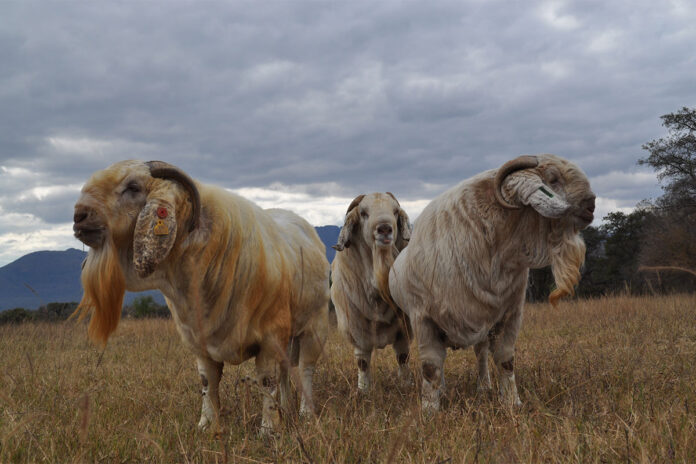
The Anton Barnard and Son Savanna stud was registered in 2021. This was after some Savannas were originally introduced to the Barnards’ farm, Boschfontein, situated approximately 20km east of Thabazimbi in Limpopo, to combat bush encroachment.
“Our initial interest in goats was merely to assist with veld management, as our research showed that goats were one of the ways to naturally manage bush encroachment. We looked at a number of ways to open up the bush and eventually decided on the Savanna,” explains Anton Barnard Snr.
“We were so impressed by the goats’ performance under our production conditions that we decided to take the stud route. The costs of breeding stud animals do not differ much from breeding animals commercially, but the return on investment in stud breeding is considerably higher,” he adds.
Bringing Savanna goats to the bushveld
According to Barnard Snr the Savanna goats stood out in terms of hardiness and adaptability, and research showed that there were relatively few Savannas in Limpopo.
“We therefore decided to use this to our advantage and not only acquire goats for the veld management benefits, but also to be pioneers in bringing the Savanna breed to the bushveld and Limpopo, and thus create a brand-new market for the breed,” he says.
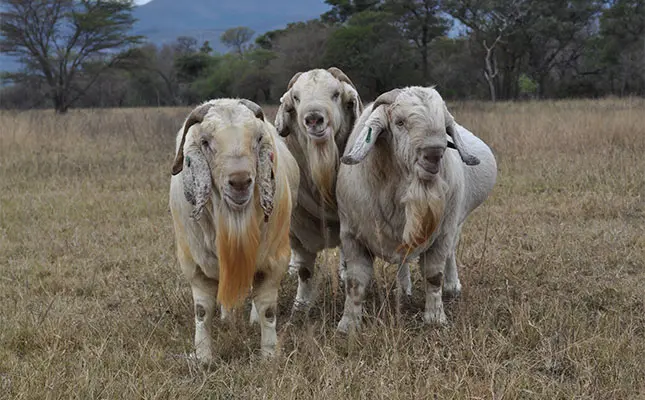
The Barnards are dedicated to breeding hardy, adaptable, functionally efficient, and virile Savanna goats with exceptional genetics and phenotypical excellence. They are also committed to making their genetics available to both commercial and stud breeders, while contributing to the expansion of Savanna production in the northern parts of South Africa.
“The Savanna goat was mainly bred and farmed with in the Northern Cape at the time we decided to breed them. To be very honest, although we did our research, we also made mistakes in the beginning by not buying selectively and from reputable breeders. However, we quickly realised our mistake and started to do research on the specific breeders and bloodlines. We therefore identified specific characteristics we preferred and started to buy selectively from particular breeders who offered the characteristics we wanted for our breeding programme,” adds Barnard.
“We therefore invested in a diverse range of bloodlines and combined these into our own special Savanna goat. In 2025, we acquired the 2023 world champion ram at a new SA record price of R340 000 to access the genetics we needed to take the stud forward. At the same auction, we also bought two exceptional ewes, one of which achieved a SA record price for a Savanna ewe at the time, he continues.
Optimum production with low inputs
Barnard says: “Breeding and selection criteria are multifaceted and cannot be limited to one or two aspects only. However, the bottom line is that our objective is to provide the market with high-performing animals with low inputs to ensure optimum income per hectare. In order to achieve our goal, we place a high priority on reproduction. A goat that does not reproduce efficiently has very little value.
“For us, issues such as conception rates, virile rams with good libidos, and high lambing percentages are of the utmost importance. We strive to maintain a lambing percentage of 170% and higher. Our average number of lambs per lambing currently stands at 1,7 over a five-year period.”
Lambs are weaned at 100 days. The lambs are kept for one year before a decision is taken on which animals to keep and which to cull. The stud’s average birth weight is 4,08kg for rams and 3,73kg for ewes.
According to Barnard, birth weights need to be managed extremely carefully so as not to overfeed pregnant ewes. This could cause the foetus to grow excessively and lead to kidding complications, while underfeeding must also be avoided to prevent weak and underweight kids.
While average daily gain (ADG) obviously differs vastly between young and adult animals, the ADG for lambs averages between 200g and 230g per day. Breeding rams weigh, on average, 128,3kg. Rams not used for breeding weigh 108kg on average. Adult ewes’ average weight is 72,4kg.
Young ewes are only mated from one year old. While rams reach sexual maturity from as early as five to six months, the Barnards only start using rams for breeding from the age of 12 months. This affords the animals ample time to fully develop.
Comprehensive data for sound management
Animal recording forms a vital part of the Anton Barnard and Son stud, and detailed records are kept, using specialised software, of birth weights, weaning weights, adult weights, average daily gain, and other measurements.
The animals are weighed every 14 days, and the weights recorded. According to Barnard, inter-lambing periods, age at first lambing, maternal weaning weights, combined weaning weights, and other data are all input information processed for the calculation of Logix Merit Indices and Reproduction Indices.
Animal recording forms a vital part of the Anton Barnard and Son stud, and detailed records are kept, using specialised software, of birth weights, weaning weights, adult weights, average daily gain, and other measurements. The animals are weighed every 14 days, and the weights recorded. According to Barnard, inter-lambing periods, age at first lambing, maternal weaning weights, combined weaning weights, and other data are all input information processed for the calculation of Logix Merit Indices and Reproduction Indices.
High tick loads and heartwater
The Thabazimbi bushveld is known for extremely high tick loads, and heartwater is generally regarded as the most significant tick-borne disease in the area.
“The heartwater strain present on our farm is, to my knowledge, the Welgevonden strain, which is extremely aggressive. Heartwater is transmitted primarily by the bont tick (Amblyomma hebraeum), which is found in abundance in our area. Our goats are sent through footbaths twice a day to control ticks, and we have found this method to be very effective. We hardly ever have ticks on our goats,” Barnard points out.
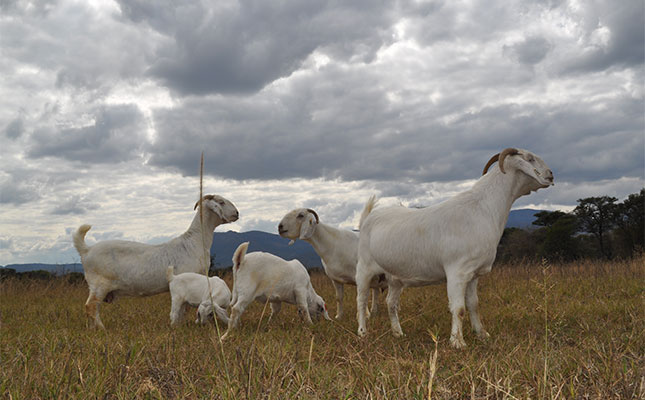
Boschfontein is situated in the Savanna Biome, the largest biome in South Africa, and the vegetation is classified as the Western Sandy Bushveld unit. The plant community on the farm consists of tall, closed woodland with tree and shrub cover, resulting in a diversity of vegetation. This is ideally suited to the goats, since they browse and graze. The goats roam the veld during the day, but are kraaled at night to prevent predation by black-backed jackals and caracals.
The geology of the farm consists of sandstone of the Sandriviersberg Formation of the Waterberg Group in the mountainous area in the south, and granite and granite-gneiss of the Archaean Complex on the plains. Deep red to yellow sandy to clay soils occur on the relatively flat areas with more than 20% clay. Shallower, rocky soils occur in the mountainous areas.
The average rainfall for the past five years on the farm is 632mm, with the rainy season extending from October to April. The wettest months are normally December, January, February, and March.
Bengufarm and Logix Genetic Analysis
“We have a camp system on the farm to split the different groups during the day for management purposes. These include, but are not limited to, keeping young animals separate from adult animals and breeding selection programmes. For stud breeding, it is imperative that ewes are not exposed to different rams during the mating season, as it may result in multi-sire pregnancies. We use the Bengufarm Advanced Livestock Management programme and participate in SA Studbook’s Logix Genetic Analysis,” he says.
The Barnards’ feed supplement programme includes, among other things, mineral licks and energy licks. In summer, the flock receives a mineral lick for essential minerals and trace elements to boost immunity, bone development, fertility, and metabolic function. In winter, an energy lick is supplied for extra calories to maintain body condition, growth, milk production, and other functions.
Ram, lamb, and ewe pellets are used to prepare ewes for lambing and during lactation. These are provided in the afternoons when the goats return from the veld.
Continuous improvement
Asked where he sees the stud in 10 years’ time, Barnard says: “We strive to continuously improve the quality of animals we put on offer. I want to emphasise that we strive to breed hardy, well-adapted, and highly economical Savannas with the commercial producer in mind. In future, we would like to become a highly regarded stud, recognised as one of the progressive Savanna breeders in the country, trusted and respected by both commercial and stud producers.”
For more information, contact Anton Barnard at [email protected].